Archive for Featured

Rowan Wick Has a Short, Quick Arm and a Good Backstory

Rowan Wick has a short, quick arm and plus velocity. He also has a good backstory. The 26-year-old right-hander didn’t begin pitching until 2015, three years after he was drafted by the St. Louis Cardinals. Four years and two organizations later, he’s currently competing for a spot in the Cubs bullpen. Chicago’s North Side club acquired Wick from San Diego over the offseason in exchange for Jason Vosler.

A lack of power isn’t why he failed to make the grade as a position player. The problem was contact. In 2014, Wick swatted 20 home runs in just 298 plate appearances between short-season State College and Low-A Peoria, but he also fanned 94 times. He then ventured even further into blind-squirrel territory the following year. Prior to being converted, Wick went down by way of the K a staggering 50 times in just 133 plate appearances.

Midway through May of that 2015 season, Wick was informed that he would henceforth be standing on a bump. Given his travails with the stick, he was in no position to argue.

“When they told me I was going to pitch, it was kind of, ‘OK, this is my last shot,’” Wick recalled thinking. “At that point, you’ve got to buy in, right? I’d started as a catcher, then went to the outfield, and now I was a pitcher. After that, you really can’t make any more moves. It was either pitch or go home.” Read the rest of this entry »


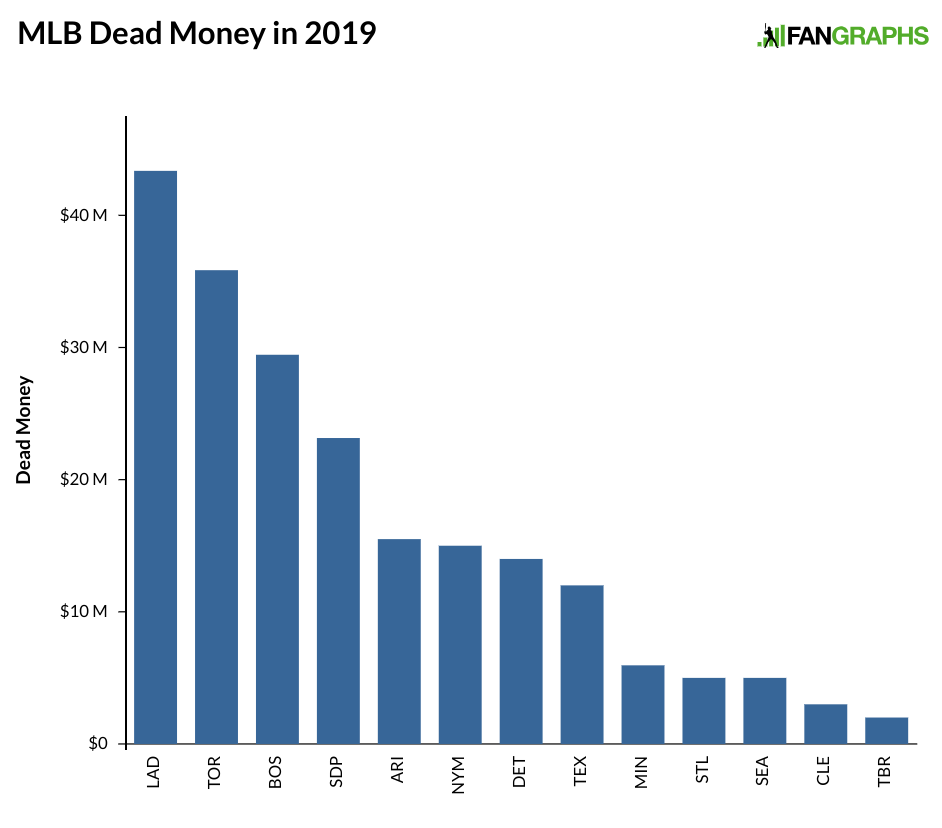
MLB Teams with the Most Dead Money in 2019

Sunk costs are difficult for all of us. We might keep a gym membership longer than we should hoping to get some value out of it despite not going for months. We might finish a meal that was terrible from the start because we cooked it or paid for it. We finish movies and books we know we will not enjoy. Once some of our money or time has been spent, there is a pull to keep spending or wasting that time and potential enjoyment because we’ve already started. Sometimes, baseball teams are just like us. Once a big contract is handed out, teams feel compelled to continue to provide playing time past the point of utility or give a roster spot to a player whose play doesn’t merit it. That’s not always the case, though. Sometimes teams move on, and when they do, they end up with dead money on their payroll.

This is my fourth year tracking dead money on payrolls and while the amount fluctuated greatly from 2016 to 2017, going from under $150 million to $300 million, last year it was back around $200 million, and it remains the same this season. As to what counts as dead money, this is what I said in last year’s post:

Dead money is generally any money a team is paying out to a player who no longer appears on their 40-man roster. There are three types of dead money:

  1. Money paid to players who have been released. Those players are free to sign with other teams, but the team releasing the player still owes the money remaining on the contract.

  2. Money paid to other teams as compensation for players who have been traded. Generally, we see teams cover a portion of a contract to receive a better return in trade.

  3. Money paid to players who are still in the organization, but who have been removed from the 40-man roster. Any team could have claimed these players if they were willing to take on the contract, and the player probably could have elected fee agency, but then he would forfeit his right to the guaranteed money.

While Jacoby Ellsbury’s salary sits on the Yankees payroll with no expected contribution, that money is only mostly dead. As far as which team has the most money this season, that honor, or dishonor, goes to the Los Angeles Dodgers. These numbers were compiled from Cot’s Contracts.

The Dodgers have been first or second on this list every year I’ve done this exercise, spending close to $140 million since 2016 on players not on their roster. This year’s big expenditure comes in the form of Homer Bailey, who the team acquired from the Reds in order to move Matt Kemp’s contract as well as acquire a few prospects in the deal that sent Yasiel Puig and Alex Wood to Cincinnati. The Blue Jays come in just behind the Dodgers as the team that decided to cut bait with the oft-injured Troy Tulowitzki as well as trade Russell Martin to the Dodgers. The moves by the Dodgers and Blue Jays illustrate contrasting styles when it comes to dead money on the roster. Los Angeles acquired Homer Bailey to drop him in a move designed to save tax space as they exchanged Kemp’s bad contract. For the Blue Jays, who are not expected to compete for the division this season, giving playing time and roster spots to aging veterans doesn’t help the club’s future as those resources can be better utilized by providing meaningful experience to younger players. Nearly one-third of Toronto’s payroll won’t even be on the team and the club’s on-field roster is set to make under $80 million this season.

Breaking the money down, here are the players who have been released by their teams.

Released Players on the Payroll
Player Old Team Current Team Money Owed in 2019
Homer Bailey Dodgers Royals $23 M
Troy Tulowitzki Blue Jays Yankees $19.45 M
Pablo Sandoval Red Sox Giants $18.45 M
David Wright Mets None $15 M
Prince Fielder Rangers None $9 M
Phil Hughes Padres None $7.25 M
Hector Olivera Padres None $7.5 M
Austin Jackson Rangers None $3 M
Dian Toscano Dodgers None $200,000

In Prince Fielder’s case, the Tigers are paying some of his salary and a discount for insurance proceeds has been taken. It would be useful to do the same with David Wright, though those numbers are a bit more murky. We know that Wright restructured his contract with some deferrals so that he will make $9 million this year. It’s possible that insurance proceeds, estimated at $12 million by Ken Davidoff over the next two seasons might mean the Mets aren’t actually paying any money to Wright this season. The Padres essentially bought a draft pick by taking on some of Phil Hughes’ salary last year, while also taking on Olivera, who they immediately released, allowed them to get out from under Matt Kemp’s money.

As for trades, here are the players for whom teams are paying some or all of their salaries this season. There are a few repeat names from the list above.

Traded Players Still on the Payroll
Player Old Team New Team Money Sent for 2019
Russell Martin Blue Jays Dodgers $16.4 M
Matt Kemp Dodgers Padres and Reds $10.5 M
Justin Verlander Tigers Astros $8 M
Prince Fielder Tigers Rangers $6 M
Phil Hughes Twins Padres $5.95 M
Robinson Cano Mariners Mets $5 M
Mike Leake Cardinals Mariners $5 M
Jedd Gyorko Padres Cardinals $5 M
Hector Olivera Dodgers Braves $4.66 M
Edwin Encarnacion Indians Mariners $3 M
Evan Longoria Rays Giants $2 M
Clayton Richard Padres Blue Jays $1.5 M

Most of these deals are pretty straightforward, with the old team offsetting some salary to get a deal done or receive a better prospect return. The Edwin Encarnacion situation is a bit complicated. Cleveland and Seattle swapped Carlos Santana and Encarnacion with Seattle actually sending a couple million dollars to Cleveland for this season and $4 million next year. That was not the entirety of the deal; Tampa Bay sent $5 million to Seattle as part of the deal with Cleveland that sent Jake Bauers to the Indians for Yandy Diaz and Cole Sulser. It’s fair to think of that $5 million as shipped through Cleveland, which is how Encarnacion ends up with $3 million from Cleveland this season.

There are just a few more players with payroll qualifying for dead money.

Players Off the Roster Still on the Payroll
Player Team Money Owed in 2019
Yasmany Tomas Diamondbacks $15.5 M
Rusney Castillo Red Sox $11 M
Yaisel Sierra Dodgers $5 M
Kazuhisa Makita Padres $1.9 M

We have multiple, big contracts for Cuban players who haven’t quite worked out. Tomas’ deal couldn’t even be made under the current rules, while Castillo suffers, in part, because adding him back on the roster would result in more competitive balance tax payments. Tomas didn’t make enough contact despite swinging a lot. Castillo has played well in the minors though still wouldn’t be a starter for Boston even if they did bring him up to the majors. Sierra is still in the Dodgers’ system and could be a reliever at some point.

Having a bunch of money on the payroll devoted to players who won’t contribute to the MLB team isn’t a great situation to consider; most of the decisions made above were done to help teams reach some goal, now or in the future. Teams have finite roster space and using that space on players who can contribute is better than using it on a player just because they have an expensive contract. Sometimes teams save money in the present, but have a bigger cost later on. While teams have gotten more frugal about long-term deals, we haven’t yet seen the amount of dead money on MLB rosters decrease significantly.


The Separate Paths of Craig Kimbrel and the Red Sox

With just over three weeks before Opening Day, Craig Kimbrel remains a free agent, and the Red Sox, whom he helped win the World Series last fall, don’t have a bona fide closer. For as sensible as a reunion might seem, it’s unlikely to happen, as the Red Sox appear more willing to experiment with late-inning roles among relatively untested pitchers than to invest heavily in a dominant pitcher who nonetheless showed signs of decline last year, or to increase their considerable tax bill. It’s a set of choices that’s very 2019, to say the least, though the bullpen will need a breakout performance or two for their plan to succeed.

Kimbrel, who turns 31 on May 28, is coming off a season in which he saved 42 games, his highest total since 2014, and made his seventh All-Star team. But he struggled after the All-Star break (4.57 ERA and 3.58 FIP in 21.2 innings), and finished with the highest FIP (3.13) and home run rate (1.01 per nine) of his career and the second-highest ERA (2.74) and walk rate (12.6%). While his knuckle-curve remained unhittable (20.9% swinging strike rate, with batters “hitting” .082/.176/.098 on 68 PA ending with the pitch), the average velocity of his four-seam fastball slipped to 97.5 mph, his lowest mark since 2011, and the pitch was hit comparatively hard (.171/.292/.388) while accounting for all seven of the homers he yielded. In the postseason, he surrendered runs in his first four appearances before discovering that he was tipping his pitches; he corrected the problem by setting up with his glove at his waist, and was scored upon in just one of his final five October outings.

Fixed though he may be, Kimbrel has produced just one season out of the past four (2017, when he posted a 1.43 ERA and 1.42 FIP) that’s in the ballpark of his 2011-14 stretch, when he was the game’s top reliever (1.51 ERA, 1.52 FIP, 11.1 WAR). He entered the winter reportedly seeking a six-year deal worth over $100 million, a price tag that might have been a pipe dream even without his relatively shaky platform season given the frosty turn of the free agent market.

Not helping matters is that three of the majors’ highest-spending teams are already rather spent in the closer market, namely the Yankees (who signed Aroldis Chapman to a five-year, $86 million deal in December 2016), Dodgers (who re-signed Kenley Jansen to a five-year, $80 million deal in January 2017), and Giants (who signed Mark Melancon to a four-year, $62 million deal in December 2016). According to Forbes’ end-of-year figures, those teams are respectively ranked sixth, fourth, and third in payroll, with the two teams ahead of them, the Nationals and Red Sox, the only ones who actually exceeded the $197 million Competitive Balance Tax Threshold. More on both of those teams momentarily.

While a recent rumor that Kimbrel was willing to sit out the season if no team met his price was quickly debunked, he remains unsigned, and interest from teams like the Phillies and Braves has hinged on short-term deals. The latter, the team that drafted and developed Kimbrel, hasn’t done anything substantial to fix a bullpen that was below average last year, beyond hoping that midseason acquisition Darren O’Day, acquired as a poison pill in the Kevin Gausman trade, has recovered from season-ending right hamstring surgery. The unit’s current projection of 2.6 WAR ranks 16th out of 30 teams. The Phillies’ bullpen, which most notably added free agent David Robertson as well as former Mariners Juan Nicasio and James Pazos, are projected for 4.2 WAR.

The Nationals, who according to Cot’s Contracts are projected to be $10.5 million below this year’s $206 million CBT threshold, have maintained interest in Kimbrel, and given their recent bullpen debacles and their current reliance on oft-injured Sean Doolittle and Tommy John surgery returnee Trevor Rosenthal, they appear to have need for the fireballer. They would likely need to make a salary-cutting move or two to give themselves some breathing room under the tax threshold, particularly given that as three-time offenders, they will pay a 50% marginal tax rate on the overages.

And then there’s the Red Sox, who according to Cots are already [puts on special payroll-viewing goggles] nearly $31.6 million over the threshold, facing not only a 30% marginal tax rate as second-time offenders but also a 12% surtax for being between $20 million and $40 million over. Re-signing Kimbrel to even a one-year, $9 million deal would not only push them out of that range and into one that, if I’m reading this correctly, boosts their surtax to 42.5%; it would also mean that they would also have their top pick in the upcoming June amateur draft moved back 10 places. All of which seems rather draconian. MLB Trade Rumors, which uses slightly different payroll figures via Roster Resource, estimated that to pay Kimbrel a one-year, $17.5 million salary (thus exceeding Wade Davis‘ $17.33 million to set an AAV record for relievers) would cost an additional $11.564 million in taxes. Woof.

So that’s not happening, and while we wait for some other team to meet Kimbrel’s price — my money is still on Atlanta — Boston’s bullpen is worth a closer look. Last year, with Kimbrel in tow, the unit ranked a modest sixth in the AL in WAR (4.9), but third in FIP- (92), fourth in ERA- (83), and fifth in K-BB% (15.3%). In losing Kimbrel and the often erratic Joe Kelly, who after leading the team with 65.2 relief innings signed a free agent deal with the Dodgers, the team has shed a pair that accounted for 21.8% of their bullpen’s innings and 44.9% of their WAR (1.5 for Kimbrel, 0.7 for Kelly).

Nobody new of any note has come into the fold besides Jenrry Mejia, who signed a minor league deal in January after being reinstated from a PED-related, lifetime ban that cost him the past 3 1/2 seasons. Via our depth charts, the primary pool of relievers appears to consist of lefties Brian Johnson and Bobby Poyner, and righties Matt Barnes, Ryan Brasier, Heath Hembree, Tyler Thornburg, Hector Velazquez, Marcus Walden, and Brandon Workman, with knuckleballer Steven Wright coming along slowly after arthroscopic surgery on his left knee [update: and also suspended for 80 games due to a PED violation] and Carson Smith not available until sometime in midseason as he works his way back from last June’s shoulder surgery.

None of those pitchers besides Mejia, who saved 28 games in 2014 but did not even get a non-roster invitation to Boston’s big league camp, has much major league closing experience. Thornburg owns 13 career saves, all from 2016 with the Brewers, before he was traded (for Travis Shaw) and missed all of 2017 and half of ’18 due to surgery to correct thoracic outlet syndrome. Barnes owns two saves, Waldman and Wright one apiece, and that’s it, though some of the aforementioned pitchers did close in the minors. This apparently does not faze the Red Sox, who may not anoint a single pitcher for ninth-inning duties. From the Boston Globe’s Alex Speier:

As the Red Sox contemplate how they’ll handle ninth-inning responsibilities in a post-Kimbrel world, the team seems increasingly open to the possibility of taking a flexible approach to the later stages of the game rather than making an unwavering commitment to one person for the last three outs.

Manager Alex Cora reiterated on Sunday morning that he has “a pretty good idea of what I want to do” with the ninth inning, but that the topic is one that is currently subject to organizational debate — a conversation driven less by how individual pitchers perform in spring training than by what the organization is willing to do with them. He opened the door to the possibility of using matchups to dictate the back end of the bullpen structure.

“We know who [the relievers] are. We know the stuff. It’s just about the plan. The plan will be out there on March 28th,” Cora said, referring to the Opening Day date against the Mariners. “It’s just a matter of, see what we’re going to do as an organization, what plan we’re going to do, how comfortable are we with a closer or mixing it up, or getting people out in certain situations? We still have a lot of days to see how we feel about it.”

Those well-versed in Red Sox history may recall the team’s ill-fated 2003 “closer by committee” plan, which fared poorly and ultimately led to the late May acquisition of Byung-Hyun Kim from the Diamondbacks. As Speier points out, current pitching coach Dana LeVangie was that team’s bullpen coach. But those were different times, and the past few years have seen teams show more open-mindedness about late-inning reliever usage, with roles — including who finishes the ninth — less rigidly defined. Ninth-inning-wise, think the 2016-18 Indians, with Andrew Miller (or, when Miller was hurt in 2018, Brad Hand) occasionally taking save chances instead of Cody Allen; or last year’s Cubs, with Pedro Strop, Steve Cishek, and Jesse Chavez all used to cover for the second-half absence of Brandon Morrow; or last year’s Brewers, who had three pitchers (Corey Knebel, Jeremy Jeffress, and Josh Hader) save at least 10 games without manager Craig Counsell relying upon any one of them as his main guy.

There’s no reason why the Red Sox, an organization as analytically inclined as those teams, couldn’t get away with a similar approach, given a manager who’s comfortable with such an arrangement and talented pitchers who can boil the job down to “go in and get outs,” as Hader described his role last year. Cora, who as a rookie manager piloted the Red Sox to a franchise-record 108 wins and a World Series victory over the Dodgers, appears quite qualified and game for the challenge. Barnes and Brasier, the two pitchers most likely to figure into a late-game plan, both sound receptive and upbeat via Speier’s reporting. We’re a far cry from 2015, when Angels closer Huston Street declared that he’d rather retire than be used in high-leverage situations outside of the ninth.

Of course, the success of such a plan isn’t just dependent upon player buy-in but also execution, and it’s there that the Red Sox may have more to worry about. With the personnel on hand, the team’s bullpen projects to rank 23rd in the majors in WAR. Here’s how the key individuals that I mentioned stack up with regards to 2018 performance and 2019 projections:

Red Sox Bullpen, 2018-19
Name IP K% BB% ERA FIP WAR Proj IP Proj ERA Proj FIP Proj WAR
Matt Barnes 61.2 36.2% 11.7% 3.65 2.71 1.3 65 3.42 3.32 1.1
Ryan Brasier 33.2 23.4% 5.7% 1.60 2.83 0.7 65 3.87 3.92 0.6
Heath Hembree 60.0 29.2% 10.4% 4.20 4.19 0.2 60 3.95 3.93 0.4
Bobby Poyner 22.1 25.8% 3.2% 3.22 4.01 0.2 50 4.43 4.53 0.0
Hector Velazquez 54.2 12.8% 5.6% 2.63 3.53 0.5 50 4.48 4.57 -0.1
Marcus Walden 14.2 23.7% 5.1% 3.68 2.07 0.3 50 4.31 4.25 0.0
Steven Wright 29.2 20.5% 13.1% 1.52 4.07 0.1 50 4.44 4.62 -0.1
Tyler Thornburg 24.0 19.6% 9.4% 5.63 6.04 -0.3 50 4.84 4.90 -0.2
Brandon Workman 41.1 22.2% 9.6% 3.27 4.42 0.0 30 4.35 4.35 0.0
Brian Johnson* 38.2 20.5% 9.0% 4.19 3.91 0.2 19 4.99 5.01 0.1
2018 statistics are for relief usage only. * = projection based upon usage as a starter.

Much depends upon the continued success of Barnes and Brasier, however they’re deployed. Barnes, a 2011 first-round pick who has spent virtually all of the past four seasons in Boston’s bullpen, more or less ditched his slider in favor of further emphasizing his curve, which generated a career-best 18.0% swing-and-miss rate (up from 12.5% to 13.5% from 2015-17); his 36.2% K rate ranked ninth among the 151 relievers with at least 50 innings last year, while his 2.71 FIP ranked 22nd.

Brasier didn’t join the Red Sox bullpen until July 9 last year, his first major league appearance since September 27, 2013, with the Angels, for whom he made seven appearances that season. In the interim, he lost a year and a half to Tommy John surgery, spent a year and a half in the A’s chain and then a season in Japan, and finally spent half a season closing in Pawtucket, where he pitched his way to the Triple-A All-Star Game on the back of a 1.34 ERA and a 40/8 K/BB ratio in 40.1 innings before getting called up and carrying over a similarly effective performance to the majors. Both pitchers came up big in October, which should lessen fears about whether they can handle the pressure of the ninth inning during the regular season, even if the usage pattern is less regular than your average ninth-inning guy.

It’s the rest of the cast that carries the bigger question marks; most of them project to be more or less replacement level, and they’ll need a few somebodies to step up — perhaps Thornburg rediscovering his pre-surgical form, Hembree avoiding the gopher balls (1.5 per nine over the past two seasons), Smith giving the team a midseason shot in the arm, and so on. Maybe Mejia shakes off the rust and pitches his way to an unlikely comeback. Maybe rookies like Poyner and Travis Lakins (10th on the team’s prospect list) break through. Perhaps president of baseball operations Dave Dombrowski can augment this core with an inexpensive signing or a judicious trade, if not in March then by midseason. There’s little doubt that the Sox, even without Kimbrel, have the talent and firepower to repeat as division winners. But particularly if they hope to do so as champions, somewhere within this group, they’re going to have to get a little lucky.


Top 25 Prospects: Seattle Mariners

Below is an analysis of the prospects in the farm system of the Seattle Mariners. Scouting reports are compiled with information provided by industry sources as well as from our own (both Eric Longenhagen’s and Kiley McDaniel’s) observations. For more information on the 20-80 scouting scale by which all of our prospect content is governed you can click here. For further explanation of the merits and drawbacks of Future Value, read this.

All of the numbered prospects here also appear on The Board, a new feature at the site that offers sortable scouting information for every organization. That can be found here.

Mariners Top Prospects
Rk Name Age Highest Level Position ETA FV
1 Justus Sheffield 22.8 MLB LHP 2019 50
2 Yusei Kikuchi 27.7 MLB LHP 2019 50
3 Jarred Kelenic 19.6 R CF 2021 50
4 Justin Dunn 23.5 AA RHP 2019 50
5 Evan White 22.9 AAA 1B 2020 50
6 Shed Long 23.5 AA 2B 2019 50
7 Julio Rodriguez 18.2 R RF 2022 45+
8 Logan Gilbert 21.8 None RHP 2020 45+
9 Kyle Lewis 23.6 AA RF 2020 45
10 Noelvi Marte 17.4 None SS 2023 40+
11 Cal Raleigh 22.3 A- C 2021 40+
12 Erik Swanson 25.5 AAA RHP 2019 40+
13 Sam Carlson 20.3 R RHP 2022 40+
14 Braden Bishop 25.5 AA CF 2019 40
15 Wyatt Mills 24.1 AA RHP 2020 40
16 Jake Fraley 23.8 A+ LF 2020 40
17 Dom Thompson-Williams 23.9 A+ LF 2021 40
18 Juan Querecuto 18.5 R SS 2022 40
19 Gerson Bautista 23.8 MLB RHP 2019 40
20 Matthew Festa 26.0 MLB RHP 2019 40
21 Joey Gerber 21.8 A RHP 2021 40
22 Anthony Misiewicz 24.3 AA LHP 2019 40
23 Jorge Benitez 19.8 A- LHP 2022 35+
24 Luis Liberato 23.2 AA CF 2020 35+
25 Ricardo Sanchez 21.9 AA LHP 2019 35+
Reading Options
Detail Level
Data Only
Full
Position Filter
All

50 FV Prospects

Drafted: 1st Round, 2014 from Tullahoma HS (TN) (CLE)
Age 22.8 Height 5′ 10″ Weight 195 Bat / Thr L / L FV 50
Tool Grades (Present/Future)
Fastball Slider Changeup Command Sits/Tops
55/55 55/60 50/55 45/50 91-96 / 97

Sheffield has now been traded twice: once from Cleveland to New York for Andrew Miller, and then from New York to Seattle for James Paxton. Except for his 2017 Fall League excursion, during which Sheffield had the best stretch of command he’s ever had, he’s had issues throwing strikes. This, combined with some injuries (an oblique strain in 2017, shoulder stiffness in 2018) and the way Sheffield’s body has thickened, has led some scouts to conclude that Sheffield will eventually be a reliever, albeit a very good one due to the quality of his stuff. We don’t think his fastball is going to miss as many bats as you might expect given its velocity. It’s a mid-90s bowling ball sinker with well-below average spin rate. This should pair well with Sheffield’s changeup, but it may not effectively set up his slider, which on its own is excellent. He’s more likely to end up a league-average starter than a middle or top of the rotation type, and he might be a dynamic, multi-inning reliever.

(SEA)
Age 27.7 Height 6′ 0″ Weight 194 Bat / Thr L / L FV 50
Tool Grades (Present/Future)
Fastball Curveball Splitter Cutter Command Sits/Tops
50/50 60/60 55/55 55/55 45/45 91-95 / 96

One could argue the 27-year-old Kickuchi doesn’t belong on a prospects list, but he’s not even the oldest player on The Board, and you’d probably like to know more about him, so here we go. MLB teams had interest in Kikuchi when he was a teenager and several of them courted him before he was drafted into NPB. Though minor ailments limited his early-career workload, he’s been one of the better starters in Japan for the last six years and has been especially good for the last two, before Saitama posted him. He started getting into pitch design after his parent club installed a TrackMan unit in 2016.

Like a lot of Japanese pitchers, Kikuchi has a kitchen sink repertoire that features a splitter and various breaking balls. Everything is above-average, except for Kikuchi’s fastball. Mechanically, Kikuchi is similar to MacKenzie Gore, although his stride direction is more direct to the plate and his delivery has a brief intermission as his landing leg descends (pause) then everything comes home. His arm action is efficient and Kikuchi’s slot is vertical, something it seems that more analytically inclined teams prefer. He sounds like a mid-rotation starter who, for our purposes, will enter his decline phase earlier than everyone else on this list because of his age.

Drafted: 1st Round, 2018 from Waukesha West HS (WI) (NYM)
Age 19.6 Height 6′ 1″ Weight 196 Bat / Thr L / L FV 50
Tool Grades (Present/Future)
Hit Raw Power Game Power Run Fielding Throw
25/60 55/55 20/50 55/50 45/50 60/60

Kelenic was one of four prep hitters in the 2018 class — along with Brice Turang, Alek Thomas, and Mike Siani — who played together in the Team USA pipeline for years; all got top-two round money in the draft. Kelenic is the best of the group because he offers the best contact skills while also being tied for having the most raw power, speed, and defensive value. His well-rounded skillset enticed the Mets to take him sixth overall, but he was then traded by new GM Brodie Van Wagnen as the headliner to acquire Robinson Cano and Edwin Diaz. Kelenic is an intense competitor who works tirelessly, to the point that some teammates and scouts think he should reel it back in a bit at times, though they point out they’d rather have a guy who’s too dedicated than one who’s not enough. He’s a plus straight-line runner but more of a 55 on the field, and thus isn’t a slam dunk to stick in center. But he has 55 raw power, so there’s enough thump to profile if he ends up sliding over to right field, where his plus arm would also fit.

4. Justin Dunn, RHP
Drafted: 1st Round, 2016 from Boston College (NYM)
Age 23.5 Height 6′ 2″ Weight 210 Bat / Thr R / R FV 50
Tool Grades (Present/Future)
Fastball Slider Curveball Changeup Command Sits/Tops
55/55 55/60 45/50 50/55 45/50 92-95 / 97

A college reliever until midway through his junior year at Boston College, Dunn’s repertoire has developed quickly and he now has four above-average pitches. Both of his breaking balls (a slider in the mid-80s and an upper-70s curve) work because he has terrific command of both, almost always locating them down and to his glove side in places that are enticing but unhittable. This wanes when he’s pitching from the stretch. His fastball command is below average but he throws hard enough to get away with mistakes, sitting 92-95 and touching 97. His changeup came on late in the year and will flash plus. It’s firm, 85-88mph, but some of them have a lot of arm side movement and will still miss bats. Dunn finished 2018 at Double-A and has a shot to debut next year, but more likely sees Safeco in 2020.

5. Evan White, 1B
Drafted: 1st Round, 2017 from Kentucky (SEA)
Age 22.9 Height 6′ 3″ Weight 205 Bat / Thr R / L FV 50
Tool Grades (Present/Future)
Hit Raw Power Game Power Run Fielding Throw
35/55 50/50 40/50 60/55 60/70 55/55

We now have a full season of data to help us figure out whether Evan White’s weird profile is going to play. A plus-running, backwards guy (he bats right and throws left, a generally unfavorable combination due to the defensive limitations and platoon issues caused by both) who plays plus defense at first base, White was slugging .391 at the start of August, which is rather uninspiring for a college hitter in the Cal League. By the end of the month, however, White had 30 hits in 90 plate appearances and was slugging .763.

He has made subtle changes to his lower half, drawing his front knee back toward his rear hip more than he did at Kentucky, and taking a longer stride back toward the pitcher. White is more often finishing with a flexed front leg, which has helped him go down and lift balls in the bottom part of the strike zone by adjusting his lower half instead of his hands. White looked good during the Arizona Fall League, too, squelching some concern that he was just a polished college hitter beating up on Cal League pitching. He’s one of the more bizarre players in the minors.

6. Shed Long, 2B
Drafted: 12th Round, 2013 from Jacksonville HS (AL) (CIN)
Age 23.5 Height 5′ 8″ Weight 180 Bat / Thr L / R FV 50
Tool Grades (Present/Future)
Hit Raw Power Game Power Run Fielding Throw
40/45 55/55 40/50 55/55 40/45 50/50

After a bad 42-game initial foray into Double-A in 2017, Long’s BABIP and overall statline rebounded in his 2018 full season campaign at Pensacola, where he hit .261/.353/.412 with 12 homers and 19 steals. A converted catcher, with rare straight-line speed for a backstop but the stereotypically excellent catcher makeup, Long is still not a very good second baseman and has below average hands and clunky footwork. He has now been playing there regularly for three and a half seasons, and his development has plateaued. We still have him projected as a 45 defender at second base but also think there’s an increased chance that he eventually moves to the outfield. It would be much easier for Long to profile were he to stay at second base, where big leaguers slashed a collective .254/.317/.395 (good for a 93 wRC+) in 2018. The outfield corners are not so kind. Ultimately, Long has some power and his thunderous uppercut swing is going to enable him to get to it in games, even if his contact profile is fringy. That will play everyday at second base so long as he can. Since acquiring him, the Mariners have used Shed at second, third, and in left field. He’s looked pretty good at third for not having played there and he’s hit well in big league spring training games.

45+ FV Prospects

Signed: July 2nd Period, 2017 from Dominican Republic (SEA)
Age 18.2 Height 6′ 3″ Weight 205 Bat / Thr R / R FV 45+
Tool Grades (Present/Future)
Hit Raw Power Game Power Run Fielding Throw
25/55 55/65 30/60 45/40 40/50 55/60

It isn’t often that people in baseball begin recounting their thoughts on a player as talented as Rodriguez with fawning anecdotes about the player’s maturity, but that is almost always what happens when scouts talk about Julio. He is an old, reflective soul with an adolescent’s enthusiasm for baseball in the body of a Division I tight end. Because Rodriguez spent his 2018 summer in the DSL (which isn’t heavily scouted) and Seattle eschews game action during instructional league, if people in baseball wanted a look at Rodriguez they sought out the highlight clips he would upload to his Instagram account. He hit .315/.404/.525 in the DSL, so there were plenty of those. His feed is also full of group photos with other young prospects and several big leaguers, all of whom Rodriguez is taller than.

The convergence of his physical, technical, and seeming emotional maturity have caused Seattle to publicly consider skipping Rodriguez over the AZL and Northwest League in favor of sending him right to their new Low-A affiliate in Charleston, West Virginia as a young 18-year-old. The cultural assimilation curve may be steep, but Rodriguez is talented enough to have on-field success there. His approach is quiet and would appear contact-oriented if not for his prodigious natural strength, which turns would-be flare singles into gap doubles, and causes mis-hit flyouts to threaten the warning track. He could end up with a plus bat and plus power, plenty to profile in an outfield corner, hit in the middle of a good order, and perhaps be a perennial All-Star. The Kelenic/Rodriguez duo is refined enough that they each might be promoted at a pace that more closely mimics college players than recently-acquired teenagers, which would enable them to have more big league overlap with the crop of twenty-somethings the org acquired in the Paxton/Diaz deals.

8. Logan Gilbert, RHP
Drafted: 1st Round, 2018 from Stetson (SEA)
Age 21.8 Height 6′ 5″ Weight 195 Bat / Thr R / R FV 45+
Tool Grades (Present/Future)
Fastball Slider Curveball Changeup Command Sits/Tops
50/60 45/50 50/55 45/50 45/55 87-92 / 96

We don’t typically project such a strong post-draft uptick in velocity for a college starter, but Gilbert was worked so hard during his junior year at Stetson that we believe the velo he showed last year was beneath what we’ll see with a more regimented workload as a pro. He was sitting 92-96 as a rising sophomore on Cape Cod, but often sat 90-94, and sometimes 88-91, throughout his starts the following spring. While we anticipate a rebound — and Gilbert has been 94-97 in bullpens and simulated environments this spring — college starters often experience a slight downturn in velo because they’re being asked to go every fifth day for five months instead of once a week for three and a half. While there’s a wide array of potential outcomes for Gilbert’s fastball, his command, breaking ball quality, prototypical frame, and mechanical consistency have been stable. He at least profiles as a quick-moving backend starter, but could be a mid-rotation arm if the velo comes back, and he’s a good bet to be on our mid-year top 100 update.

45 FV Prospects

9. Kyle Lewis, RF
Drafted: 1st Round, 2016 from Mercer (SEA)
Age 23.6 Height 6′ 4″ Weight 210 Bat / Thr R / R FV 45
Tool Grades (Present/Future)
Hit Raw Power Game Power Run Fielding Throw
35/40 60/65 45/55 50/45 45/50 60/60

We still know less about Lewis than is typical of a 23-year-old prospect, largely due to the significant time he missed because of a 2016 ACL tear suffered just a month after his pro debut. The injury washed away the rest of 2016 and essentially all of 2017, as a visibly hobbled Lewis stopped and started baseball activity several times due to ongoing issues with the knee. He even began 2018 with a month-long stay on the injured list because he wasn’t a full go when spring training began. He was healthy for the rest of 2018 but his performance was mixed, and his tools beneath where they were in college. He was clearly less explosive than most of his peers at the Futures Game were, but of course at that point he had only been playing healthy, regular baseball for about two months.

This spring, the physical ability that had scouts calling Lewis the most talented prospect on Cape Cod — and that drove him to near the top of 2016 draft boards — has returned. That injured right knee looks healthy as it twists and bends through contact. It’s shouldering more of a mechanical burden now than it was in 2017, certainly, and Lewis is taking healthy but comfortable hacks with the same natural flyball loft he exhibited in college. He’s hit a few impressive spring training homers but has also swung through quite a few fastballs in the zone, some in the 90-92 mph range. Teams were concerned about potential strikeout issues in college, concerns that were exacerbated by the small-school competition he faced, which served to limit the confidence teams had in his performance. This year is not only important for Lewis’ development but for the industry’s understanding of his profile. He finally appears healthy and he has heart-of-the order offensive talent so long as he doesn’t have severe contact issues.

40+ FV Prospects

10. Noelvi Marte, SS
Signed: July 2nd Period, 2018 from Dominican Republic (SEA)
Age 17.4 Height 6′ 1″ Weight 180 Bat / Thr R / R FV 40+
Tool Grades (Present/Future)
Hit Raw Power Game Power Run Fielding Throw
20/50 50/60 20/55 45/40 40/50 45/50

Marte, who signed for $1.5 million last July, was one of the more exciting power hitters in the class. For the second straight year, the Mariners’ top international signee was a strong-bodied prospect more physically mature than the typical teenager. With broad, tapered shoulders and a sizable lower half, he body comps to Jonathan Schoop and like Schoop, he projects to move off of shortstop at some point. His size prohibits projection at the position on its own, and Marte’s hands were also inconsistent as an amateur; some international scouts thought he might move to the outfield.

But Marte has the thunderous, pull-side power to profile just about anywhere, especially if he can stay on the dirt. He should end up with plus raw power at peak, perhaps more. He has a long, slow leg kick that doesn’t add much to his swing efficacy right now, as most of Marte’s power comes from pure hand speed and strength, but that will likely improve with reps. He’s a volatile, exciting young prospect who may be on the Julio Rodriguez development track, which would mean we likely won’t see him play much in the U.S. until 2020.

Drafted: 3rd Round, 2018 from Florida State (SEA)
Age 22.3 Height 6′ 3″ Weight 225 Bat / Thr R / R FV 40+
Tool Grades (Present/Future)
Hit Raw Power Game Power Run Fielding Throw
35/45 55/55 40/55 45/40 40/50 55/55

Raleigh switched his college commitment from Clemson to Florida State late when the Clemson head coach was fired after the season, freeing up signees to move. One other Clemson signee, current Royals right-handed pitcher Jackson Kowar, switched to Florida and cost the Tigers two solid three-year contributors. Raleigh had a big bonus number out of high school and was well-rounded, but had enough questions that clubs didn’t feel comfortable going well past the $1 million mark.

At Florida State, he developed skills that work best in today’s game: he’s not seen as a lock to stick at a catcher but has above average arm strength to work with and is a plus framer according to some clubs’ metrics. He’s seen as a below average hit, above average power type at the plate and with the sorry state of big league catching, that adds up to a regular if things continue developing in this way. We’ve heard of at least two other clubs that attempted to get Raleigh to their pick in the draft for an overslot bonus when Seattle stepped in and ruined those plans — the best way to confirm that a player has industry trade value — so we’ve moved him up just a bit since our draft day 40 FV grade.

12. Erik Swanson, RHP
Drafted: 8th Round, 2014 from Iowa Western JC (IA) (TEX)
Age 25.5 Height 6′ 3″ Weight 235 Bat / Thr R / R FV 40+
Tool Grades (Present/Future)
Fastball Slider Changeup Command Sits/Tops
60/60 45/50 45/50 50/55 91-95 / 96

Swanson’s fastball exhibits several of the nuanced traits that aid velocity in missing bats. For one, his heater has a 12:30 spin axis, which means it has nearly perfect backspin, better enabling fastball rise. It also has an approach angle that plays well at the top of the strike zone, which, in combination with the rise and velocity, makes it the archetypal modern fastball. His secondary stuff is quite average but as long as he is locating his mid-80s slider and changeup — something he has struggled with in his big league appearances this spring — he should at least be a good backend starter or multi-inning reliever, and it’s possible the secondary fastball characteristics are so strong that we’re underselling him a little bit.

13. Sam Carlson, RHP
Drafted: 2nd Round, 2017 from Burnsville HS (MN) (SEA)
Age 20.3 Height 6′ 4″ Weight 195 Bat / Thr R / R FV 40+
Tool Grades (Present/Future)
Fastball Curveball Changeup Command Sits/Tops
55/60 45/50 50/60 40/55 89-93 / 94

Carlson has thrown just three pro innings since signing, as the minor flexor strain that shelved him after his draft turned out to be a prelude to surgery. He was given a PRP injection in an attempt to avoid Tommy John, but it was unsuccessful and he went under the knife in early July of 2018. The timing of the surgery may keep Carlson out for all of 2019. When he finally returns, he’ll be a 21-year-old with less developmental polish than a lot of teenage prospects from year-round baseball areas like Florida and Texas, as a former a two-way, cold-weather high schooler who will have missed about 30 consecutive months of reps.

The summer before his senior year, Carlson was 88-92 with better command and changeup feel than is typical for a northern prep arm. His velocity ticked up the following spring and he was touching 96, then sat 92-95 in his few pro innings before his injury. If his stuff comes back, he has No. 4 starter upside.

40 FV Prospects

Drafted: 3rd Round, 2015 from Washington (SEA)
Age 25.5 Height 6′ 1″ Weight 190 Bat / Thr R / R FV 40
Tool Grades (Present/Future)
Hit Raw Power Game Power Run Fielding Throw
35/40 50/50 40/40 70/70 70/70 55/55

Bishop’s 2018 season ended in July when he was hit by a pitch and suffered a fractured forearm. Though he has made swing tweaks that have dropped his groundball rate from a whopping 60% to 48% (which is still greater than league average), he is unlikely to do much offensive damage, and probably not enough to profile as an average everyday player. But he can really go get it in center field, and could turn into a Kevin Pillar type of regular who ends up playing every day simply because of how good he is in the field. A plus-plus runner with expansive range at the position, Bishop is capable of turning would-be extra-base hits into outs, and his speed and instincts on the basepaths will make him a dynamic pinch running option if he ends up in a bench outfield role, which most teams believe to be his median outcome. He’ll likely spend most of 2019 in Tacoma but could be up in September.

15. Wyatt Mills, RHP
Drafted: 3rd Round, 2017 from Gonzaga (SEA)
Age 24.1 Height 6′ 3″ Weight 175 Bat / Thr R / R FV 40
Tool Grades (Present/Future)
Fastball Slider Changeup Command Sits/Tops
60/60 60/60 45/55 50/55 92-94 / 95

Mills has several traits that are atypical not only of side-arm relievers, but of relievers in general. For one, he throws harder than most side-armers and will have outings where he sits comfortably in the 93-95 range with his fastball, while dropping down into the 91-94 range in others. He also throws an unusually high ratio of strikes for a bullpen arm; 70% of his 2018 fastballs went for strikes. In addition to his dastardly slider, Mills also has a pretty good changeup, which helps to mitigate platoon issues that might otherwise be worse given his arm slot. In our estimation, the strike-throwing and changeup give Mills a better chance of playing a high-leverage or multi-inning role than the other relief-only prospects in this system. A caveat here is that Mills did not throw on back-to-back days in 2018 and often had several days of rest between appearances, so we’re not sure how his stuff might respond to the more varied usage necessitated by the big league environment.

16. Jake Fraley, LF
Drafted: 2nd Round, 2016 from LSU (TBR)
Age 23.8 Height 6′ 0″ Weight 195 Bat / Thr L / L FV 40
Tool Grades (Present/Future)
Hit Raw Power Game Power Run Fielding Throw
45/50 45/45 35/45 55/55 50/55 40/40

Fraley went 77th overall in 2016, in the comp round after the second round. That’s right around the range in the draft where the college hitters come with some warts and project more as role players than potential regulars. Fraley was a plus runner who projected in center field as an amateur but he has lost a step in pro ball and profiles as more of a tweener now, with offensive skills that don’t overwhelm, so the outcome is most likely bench outfielder of some stripe. There’s a shot he can stay healthy, add some loft to his swing, maintain some contact skills, and end up as a Ben Gamel-esque soft 50 FV for a couple seasons, but he’s more likely to fall in the Jake Cave or Billy McKinney region where a swing change ensures a big league role.

Seattle acquired Fraley from the Rays, their best friend from trade camp, in the Mike Zunino/Mallex Smith swap this winter. Needs lined up, as Seattle was looking for cheap potential MLB contributors in the next season or two, and Tampa has a never-ending 40-man crunch to manage.

Drafted: 5th Round, 2016 from South Carolina (NYY)
Age 23.9 Height 6′ 0″ Weight 190 Bat / Thr L / L FV 40
Tool Grades (Present/Future)
Hit Raw Power Game Power Run Fielding Throw
30/40 50/50 35/50 55/55 50/55 50/50

In addition to his high school baseball stardom, Thompson-Williams was a good wide receiver and safety in Sioux City, Iowa. It’s rare that an athlete like this gets to college at all, let alone a junior college, but DTW spent the first two years of his college career at Iowa Western JC, then transferred to South Carolina, where he answered any lingering questions about whether he could translate his raw athleticism into on-field performance against pro-level competition.

He had a breakout 20/20 season at Hi-A last year, albeit as a 23-year-old. He has big raw power but there are questions about how readily he’ll be able to get to it in games, and teams have varying opinions about whether or not he can stay in center field. There’s low-end everyday upside if things continue to come together at the plate the way they did in 2018. More likely, Thompson-Williams is a useful platoon at multiple outfield spots, or as a player who can provide some thump and speed off the bench. Given his shorter track record and age, that’s a 40 FV for now with a chance to turn into a 45 FV with upper-level performance, which would reinforce notions that his 2018 on-paper production was real.

Signed: July 2nd Period, 2017 from Venezuela (SEA)
Age 18.5 Height 6′ 2″ Weight 175 Bat / Thr R / R FV 40
Tool Grades (Present/Future)
Hit Raw Power Game Power Run Fielding Throw
20/55 40/45 20/40 45/50 45/50 55/60

Querecuto suffered a torn meniscus in February, but his physical immaturity almost certainly had him ticketed for the AZL, so while he may be brought along slowly as minor league spring training gets underway, he should be fine for game action during extended spring training, and when rookie ball starts in June. He’s a graceful but unexplosive shortstop, with a limber, projectable frame. His arm and body control are clean fits at short, though his first step leaves a bit to be desired. He may grow into some power as his body matures, which may enable him to play every day, but it’s more likely that he becomes a utility type.

Signed: July 2nd Period, 2012 from Dominican Republic (BOS)
Age 23.8 Height 6′ 4″ Weight 195 Bat / Thr R / R FV 40
Tool Grades (Present/Future)
Fastball Slider Changeup Command Sits/Tops
70/70 50/50 45/45 40/40 92-97 / 99

Bautista was part of Seattle’s return in the Diaz/Cano trade (the Mets acquired him from Boston for Addison Reed at the 2017 trade deadline). He’s an arm strength-dependent reliever who’ll likely lose list eligibility sometime this season. He throws really hard and has been in the 96-97 mph range in his big league outings this spring while showing a slightly improved slider. It doesn’t move much, but it moves quite a bit considering how hard it is, sitting in the 86-87 mph range this spring. It has mostly horizontal action when Bautista is locating it to his glove side but has more vertical action to it when it’s closer to the middle of the plate. The secondary stuff for high-leverage duty probably isn’t here, and we have Bautista projected as a middle reliever.

20. Matthew Festa, RHP
Drafted: 7th Round, 2016 from East Stroudsburg (SEA)
Age 26.0 Height 6′ 2″ Weight 195 Bat / Thr R / R FV 40
Tool Grades (Present/Future)
Fastball Slider Curveball Command Sits/Tops
50/50 55/55 50/50 45/50 92-94 / 96

The movement profiles on Festa’s four and two-seam fastballs are sufficiently different that he’s one of the few prospects for whom we wish we had separate columns on The Board for each fastball classification. It’s imperative that Festa not only vary the shape of his fastball but that he work with his slider often because for a reliever, he doesn’t throw especially hard. His repertoire depth is a significant part of why he’s likely to be successful in the big leagues. Both his heavily-used slider and curveball are of big league quality and can miss bats when located, and Festa has a serviceable changeup. He’ll probably be the first East Stroudsburg University alum to log significant big league time in over a century and will likely graduate off this list in 2019.

21. Joey Gerber, RHP
Drafted: 8th Round, 2018 from Illinois (SEA)
Age 21.8 Height 6′ 4″ Weight 215 Bat / Thr R / R FV 40
Tool Grades (Present/Future)
Fastball Slider Changeup Command Sits/Tops
60/65 50/55 40/50 40/45 92-95 / 96

Gerber was 104th in our pre-draft rankings, and Seattle ended up popping him in the eighth round, 238th overall, in what looked immediately like a great value for a slipped-through-the-cracks prospect. Gerber was widely scouted, but clubs often start saving money by taking seniors around the fifth round, lining up 11th round picks to spend their savings on and scooping up the last signable prep prospects, or generally looking for upside and/or low cost players. In those situations, potential middle relievers who sign for about slot can sometimes be overlooked, although the 2017 version was Pirates seventh rounder Jared Oliva, a tools-over-performance corner outfielder, another demographic clubs are hesitant to take in the 5th-8th rounds. Gerber sits 92-95 and hits 96 mph with above average life, and mixes in an above average slider, a changeup that flashes average, and a combination of tempo and deception that keeps hitters off balance. He’s probably not a setup man or a closer but he’s not that different than Giants third rounder Jake Wong, who signed for $850,000, while Gerber went five rounds later and signed for $167,400, and may move even faster through the system. These are the kind of small edges a rebuilding system needs to grab when they’re available.

Drafted: 18th Round, 2015 from Michigan State (SEA)
Age 24.3 Height 6′ 1″ Weight 190 Bat / Thr R / L FV 40
Tool Grades (Present/Future)
Fastball Slider Curveball Changeup Command Sits/Tops
45/45 50/55 55/60 45/45 45/50 91-94 / 95

Part of the growing support group of players who have been traded and then reacquired by Jerry Dipoto, Misiewicz made just five starts for the Rays before they shipped him back to Seattle after the 2017 season. He’s an athletic lefty with a bevy of average or better pitches that should enable him to operate as a fifth starter or multi-inning reliever. Though his fastball plays up a little bit due to extension and occasionally has bat-missing movement, it’s fairly hittable when left in the strike zone and Misiewicz will likely have to make frequent use of his changeup and breaking ball. It’s unclear if he has two separate breaking balls or if Misiewicz is simply adept at subtle speed/shape manipulation of the same pitch, but the utility of each version is different enough that we have it graded as two different pitches. Regardless, there’s sufficient fifth starter stuff here, especially if there’s a way to alter his fastball shape and usage in a way that makes it less vulnerable in the strike zone.

35+ FV Prospects

23. Jorge Benitez, LHP
Drafted: 9th Round, 2017 from Leadership Christian HS (PR) (SEA)
Age 19.8 Height 6′ 2″ Weight 155 Bat / Thr L / L FV 35+

A good get for $150,000 in the ninth round of his draft, Benitez is a slightly atypical teenage projection arm with feel for spin. Similar to the way Triston McKenzie was viewed by a minority of teams, some clubs thought Benitez’s measurables were misleading as to his projectability and that his frame was so slight that there was nowhere to put extra mass. So far Benitez’s fastball is up a little bit from high school but still south of the average big league heater, and we now have quantifiable verification that he can spin his breaking ball well (about 2500 rpm on average). If the velocity suddenly pops, he’ll shoot up past the relief-only types on this list as Benitez will have a better chance of starting.

Signed: July 2nd Period, 2013 from Dominican Republic (SEA)
Age 23.2 Height 6′ 1″ Weight 175 Bat / Thr L / L FV 35+

Though he posted the lowest strikeout rate of his career in 2018 amid a minor swing change, Liberato still did not perform in a semi-repeat of Hi-A. His stance has closed off but there’s still a lot of noise in his hands and he only does damage on balls down and in; there’s a lot of work to be done if Liberato is going to hit enough to play everyday, despite his physical talent. He still has bench outfielder tools. There’s some pull-side power here, a plus arm, and the speed to play center when Liberato is healthy, which he really wasn’t last year. He was left back in extended spring training until late May with hamstring soreness and saw more time in left field than in center for the first time in his career. Never an efficient base stealer, Liberato was successful in just two of his seven attempts and didn’t even try to swipe a bag after June. He was running better in the Dominican Winter League and we still like his chances of bouncing back and finding his way onto a big league bench, though there are now several other left-handed hitting outfielders ahead of him in this system.

Signed: July 2nd Period, 2013 from Venezuela (LAA)
Age 21.9 Height 5′ 11″ Weight 215 Bat / Thr L / L FV 35+

21-year-old lefties who can spin a breaking ball don’t often end up in DFA limbo, but the Braves glut of talented young pitchers forced the developmentally stagnant Sanchez off the 40-man this past winter. He has been pretty much the same pitcher since he was 19-years-old, possessing enviable stuff but never the mechanical consistency to harness it. Sanchez has had a low-90s fastball (that will touch as high as 95 early in outings) and good lefty curveball since before Anaheim sent him to Atlanta for Kyle Kubitza back in 2015, and that combination drives a perfectly fine lefty relief profile, especially if Sanchez can air it out for an inning at a time and adds a few ticks to his fastball as a result. He’s only 22 and will have ample opportunity to make relevant tweaks and adjustments against big league hitters on a quickly rebuilding Seattle club.

Other Prospects of Note

Grouped by type and listed in order of preference within each category.

Corner Hitters With Fringy Offensive Profiles
Joe Rizzo, 3B
Dan Vogelbach, DH
Joey Curletta, 1B
Eric Filia, 1B/RF
Keegan McGovern, 1B
Ariel Sandoval, RF

We’ve never been huge on Rizzo despite his obvious feel for contact because his frame has been maxed out since high school and we weren’t sure where sufficient power was going to come from, especially if he were to ever move off of third base. He’s still just 20 and had respectable peripherals at Hi-A last year, so we’ll continue to keep tabs on him despite our skepticism. Vogelbach and Curletta might each see big league time this year. Vogelbach’s approach prioritizes contact over the type of selectivity he’d need to have to get to all his power. His bat control makes this approach viable, but it may not generate offense that clears the bar at 1B/DH. He may be a good buy low target for an NL team trying to get ahead of the universal DH implementation. Like a lot of Dodgers and ex-Dodgers, Curletta’s batted ball profile has shifted and become flyball heavy over the course of several years. He did have 23 dingers last year, though he was a 24-year-old in Double-A and struck out quite a bit. Those two are both younger than Filia, who has raked for his entire college and pro career amid several off-field issues and a trade that fell through due to a medical red flag. He may fall into a late-career Lenny Harris type role if a team has enough defensive flexibility elsewhere on its roster. McGovern was a high-priority senior sign who remade his physique and had a tool uptick. He’s 23 and will need to move quickly. Sandoval has big power and runs well, but the 33% strikeout rate is ominous.

Sleeper Arms
Sam Delaplane, RHP
Deivy Florido, RHP
David McKay, RHP
Brayan Perez, LHP

Delaplane has a 2700 rpm curveball and low-90s sinker, and he hides the ball pretty well and K’d 100 hitters in 60 innings at Low-A last year. Because he’s a cold-weather college arm, it’s a little more acceptable that he performed that way at 23, and we think he’s an interesting sleeper who might get pushed quickly this year. Florido will be 18 all year. He sits 87-89, has modest physical projection, advanced fastball control, and feel for spin. McKay was part of a group of minor league players the Mariners acquired from the Royals for cash early in 2018, presumably for minor league depth reasons. Seattle ‘penned him, and it turns out McKay is actually a decent fastball/slider middle relief prospect. Perez is an 18-year-old pitchability lefty who threw well in the DSL; his stuff is currently a bunch of 45s and 50s and his arm action is good, but the frame limits projection.

Older Relievers
Nick Rumbelow, RHP
Art Warren, RHP
Brandon Brennan, RHP

These are all relief or depth types in the age 25-27 range. Seattle gave up Juan Then to acquire Rumbelow from the Yankees and he barely pitched last year due to a nerve issue in his neck. When healthy, he’s 92-95, and touches 97, with an above-average changeup and slider. Warren pared his repertoire down and is now a fastball/slider middle relief prospect of somewhat advanced age. Brennan was the team’s Rule 5 pickup; his report is available here.

System Overview

This list, of course, looks much different than last year’s iteration, which was arguably the saddest list we’ve ever done, the Charlie Brown Christmas tree of prospect lists. Of course, stocking this system with several of the high-profile names now present cost Seattle 2018’s best reliever, a shortstop with a 70 bat, a Dominican icon, an emerging if perhaps unassuming face of the franchise, and Mike Zunino.

Most of the prospects Seattle acquired in return are relatively close to the majors, supporting the front office’s public assertions that this will be a short-term rebuild. Additionally, the two teenagers in the system most likely to be stars (Rodriguez and Kelenic) are quite advanced for their age, and could be on an accelerated developmental path that enables them to overlap for a while in the big leagues with the other 50 FV prospects in the system, even though they are about four or five years older than Kelenic and Rodriguez on average.

There will be prospect entropy — J.P. Crawford, who doesn’t look so great thus far in the spring, is a great example of this. Not all of these guys will end up as good as we and the Mariners currently project them to be, and this system is still pretty thin beyond the names who were brought on this offseason. The structure of the rebuild indicates intelligent design, but chaos and entropy will play their role. Mitch Haniger (who looks like a star), Domingo Santana (who has the talent to be one), and the charismatic Mallex Smith (who may sneakily already be one) will be fun to watch while the kids grow up.

We still don’t know a lot about this org’s player development. The swollen physiques of the Jack Zduriencik era seem to be a thing of the past as the strength and conditioning program has improved, but this group really hasn’t had much talent to mold, let alone enough to draw results-based conclusions about the player dev approach, and the cement is pretty dry on the 50 FV prospects listed above.

How much better is this system now than at the end of the year? It was last by a good bit in Craig’s end-of-season analysis and, while we consider re-working our math, it has currently moved up into the 14-19 range in all of baseball.


Bud Black, Zach Davies, and Robbie Ray on Developing Their Curveballs

Pitchers learn and develop different pitches, and they do so at varying stages of their lives. It might be a curveball in high school, a cutter in college, or a changeup in A-ball. Sometimes the addition or refinement is a natural progression — graduating from Pitching 101 to advanced course work — and often it’s a matter of necessity. In order to get hitters out as the quality of competition improves, a pitcher needs to optimize his repertoire.

In this installment of the series, we’ll hear from three pitchers — Bud Black, Zach Davies, and Robbie Ray — on how they learned and developed their curveballs.

———

Bud Black, Colorado Rockies [manager]

“In the early 1980s, I was with the Royals in West Palm Beach. It was spring training, and Tom House was writing a book. He wanted to highlight my curveball. There were guys he highlighted on the fastball; there were guys he highlighted on the slider. I was one of the guys he highlighted on the curveball. Because he thought that I had a good one … that heightened my awareness of how I threw it. It kind of threw me back to my youth, and what I was taught about a proper curveball. The true curveball, with overspin, 12-6. The old-school drop. Read the rest of this entry »


Sunday Notes: Scouting Put Brock Burke on the Rangers’ Radar

Brock Burke was a relatively obscure pitcher in the Tampa Bay Rays organization when I first wrote about him in 2017. He was performing well at the time — a 1.23 ERA through nine starts — but context was a mitigating factor. A blip on most prospect radar, he was facing Midwest League hitters in his third full professional season.

He’s no longer quite so obscure. Nor is he Tampa Bay property. In December, the Texas Rangers acquired the 22-year-old southpaw in the three-team trade that sent former top prospect Jurickson Profar to Oakland. His appeal to the AL West cellar dwellers was understandable. Burke fashioned a 1.95 ERA, and fanned 71 batters in 55-and-a-third innings, after earning a second-half promotion to Double-A Montgomery.

I recently asked Texas GM Jon Daniels about the deal that brought Burke to the Lone Star State.

“We’ve had a lot of conversations about Profar over the years,” Daniels told me. “This winter, after a number of talks, we defined what we were looking for. Our priority was to get a young starter who was at the upper levels, and [Burke’s] had a lot of things we liked. His trajectory is really interesting — from Colorado, not a ton of development at a young age. Sometimes guys from those cold-weather states need a little time to lay a foundation.”

Daniels brought up Tyler Phillips — “He really burst onto the scene with us last year” — as another close-to-home example. A 21-year-old right-hander from New Jersey, Phillips emerged as one of the Rangers’ better pitching prospects with a stellar season in the South Atlantic League.

Where Burke’s professional development has taken place worked in his favor. Read the rest of this entry »


Why Not Both? THE BOARD: Scouting + Stats!

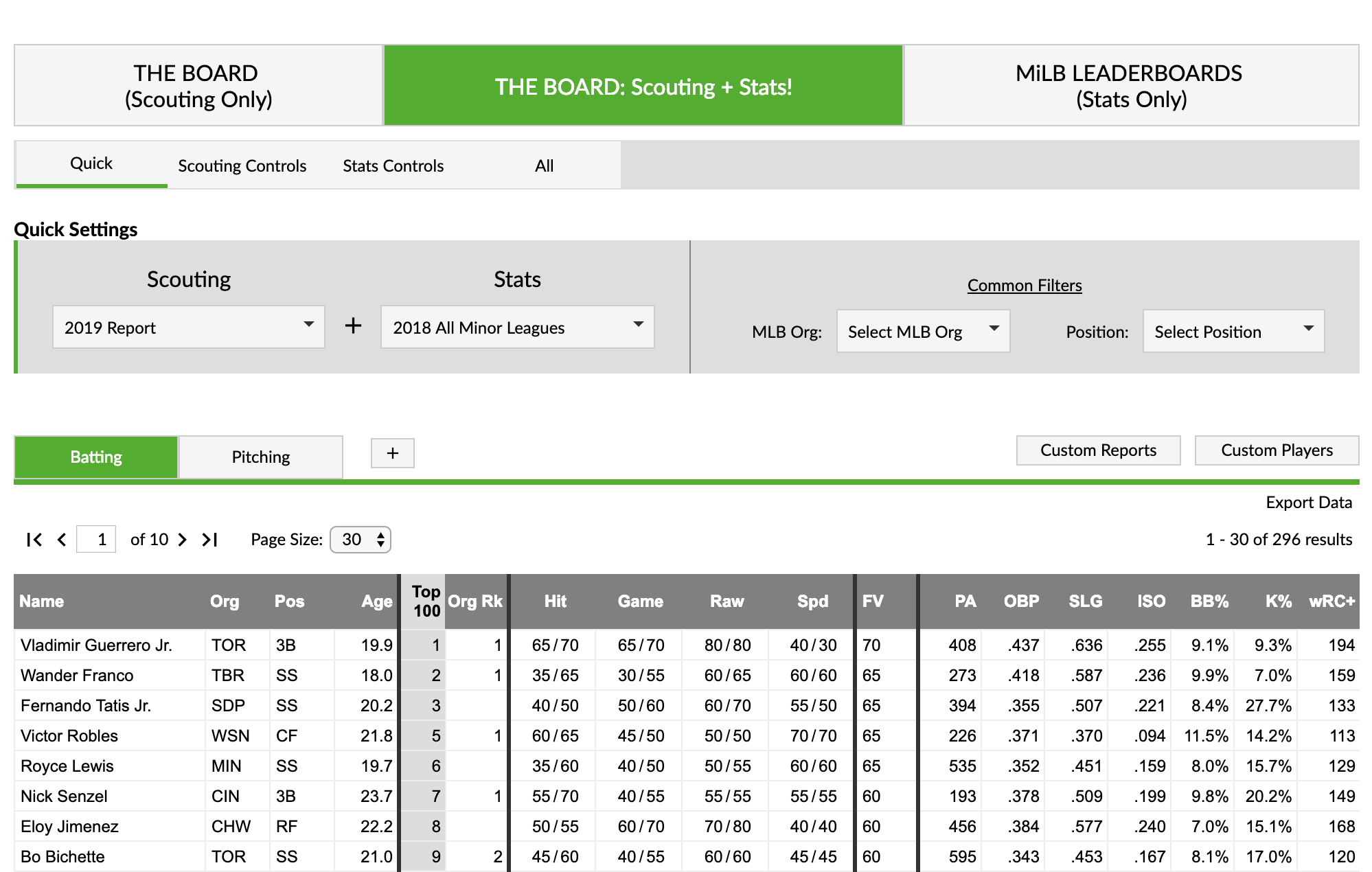
We decided to make a leaderboard that combines THE BOARD! with our Minor League Leaderboards. There are a ton of new features to review, but if you are the type of person that attempts to assemble furniture without reading the instructions, here’s the link:

https://www.fangraphs.com/prospects/the-board-scouting-and-stats

If you are still with us, we have a lot to cover. This combined leaderboard is similar to a feature we tested on our prospects landing page where the prospect list that Eric and Kiley have compiled is joined with our minor league stats.

Here’s a list of the new features:

  • THE BOARD: Scouting + Stats!
  • Revamped Minor League Leaderboards
    • Added the ability to select multiple seasons
    • Added the ability to filter by organization
    • Added three new league filters: Upper (AAA/AA), Mid (A+/A), and Low Levels (A-/R)
  • Revamped Custom Reports
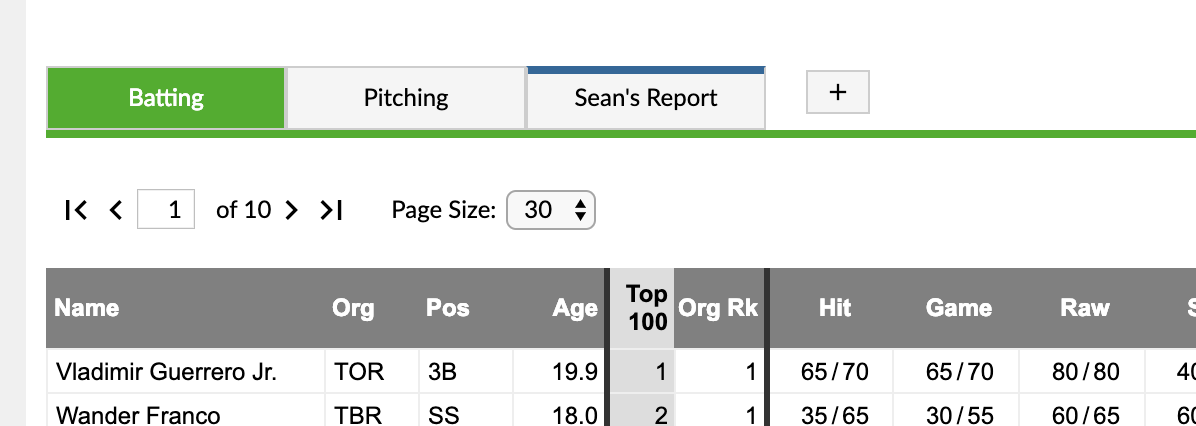
    • Your custom reports can be displayed as a tab (blue instead of green) on the leaderboard.
    • The interface to add and change stat columns is all-new.
    • You can choose to include row numbers in your report.

THE BOARD: Scouting + Stats!

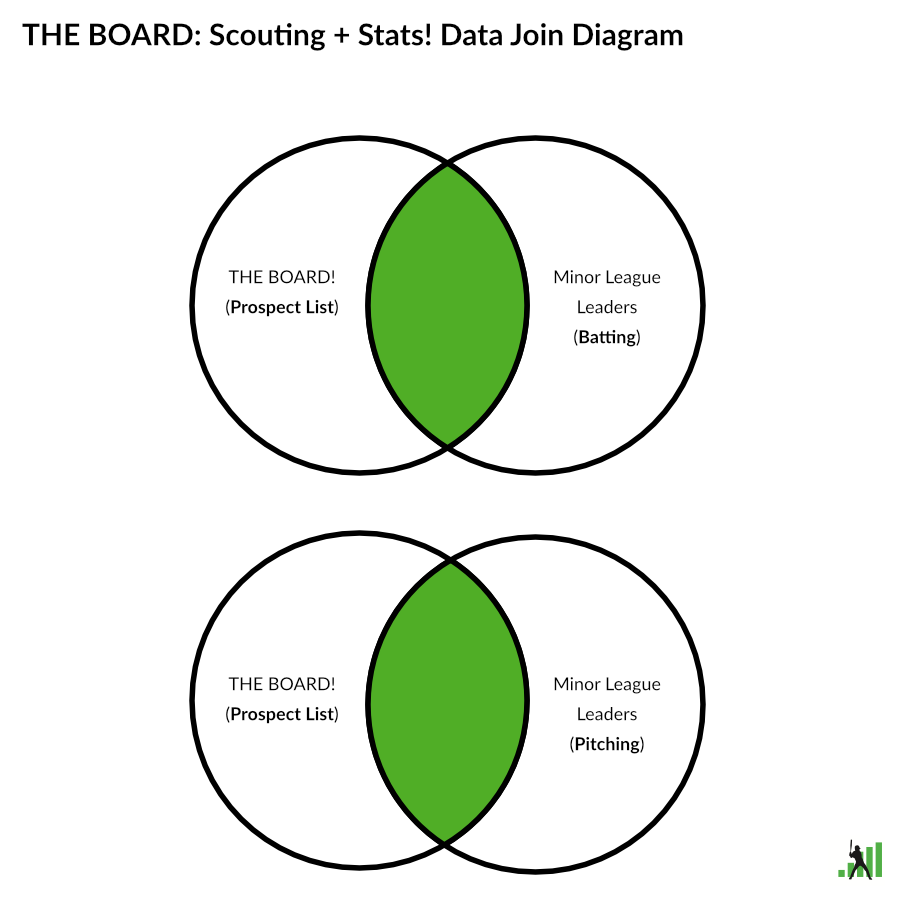
You can think of the combined leaderboard as a Venn diagram or a SQL inner join. Minor league players who are not in the selected prospect list will not appear on the combined leaderboards. Likewise, players without any minor league stats (Shohei Ohtani) are not available on this leaderboard.

Unforunately, you also can’t mix batting and pitching stats on the same leaderboard; these are still different data sets (pictured in the above data join diagram). The scouting report data is position agnostic, but the stats data still behaves like our traditional leaderboards, so you can only combined one stat data set with the scouting data set.

The filters are organized by the source of data they control. For example, scouting grade filters are on the scouting tab, while the playing time filter appears on the stats tab.

Since there is the possibility of duplicate filters for position and organization, we have those two filters located under common filters. Both filters use data from the scouting data set, so you could look at the stats of a traded prospect regardless of what system he accrued those stats. The position filter uses Eric and Kiley’s classification, instead of what position our leaderboards have for a player. This might change in the future if we deploy more advanced control options.

Important Notes:

  • A leaderboard can only contain either batting or pitching stats.
  • Right now, we are only including scouting information from prospect lists. There are plans to include draft and international players in the future.

Minor League Leaderboards

The Minor League Leaderboards have been redesigned, and we added a few new features. We added the ability to select multiple seasons and either aggregate them (default option) or have them split into multiple years. The “Split Seasons” option splits the player’s stat line by both season and team. An organization filter has been added so you can group stats across levels by the MLB organization instead of just being able to filter using the affiliate teams. We also included a few new league filters that groups tiers of levels: Upper (AAA/AA), Mid (A+/A), and Low Levels (A-/R). These will allow you to aggregate stats across those tiers.

We don’t always carry legacy tools, but we are keeping the old minor league boards around at least for a bit. These will be available in the leaders menu, but they won’t be the main link. You should be aware these might not always exist, and we are not going to continue developing them. If you are using them as a data source for research, please considering migrating to the new Minor League Leaderboards.

Custom Reports

The Custom Reports for the combined leaderboard and the Minor League Leaderboards are all-new. While FanGraphs has well-established stat groups: Standard, Advanced, and Batted Ball, combining scouting and stats data left us with too many combinations to include everything; this is where the new custom reports come in.

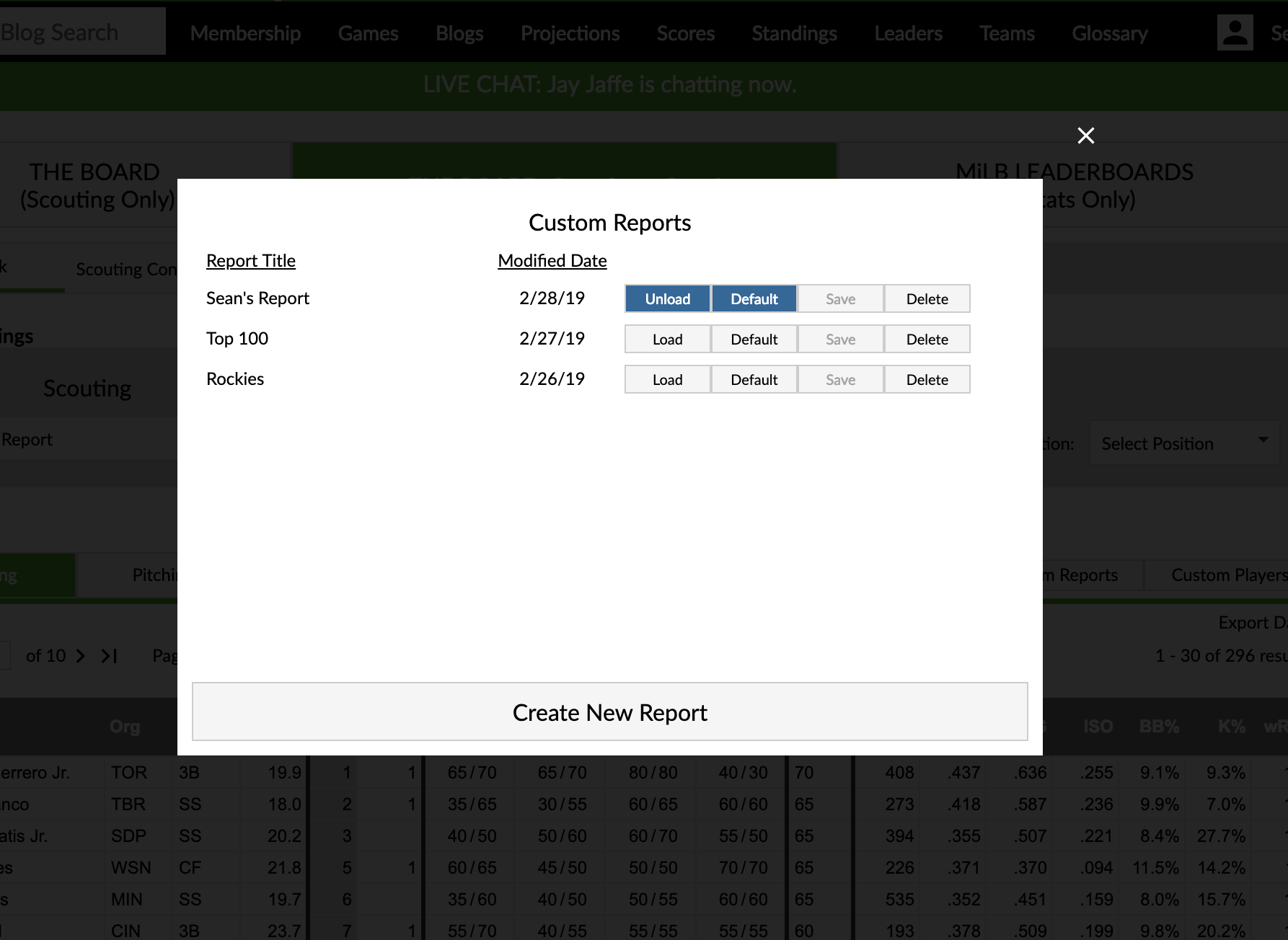
Like the old custom reports you are able to create a leaderboard with your choice of stat columns, filters, and players, but now they can be displayed as blue tabs on the leaderboard for quicker access. You can create a new report by clicking the plus button.

All of your reports for the specific leaderboard are housed in the Custom Reports dialog box accessible from the Custom Reports button on the data grid. In that dialog box, you can manage your reports including loading them into the tab bar and making them load in to the tab bar by default.

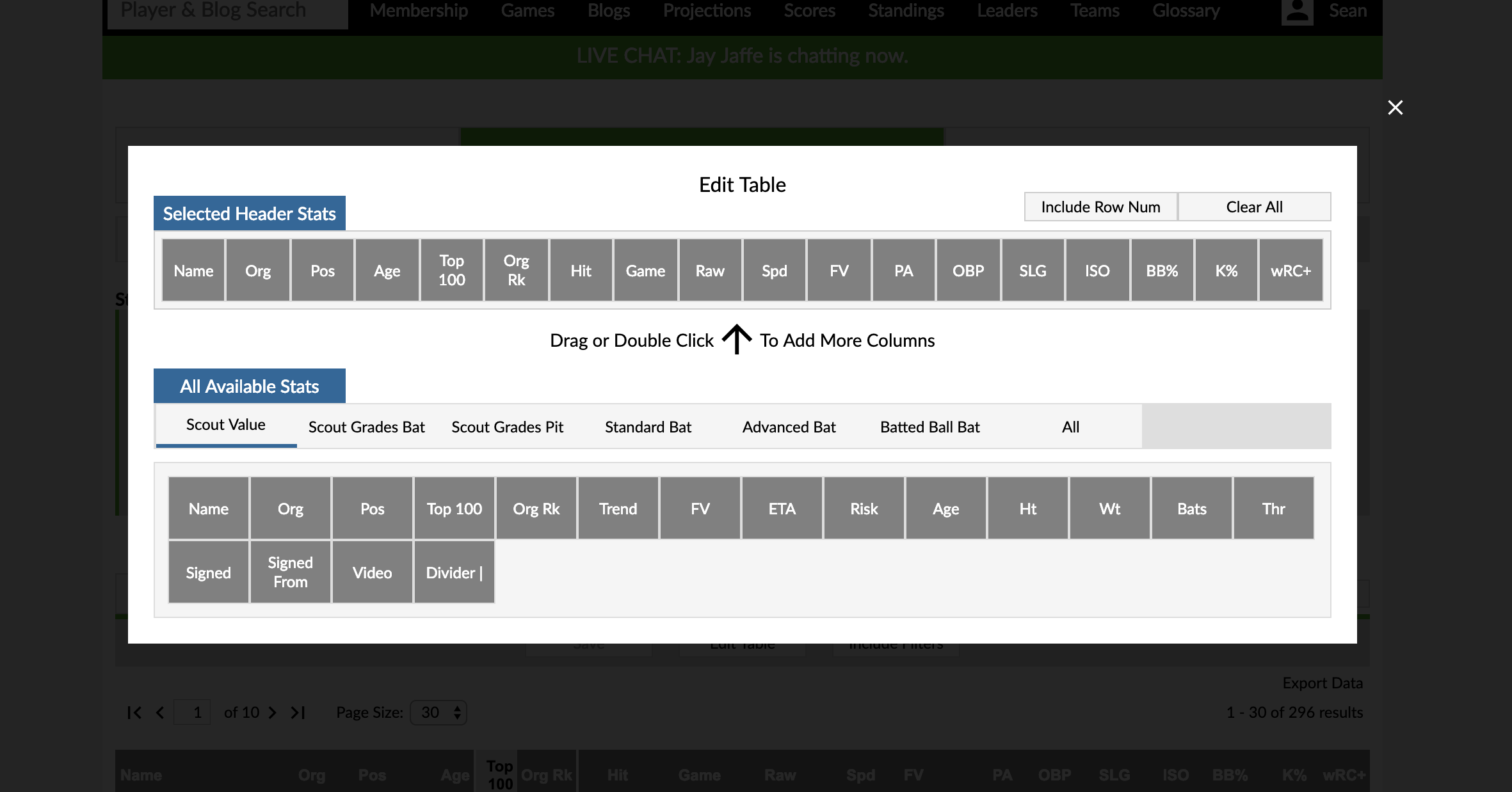
The interface to change the stat columns on the table is also completely new. You can either double click (long press on mobile) or drag/drop stats to customize your report. The columns are organized by the default tab they appear in. Once again, you can’t mix batting and pitching stats, but mixing scouting columns is cool.

Important notes:

  • Each report has an owner.
  • The owner is the only one who can modify, save, or delete that report.
  • You also must be signed into your FanGraphs account to modify, save, or delete any report.
  • However, every report is viewable by anyone if you have the URL with the report id in it.
  • You can create a copy of a report by viewing it and clicking to create a new report.
  • “Edit Table” allows you to choose different columns on the table.
  • Turning off the “Include Filters” button allows you to create a report that is agnostic to filters including custom players. This can be used if you want to create a tab with certain stats acting like native tabs.
  • Your older minor league reports are still available, though you won’t be able to save them.

Future Notes

  • We are in the process of determining how to handle the “current” level for prospects. It’s an addition we want to add to THE BOARD, but it’s not ready for this update.
  • While these tools are conceptually connected, they don’t share data between them, so going from the Minor League Leaderboards to THE BOARD: Scouting + Stats! won’t retain settings and filters.
  • Custom Reports “belong” to the tool you created them in, so you can’t make one in the leaderboards and use it with the combined leaderboard. This might change in the future, but it’s a restriction for now.

Phillies Get Bryce Harper and Bryce Harper Gets Massive Payout

This offseason, Bryce Harper failed to reach an agreement with 29 teams on a long term contract that will pay him more millions in any one deal than any baseball player has ever received before. Fortunately for Harper, there are 30 teams in major league baseball, and after a winter (and arguably, a life time) of waiting, the 26-year-old and the Philadelphia Phillies have agreed to a contract that will pay Harper $330 million dollars over 13 years, with a no-trade clause and no deferrals or opt-outs, per Jon Heyman and Jeff Passan. In exchange for that large guarantee, the Phillies get a star player, both in reputation and performance. His five-win 2019 projection is one of the very best in the game, and he greatly improves the Phillies’ chances of a playoff spot in a tough division.

Prior to adding Harper, the Phillies had already made several big moves, adding J.T. Realmuto, Andrew McCutchen, Jean Segura, and David Robertson. Despite those additions, the Phillies were still projected for a win total in the low 80s, and found themselves in a real fight with the Braves and Mets for second place in the division. Harper jumps into a corner outfield spot with the Phillies and improves the team by around four wins over what Nick Williams would’ve provided, vaulting the Phillies past the Mets and Braves and into a conversation with the Nationals for best team in the division and potentially the National League. Harper gets his record-breaking contract, topping Machado’s free agent deal and Giancarlo Stanton’s $325 million extension. The money is more spread out, with a roughly $25 million average annual value that could benefit the Phillies as they navigate the competitive balance tax in the future, so go ahead and start (or continue) the rumor that Mike Trout will make his way to Philly after the 2020 season.

While the wait this winter has been a long one, as free agency drags into spring training, this deal has been an even longer time coming for the former teen phenom. Ten years ago, a 16-year-old Harper was asked what he wanted from baseball, and he responded with all the bravado of a teenager, mentioning the Hall of Fame, pinstripes, and becoming “the greatest baseball player who ever lived.” As for the criticism that came with the comparisons to LeBron James and seeming hubris of a wunderkind gracing the cover of Sports Illustrated when he could barely drive, Harper embraced it, saying “I love the way people talk crap. I hear it all the time. Overrated. You suck. I’ll just do something to shut them up, like, I’ll show you.”

A decade later, he’s still on track for the Hall of Fame, though New York’s trade for Giancarlo Stanton made pinstripes unlikely, and Mike Trout’s existence all but ensures that Harper won’t even be the greatest player of his generation. That Harper might have to settle for Cooperstown speaks to the great expectations placed on the former number one overall pick and NL Rookie of the Year. As for those trying to cut him down, a decade has likely wisened Harper to the reality that nothing he can do will ever stop the naysayers or the perception that he hasn’t done enough. After putting up consecutive four-win seasons at 19 and 20 years old, Harper was rewarded by his peers by being voted the most overrated player in the game two years in a row. While multiple All-Star-level campaigns should have been enough to draw positive attention, Harper wasn’t satisfied; he got better. At 22 years of age, he put up one of the greatest single hitting seasons of all-time and won the NL MVP award unanimously. Just two seasons later, he was again considered the most overrated player in the game by his peers.

The expectations placed upon Harper by the media, his agent Scott Boras, and by Harper himself have shaped the way he is viewed by players and fans. The Commissioner opted to single Harper out for daring to think a $400 million contract was a reasonable ask. When greatness is the standard, slumps, team failures in the playoffs, injuries that have shortened seasons, and one season’s worth of poor defensive metrics garner more attention than a Hall of Fame pace. With this contract, those expectations aren’t going away, but if his track record, projections, and comps are any indication, some of the boasts of a 16-year-old might well become reality, as Harper continues to put up Hall of Fame caliber numbers.

Comparisons help frame our understanding of players, but in free agency, historical comparisons can often do a disservice to a player like Harper. Most free agents are older than he is. Andrew McCutchen became a free agent for the first time this winter at age 32. When Harper reaches McCutchen’s age, he will be in the seventh year of his contract. Comparing Harper’s contract to 10-year deals is nearly meaningless when those deals miss on multiple prime years at the beginning and instead mostly contain multiple years in the late-30s when age decimates nearly all players. Perpetuating the owner’s message that 10-year deals don’t work out is an exercise without utility.

Since Jackie Robinson joined the majors in 1947, only 13 players have put up a WAR within five of Harper’s 30.7 and within 20% of his 3957 plate appearances through their age-25 seasons, including Manny Machado. The 11 players who preceded this year’s free agent pair averaged 39 WAR from age 26 through age-35, and eight of the 11 players are in the Hall of Fame. Even ignoring Harper’s MVP season, his comps create an incredibly high floor. According to my colleague Dan Szymborski, ZiPS, which uses some fairly conservative playing time estimates due to the length of the deal, still has Harper worth more than 30 wins over the life of the contract even with the last few seasons projected to be below replacement-level.

In the past two decades, the only players at Harper’s age or younger to reach free agency with a similarly high level of play are Alex Rodriguez, whose 140 wRC+ through age-25 is identical to Harper, and Manny Machado. The latter just received his own $300 million deal, while the former signed for $252 million nearly two decades ago. Those dollar figures can also deceive in free agency, as Rodriguez’s deal is worth close to $600 million in today’s payroll dollars. Machado’s contact might be the first free agent contact to reach $300 million, but it’s the 10th MLB contract to reach that amount in today’s dollars, while 22 deals have been worth $252 million or more adjusting for MLB payroll inflation.

It’s possible that Harper’s defense has taken a more lasting turn for the worse, and will limit his value going forward. It’s possible Harper gets hurt. He might age poorly. There is inherent risk in making any decade-long-plus commitment when you only get to see a single outcome. It’s important to bake that risk and that downside into future expectations. When we factor that risk with the very good player Harper has mostly been, the great player he’s sometimes been, and the upside associated with a star’s late-20s–make no mistake, even at this high cost, there is still substantial upside–this is an objectively good deal. Adding Harper for 2019 is always going to look good. Every single team in baseball would love to have had Harper for this season. The reason those 29 other teams don’t is their unwillingness to make the substantial commitment that comes after this season. Those teams undoubtedly have their reasons for not making that outlay, but based on everything we know, the Phillies did a very good job in securing a likely Hall of Famer fairly early on his career while paying a reasonable price to do so. For both sides, it has been a long time coming.


A Modest Proposal to End Service Time Manipulation

Major league baseball is at its best when the game’s most talented players are able to showcase their skills at the sport’s highest level. Anything that serves to limit these displays is to baseball’s detriment. Of course, sometimes, fate intervenes. The game’s best players are susceptible to injury, and though major league organizations and the players themselves take great care to try to stay on the field, seasons are lost to tweaked knees and torn elbow ligaments. Some obstacles are impossible to avoid fully. But other absences are the result of careful, intentional planning. Take the example of service time manipulation.

Vladimir Guerrero, Jr. is generally considered to be the best prospect in baseball. He probably earned a callup last season when he was destroying minor league pitching. Right now, Steamer projects the younger Guerrero to put up 4.6 WAR in 545 plate appearances. That’s the 13th-best projection among position players, right behind Nolan Arenado and just ahead of Jose Altuve. He’s not a player who needs to spend more time in the minors, and yet yesterday, Blue Jays General Manager Ross Atkins said that, “I just don’t see him as a major league player. He’s 19.” To start with, Guerrero is older than Juan Soto was when the latter debuted last year, and will turn 20 before Opening Day. Atkins assertion that Guerrero isn’t ready is belied by his minor league performance and industry consensus, and it is hard to interpret the GM’s comments as anything other than an attempt to provide some public, baseball-related justification for keeping Guerrero in the minors so that he can stay under team control through 2025 instead of hitting free agency after the 2024 campaign. That’s service time manipulation.

The practice isn’t unique to Toronto. Kris Bryant was famously held down at the beginning of 2015; he won’t be a free agent until after the 2021 season instead of in 2020. Last season, Ronald Acuña didn’t start the season with the Braves. The White Sox’s Eloy Jimenez is likely to spend time cooling his heels in Charlotte despite being much better than the players ahead of him on the depth chart. Vladimir Guerrero, Jr. is ready now, and the Blue Jays will be worse for every game that Guerrero spends in Buffalo, but that is exactly where he figures to begin this season.

The incentives for teams are obvious, but they are deliberately choosing not to field their best roster, depriving the sport of its best possible product, and delaying deserving players from fulfilling life-long dreams and obtaining market contracts. The easiest solution would be for teams to simply call up players when they are capable of meaningfully contributing, but given that teams could easily do that right now and don’t, another solution is likely necessary. Others have offered solutions to this issue in the past. In 2015 in response to the Cubs’ treatment of Bryant, FanGraphs alum Mike Petriello proposed changing the a full year of service to time to 100 days on the major league roster. Erstwhile Baseball Prospectus scribe Russell Carleton proposed an age-based free agency model as a means of curtailing the practice. Sheryl Ring proposed that a player accrue a year of service if he spends the majority of the league year on the major league roster. And while a solution might not even be possible until the players and owners negotiate a new Collective Bargaining Agreement in 2021, I’d like to put forth my own proposal to eliminate service time manipulation. The problem is fairly straightforward, but as most potential solutions have unintended consequences, this one is a multi-parter.

First, a player’s first year of service time will be reached with 90 days of MLB service. This is a fairly direct solution, but unfortunately, it could also incentivize teams to keep players down even longer than they do now. While it might make clubs’ decisions more difficult if they are potential contenders, organizations might still opt to keep players in the minors, and non-contending teams might be more likely to do so than those with playoff aspirations; in a year where the Blue Jays are only projected for 77 wins, they might decide that Vlad Jr.’s defense at third needs yet more time, bad PR and a potential grievance be damned.

As a result, it will be necessary to give players half-service time for their days on the 40-man roster. If a player spends the entire season on the 40-man roster in the minors, he will reach 90 days of service time at the end of the season. To prevent shenanigans for those with MLB experience, players can earn one year of MLB service time in the minors at any point in their careers, but can only accrue one year this way. This will get some players closer to free agency without actually playing in the big leagues, and incentivizes putting a team’s best players on the active roster. After all, if a player’s free agency clock is going to start anyway, why not have him lend his talents to the big league club if he’s ready? Unfortunately, teams don’t put players on the 40-man roster until they have to, and many top prospects won’t be on the 40-man roster as a result.

To combat the phenomena described in the previous paragraph, it will be necessary to put more teeth behind the Rule 5 draft by making players draft-eligible a year earlier than they are under the current system. Players who signed their first pro contract at age 18 or younger would now be eligible after four years of minor league service instead of five, while those who did so at age 19 or older would be eligible after three years instead of the current four. This would make many more good prospects eligible for the Rule 5 draft and in order to protect them, teams would then put them on the 40-man roster.

Unfortunately, making so many more players eligible for the Rule 5 draft would create a massive roster crunch, and could result in teams being unable to get the prospects they develop to the majors. To prevent this situation, and to keep the Rule 5 draft roughly as it is, the 40-man roster would become a 50-man roster. Teams would then have no difficulty protecting eligible players, but would still be encouraged to promote their prospects as those prospects would end up with a year of service time. While teams would move more players to the majors earlier, those players accruing service time in the minors are a limited set of players: those who are close to the majors or have star potential after multiple years in the minors, hence creating the need to protect them from the Rule 5 draft. For players, it would also have the added benefit of welcoming hundreds more players into the union with better minor league wages as players who have been named to the 40-man, now 50-man, roster are paid at a higher rate thanks to union protections. As a benefit to teams, an additional option year could be added.

So to review:

  • Players receive their first, and only first, year of service time after 90 days
  • Players receive half-service time for days spent on 50-man roster, but not in the majors
  • Rule 5 Eligibility moved up one year
  • 40-man roster increased to 50 players
  • Teams receive an extra option year

This proposal is admittedly complicated. The irony of this idea is that Kris Bryant, the poster-boy for service time manipulation, actually wouldn’t have been spared due to his rapid ascent to the majors, though the Cubs would have had to hold Bryant out until the All-Star Break in 2015 to get an extra year of his services. While this deal favors the interests of the players at the expense of teams and team owners, it is a much more reasonable proposal from ownerships’ perspective than cutting the service time necessary for free agency to less than six years. A union proposal that cuts free agency down to five years and deals with service time manipulation in some other way would mean less team control for those young, ready stars that this proposal is designed to protect, and might make it a non-starter come 2021. Negotiating this solution is likely to be difficult and part of a much larger deal. Teams are going to be highly resistant to any change that deprives them of cost controlled years of their best players. But the union focusing some of their attention on getting players like Vlad Jr. to the majors, as well as getting better benefits to the minor leaguers left behind, can only be to the game’s benefit. Many of baseball’s stars of tomorrow are ready today. Let’s watch them play, shall we?


Rockies’ Arenado Gets His Mountain of Money

Earlier this month, I made the case for the Rockies to sign Nolan Arenado to an extension that could rival Miguel Cabrera’s eight-year, $248 million deal for the largest average annual value of any position player contract. My suggestion wasn’t coming out of left field, as the going-on-28-year-old third baseman had just set a record for an arbitration-eligible player by agreeing to a $26 million salary for 2019, and had reportedly indicated a willingness to work out a long-term deal. That willingness has resulted in the completion of an eight-year contract reportedly worth $260 million, the fourth-largest guaranteed salary in MLB history.

The exact breakdown of Arenado’s contract has not been reported at this writing, but the deal replaces or incorporates the aforementioned $26 million salary for this year and runs through 2026, for a $32.5 million AAV, the highest of any player besides Zack Greinke ($34.17 million). The dollar value currently trails only those of Giancarlo Stanton (13 years, $325 million), Manny Machado (10 years, $300 million), and Alex Rodriguez (10 years, $275 million) in terms of overall value, though according to Craig Edwards’ inflation-adjusted conversions of MLB’s biggest deals into 2019 dollars, the amount would place just 19th. Taking account of Rockies history, that’s three spots behind the current $277 million valuation of Todd Helton‘s nine-year, $141.5 million extension, which covered 2003-11, and six spots ahead of the current $248 million valuation of Troy Tulowitzki’s 10-year, $157.75 million extension covering 2011-20. Arenado’s contract includes an opt-out after 2021, which would allow him to become a free agent after his age-30 season, and also gets him full no-trade protection now instead of waiting until the point in early 2023 when his 10-and-5 rights would kick in. Read the rest of this entry »