Taylor Williams is a tad shorter than the 5-foot-11 he’s listed at in the Milwaukee media guide. But as the saying goes, size doesn’t matter. His fastball averaged 96.1 mph, and ticked up even higher, in his 2018 rookie season. More importantly, he consistently recorded outs. In 56 appearances out of the Brewers bullpen, Williams fanned 57 batters in 53 innings, and fashioned a 3.95 FIP. All in all, it was a successful campaign for the 27-year-old right-hander who hails from Camas, Washington.
He faced a speed bump on his way to Beer City. Seemingly on the fast track after a stellar first-full professional season, the 2013 fourth round pick suddenly began feeling elbow discomfort. Rest didn’t help, nor did a platelet-rich plasma injection. He underwent Tommy John surgery and missed all of the 2015 and 2016 seasons.
He barely missed a beat after returning to action. Williams pitched well enough at Double-A Biloxi to earn a five-game cameo with the Brewers in September 2017. Then came last season’s further step forward, which portends a continuation of what could arguably be called a David-slays-Goliath career.
The undersized — but by no means underperforming — hurler discussed his path to the big leagues midway through last summer.
———
Williams on being drafted out of Kent State: “I was originally at Washington State, but decided that I didn’t want to go back. This was after after my freshman year. I transferred to Mount Hood Community College, in Oregon, in part because I didn’t want to have to sit out a season. I finished my associates degree at Mount Hood, then transferred to Kent State.
“I’d played summer ball with some Kent State guys after my freshman year. That was up in the New England Collegiate Baseball League. The team I was with played out of Keene, New Hampshire. The NECBL is a good league. Our All-Star team actually beat Team USA that year. Read the rest of this entry »
The Cincinnati Reds did more than hire a new manager over the offseason. They also revamped their coaching staff. Two of the additions will be entrusted with optimizing the offense. Turner Ward, formerly with the Dodgers, is now the hitting coach. Donnie Ecker, who came over from the Angels, will serve as the assistant hitting coach. Neither will be faced with the challenge of helping Billy Hamilton turn a corner. The Reds non-tendered the enigmatic speedster, who subsequently signed with the Royals, back in November.
I recently asked Dick Williams about the decision to cut ties with Hamilton, who slashed .245/.298/.333 in his five seasons as Cincinnati’s centerfielder. Before we get to that, here is the team’s President of Baseball Operations on Ecker:
“We’ve had some really interesting sessions the last couple of days, where coaches have gotten up and talked about their areas. Donnie Ecker is a movement specialist. He has a bio-mechanical approach to the swing. We had some great hitters in the room, like Barry Larkin and Eric Davis. Donnie gave a bio-mechanical explanation of some of the things he sees in hitters, using descriptions and examples that all of us could understand.”
Would Ecker, along with Ward, have been able to transform Hamilton into the productive hitter he’s thus far failed to become? Read the rest of this entry »
When publishing our lists — in particular, the top 100 — we’re frequently asked who, among the players excluded from this year’s version, might have the best chance of appearing on next year’s version. Whose stock are we buying? This post represents our best attempt to answer all of those questions at once.
This is the second year that we’re doing this, and we have some new rules. First, none of the players you see below will have ever been a 50 FV or better in any of our write-ups or rankings. So while we think Austin Hays might have a bounce back year and be a 50 FV again, we’re not allowed to include him here; you already know about him. We also forbid ourselves from using players who were on last year’s inaugural list. (We were right about 18 of the 63 players last year, a 29% hit rate, though we have no idea if that’s good or not, as it was our first time engaging in the exercise.) At the end of the piece, we have a list of potential high-leverage relievers who might debut this year. They’re unlikely to ever be a 50 FV or better because of their role, but they often have a sizable impact on competitive clubs, and readers seemed to like that we had that category last year.
We’ve separated this year’s players into groups or “types” to make it a little more digestible, and to give you some idea of the demographics we think pop-up guys come from, which could help you identify some of your own with THE BOARD. For players who we’ve already covered this offseason, we included a link to the team lists, where you can find a full scouting report. We touch briefly on the rest of the names in this post. Here are our picks to click:
Teenage Pitchers
Torres was young for his draft class, is a plus athlete, throws really hard, and had surprisingly sharp slider command all last summer. White looked excellent in the fall when the Rangers finally allowed their high school draftees to throw. He sat 92-94, and his changeup and breaking ball were both above-average. Pardinho and Woods Richardson are the two advanced guys in this group. Thomas is the most raw but, for a someone who hasn’t been pitching for very long, he’s already come a long way very quickly.
The “This is What They Look Like” Group
If you like big, well-made athletes, this list is for you. Rodriguez was physically mature compared to his DSL peers and also seems like a mature person. The Mariners have indicated they’re going to send him right to Low-A this year. He could be a middle-of-the-order, corner outfield power bat. Luciano was the Giants’ big 2018 July 2 signee. He already has huge raw power and looks better at short than he did as an amateur. Canario has elite bat speed. Adams was signed away from college football but is more instinctive than most two-sport athletes. Most of the stuff he needs to work on is related to getting to his power.
Advanced Young Bats with Defensive Value
This is the group that produces the likes of Vidal Brujan and Luis Urias. Edwards is a high-effort gamer with 70 speed and feel for line drive contact. Marcano isn’t as stocky and strong as X, but he too has innate feel for contact, and could be a plus middle infield defender. Perez has great all-fields contact ability and might be on an Andres Gimenez-style fast track, where he reaches Double-A at age 19 or 20. Ruiz is the worst defender on this list, but he has all-fields raw power and feel for contact. He draws Alfonso Soriano comps. Palacios is the only college prospect listed here. He had three times as many walks as strikeouts at Towson last year. Rosario controls the zone well, is fast, and is a plus defender in center field.
Corner Power Bats
Nevin will probably end up as a contact-over-power first baseman, but he might also end up with a 70 bat. He looked great against Fall League pitching despite having played very little as a pro due to injury. Lavigne had a lot of pre-draft helium and kept hitting after he signed. He has all-fields power. Apostel saw reps at first during instructs but has a good shot to stay at third. He has excellent timing and explosive hands.
College-aged Pitchers
It’s hard to imagine any of these guys rocketing into the top 50 overall. Rather, we would anticipate that they end up in the 60-100 range on next year’s list. Gilbert was a workhorse at Stetson and his velo may spike with reshaped usage. Singer should move quickly because of how advanced his command is. Lynch’s pre-draft velocity bump held throughout the summer, and he has command of several solid secondaries. Abreu spent several years in rookie ball and then had a breakout 2018, forcing Houston to 40-man him to protect him from the Rule 5. He’ll tie Dustin May for the second-highest breaking ball spin rate on THE BOARD when the Houston list goes up. We’re intrigued by what Dodgers player dev will do with an athlete like Gray. Phillips throws a ton of strikes and has a good four-pitch mix.
Bounce Back Candidates
The Dodgers have a strong track record of taking severely injured college arms who return with better stuff after a long period of inactivity. That could be Grove, their 2018 second rounder, who missed most of his sophomore and junior seasons at West Virginia. McCarthy was also hurt during his junior season and it may have obscured his true abilities. Burger is coming back from multiple Achilles ruptures, but was a strong college performer with power before his tire blew.
Catchers
We’re very excited about the current crop of minor league catchers. Naylor is athletic enough that he’s likely to improve as a defender and he has rare power for the position.
Potentially Dominant Relievers
These names lean “multi-inning” rather than “closer.” Gonsolin was a two-way player in college who has been the beneficiary of sound pitch design. He started last year but was up to 100 mph out of the bullpen the year before. He now throws a four seamer rather than a sinker and he developed a nasty splitter in 2017. He also has two good breaking balls. He has starter stuff but may break in as a reliever this year.
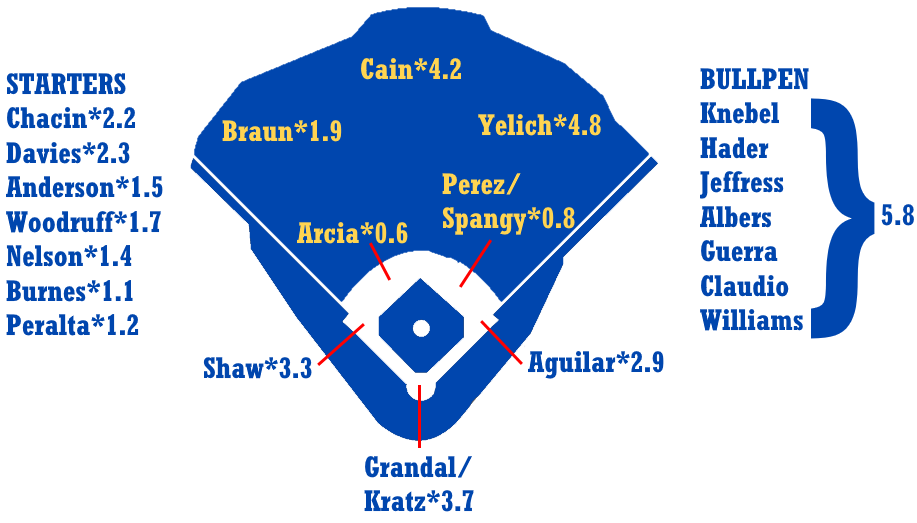
After having typically appeared in the hallowed pages of Baseball Think Factory, Dan Szymborski’s ZiPS projections have now been released at FanGraphs for more than half a decade. The exercise continues this offseason. Below are the projections for the Milwaukee Brewers.
With the position players, we have the sizzle that moved the Brewers from an adequate team to a very good one, thanks to the additions of last year’s best, high-profile free agent signing in Lorenzo Cain and the best, high-profile trade in Christian Yelich. ZiPS was a believer in both — I peppered my articles last winter with predictions of a Yelich breakout and Cain as the best free agent hitter available after J.D. Martinez — so the two of them having MVP-type seasons hardly should make ZiPS sour on them. And it didn’t! Sure, Cain turns 33 early in the season, but his defense hasn’t declined as of yet. Indeed, he may actually be underrated at this point; he should have made a minimum of four All-Star appearances rather than a measly two.
I feel for Manny Pina, who is essentially getting pushed aside for Yasmani Grandal, and while the Brewers absolutely should prefer Grandal — he’s younger, better, and signed to a ridiculously team-friendly contract — Pina’s been perfectly adequate behind the plate. The depth charts have Kratz backing up Grandal, but I’d suspect that in a time when the catcher position is weak around baseball, Milwaukee will trade Pina, or play him for a bit before leaving him open to a waiver claim later in the spring.
I’m kind of sad that Arcia’s projection for 2019 is so light on WAR. He’s always been a favorite of mine, but if he’s not matching his minor league glove reputation in the majors, he’s not much of a starter unless his bat rebounds in a big way.
Pitchers
ZiPS is once again more bullish on the Brew Crew’s starting pitching than Steamer is this year, but it still doesn’t see any of the Brewers as an obvious ace type. It’s easy for people criticize Steamer based on the current depth charts, but I think people are underestimating the challenges of projecting essentially the entire Brewer rotation. Each pitcher who is likely to contribute has at least something that makes it difficult for any prognosticator to do their job. Let’s take a look.
Jhoulys Chacin beat his FIP by half-a-run thanks to a .250 BABIP. He’s shown no signs of being able to do this repeatedly in the past, but also spent a lot of his career at Coors, which is obviously an extremely difficult environment for a pitcher.
Zach Davies looked like he was becoming a solid No. 2 or 3 guy, but missed significant time with shoulder injury in 2018.
When it comes to Chase Anderson, well, there’s beating your FIP, and there’s beating your FIP, and Anderson did the latter in 2018, besting it by nearly a run-and-a-third. ZiPS buys that there’s some ability here, but just how big that ability is remains up in the air.
Brandon Woodruff was up-and-down all year after struggling early, but will likely to get rotation spot despite only four major league starts in 2018 (he had more in the minors).
Jimmy Nelson missed the entire 2018 season due to shoulder surgery. Corbin Burnes has yet to make a major league start. Freddy Peralta has a stat profile that looks like that of a guy who throws 97 rather than 90-91.
ZiPS was closer when it came to the Brewers last year, but that’s not necessarily predictive; it wouldn’t take a lot for Steamer to win this battle. I’m less certain about the Brewers’ projections, at least on the pitching side, than I am most others this offseason.
Bench and Prospects
ZiPS buys Keston Hiura, and while it doesn’t have him becoming prime Dan Uggla or anything — I’m not sure why I chose Uggla here — the computer thinks that he’ll force his way into a job fairly quickly. I don’t think the Brewers will do with him what the White Sox did with Eloy Jimenez, and I suspect that if they weren’t going to give Hiura every opportunity to clear the field this summer, they’d have tendered Jonathan Schoop a contract.
The projections now have Mauricio Dubon as the equal of Arcia, though a large part of that has to do with Arcia’s forgettable 2018 season. That the projection is damning with faint praise is further evidenced by the fact that ZiPS sees Tyler Saladino as roughly equivalent as well. After Hiura, Dubon, Trey Supak, and Zack Brown, ZiPS sees the quality falling off very quickly, not expecting Corey Ray to ever make enough contact to be an effective major league hitter, or Lucas Ercerg to be better than a reserve.
One pedantic note for 2019: for the WAR graphic, I’m using FanGraphs’ depth chart playing time, not the playing time ZiPS spits out, so there will be occasional differences in WAR totals.
Disclaimer: ZiPS projections are computer-based projections of performance. Performances have not been allocated to predicted playing time in the majors — many of the players listed above are unlikely to play in the majors at all in 2019. ZiPS is projecting equivalent production — a .240 ZiPS projection may end up being .280 in AAA or .300 in AA, for example. Whether or not a player will play is one of many non-statistical factors one has to take into account when predicting the future.
Players are listed with their most recent teams, unless I have made a mistake. This is very possible, as a lot of minor-league signings go generally unreported in the offseason.
ZiPS’ projections are based on the American League having a 4.29 ERA and the National League having a 4.15 ERA.
Players who are expected to be out due to injury are still projected. More information is always better than less information, and a computer isn’t the tool that should project the injury status of, for example, a pitcher who has had Tommy John surgery.
Both hitters and pitchers are ranked by projected zWAR — which is to say, WAR values as calculated by me, Dan Szymborski, whose surname is spelled with a z. WAR values might differ slightly from those which appear in full release of ZiPS. Finally, I will advise anyone against — and might karate chop anyone guilty of — merely adding up WAR totals on a depth chart to produce projected team WAR.
Payton Henry grew up in a wrestling family in a wrestling town. That’s not the sport he settled on. The 21-year-old native of Pleasant Grove, Utah cast his lot with baseball, and went on to be selected in the sixth round of the 2016 draft by the Milwaukee Brewers. He’s seen by many as the NL Central club’s catcher of the future.
His backstory is one of Greco-Roman lineage. Henry’s paternal grandfather, Darold, won 10 state championships as a coach, and is a member of Utah’s Wrestling Hall of Fame. The patriarch coached 65 individual champions, including his son Darrin — Payton’s father — who captured a pair of titles. And while it eventually rolled away, the greenest of the apples tumbled from the same tree.
“I was kind of born to grow up a wrestler,” said Henry. “But then I fell in love with baseball. Once I realized I had a future in it, and started traveling a lot for baseball tournaments, I stopped wrestling. I didn’t have the time for it anymore.”
Being physically strong — weight training has long been part of his workout routine — and well-schooled in the sport’s technical aspects, he probably could have followed in his father’s footsteps. The coaches at Pleasant Grove High School certainly thought so. At the start of each year they would approach him and say,“Are you sure you don’t want to come out and wrestle?” Read the rest of this entry »
I’ll grant that trying to answer this is unavoidably subjective. The Nationals just signed Brian Dozier, and a bone bruise might’ve clipped four wins from his WAR. The Braves are crossing their fingers for a healthy season from Josh Donaldson. Corey Seager is returning to the Dodgers after missing almost the whole year. The Cubs are looking for Yu Darvish to rebound. The Angels are looking for Zack Cozart to rebound. Dustin Pedroia should be coming back. Michael Pineda should be coming back. Buster Posey should be coming back. And so on and so forth. Baseball players get hurt. They try to put those injuries behind them. They try to get back to being what they were.
But as I think about this — certain recoveries are more predictable than others. Certain recovering players have bigger error bars than others. In a sense, the purpose behind this post is simply to remind you of the existence of Jimmy Nelson. But I think he really is the biggest injury wild card for the season ahead. The Brewers will play in a division with at least three and possibly five competitive teams. As of this moment, the Brewers are projected to have a below-average starting rotation. Jimmy Nelson might be a zero, as he was in 2018. Or he might be an ace, as he was in 2017. I don’t know which it’s going to be. The Brewers don’t, either.
Free agent Yasmani Grandal reached a one-year agreement with the Brewers, worth $18.25 million. Grandal’s contract — while surprising — is not proof that baseball is broken. Not in an offseason where Lance Lynn got $30 million. Not in an offseason where Zach Britton got $39 million. Not in an offseason where Andrew McCutchen got $50 million. Nathan Eovaldi got $68 million. Patrick Corbin got $140 million. And even in Grandal’s specific case, it’s been reported he turned down an offer of $60 million or so from the Mets. Now, there’s reason to believe that didn’t happen exactly as so. It feels more than a little far-fetched. But the conversations, at least, were productive, before the Mets opted for Wilson Ramos instead. Grandal had a chance to do better than this.
But still, Yasmani Grandal signed a one-year contract barely worth more than the qualifying offer he declined. He signed a one-year contract with a competitive team, but a competitive team that happens to play in baseball’s smallest market. This could ultimately work out just fine — with a big season ahead, Grandal would re-enter free agency, and maybe next winter he’d find a larger guarantee. There’s nothing wrong with bringing home $18.25 million in the meantime. It’s just surprising there wasn’t greater demand. The Brewers lucked out; a good player just fell into their lap. It probably shouldn’t have happened.
On Saturday, the Brewers and Mets continued to reshape their outfields, making a four-player swap headlined by dynamic outfield defender Keon Broxton. Here’s the deal:
Almost by default, Broxton tentatively slots in as the Mets’ starting center fielder, between Michael Conforto and Brandon Nimmo. There’s a stark lack of outfield depth on New York’s 40-man; Jay Bruce was traded, the org isn’t expecting much from Yoenis Cespedes next season as he recovers from surgery to remove bone spurs from both heels, and Juan Lagares provides very little on offense and is injury prone. Since 2014, he has endured a strained hamstring, an intercostal strain, several thumb injuries, an oblique strain, and a plantar plate tear. In 2018, he was shut down for the year in May due to toe surgery and has only played seven Dominican Winter League games this offseason.
As far as others on the 40-man are concerned, T.J. Rivera and Dom Smith have each played some left field, while Jeff McNeil, who turns 27 in April, has started just five pro games in the outfield. It’s debatable as to whether any of them are actually playable out there. It is not debatable that Broxton, who is an elite defender at all three outfield spots, is simply better than all of them.
Set to turn 29 in May, Broxton’s growth as a player has likely concluded. He struggled badly with strikeouts as a prospect and was traded straight up for cash before being part of a two-player package for half-year big league performer and fringe 40-man talent Jason Rogers. That deal landed him in Milwaukee, where Broxton improved enough in his late-twenties to be rostered as defensive ace and pinch runner.
The strikeout issues remain (his career strikeout rate is 36%), and Broxton’s propensity to whiff undercuts his offensive production enough to make him a bench-quality player, albeit a good one because of the defense. Ideally, he’s not your everyday center fielder, but it’s reasonable to project him as one right now because of the dearth of other outfielders on the Mets roster.
Broxton and Lagares seem, on the surface, like odd bedfellows for a platoon because they’re each right-handed. It’s possible a timeshare might help keep Lagares healthy, or that the two complement one another in harder-to-see ways. For instance, a quick examination of their heats maps on the site shows that Broxton does his damage on pitches middle-in, while Lagares thrives on pitches down-and-in. They could be platooned in accordance with where the opposing starter likes to work. That’s probably not a different enough offensive profile for this type of thinking to matter, but maybe their skill sets with mesh with each other in some other way we can’t see. Or perhaps the Mets will keep an open mind about further upgrading in center field.
From Milwaukee’s perspective, Lorenzo Cain’s defense made Broxton’s best skill redundant in a crowded outfield picture that now projects to see more action from Eric Thames, Ben Gamel, and Tyrone Taylor, who is a sleeper breakout candidate due to a recent swing change that might have altered his power output.
From the Mets, the Brewers receive another immediately relevant relief piece in Wahl, who will likely compete for an opening day bullpen spot in the spring. He was part of the two-player package Oakland sent to the Mets for Jeurys Familia last summer. Wahl, who turns 27 in March, has thrown just 12 career big league innings at this age mostly because he missed extended development time to multiple surgeries, including one in 2017 to remedy thoracic outlet syndrome.
His stuff was back last year. Wahl’s fastball sits in the mid-90s and will touch 99. He has a four-pitch mix but works primarily with the fastball and a power, mid-80s breaking ball that has bat-missing vertical action. A firm cutter and changeup are also folded in on occasion. Wahl has set-up man stuff but below average command and more significant injury risk than most pitching prospects.
The Brewers also acquired Adam Hill, the Mets’ 2018 fourth round pick out of the University of South Carolina. Hill was dominant during the first four starts of his junior year, but his control disappeared once the Gamecocks began conference play. He struggled to throw strikes for two months leading up to the draft and fell to the fourth round.
Hill does have good stuff. He’ll sit 90-94 and his big, 6-foot-6 frame and lower arm slot combine to create a unique look for hitters. His slider breaks late and has good length when located to Hill’s arm side, and his changeup has good action because of his lower arm slot. His limited command probably relegates Hill to the bullpen eventually, but he has No. 4 or 5 starter stuff if he can develop better control in his mid-20s, which sometimes happens to pitchers this size.
Finally, the Brewers also acquired 18-year-old Dominican second baseman Felix Valerio, who hit .319/.409/.433 in the DSL during his first pro season. Valerio is a skills-over-tools type of prospect who is more polished than most of his peers. He has promising feel for contact and is athletically viable at second base but at 5-foot-7 and 165 pounds, he’s less likely to grow into more impressive physical tools than someone with some length and room on their frame. Players like this either hit enough to play second base every day, or don’t and end up as org guys. Valerio walked more than he struck out last year, and those types of peripheral indicators can offer great evidence to support a case that a player will indeed hit enough to play every day, but not when we’re talking about DSL stats. Still, league sources indicated to me that this was not the first time Valerio’s name has come up in trade talks, so it seems that other teams besides Milwaukee have had interest in him.
All three players have been added to the Brewers prospect rankings on The Board. Wahl and Hill are in the 40 Future Value tier, while Valerio will be added to the Others of Note section of the team’s long form writeup.
Would MLB actually go so far as to ban the shift? Asked about that conjecture, David Stearns made it clear that he’s no fan of the idea. Not because he’s against change, but rather because change is already a big part of baseball. More specifically — yes, there have been exceptions to the rule — organic charge is already a big part of baseball.
“Teams have evolved,” the Brewers GM said during the Winter Meetings. “Strategies have evolved. Players adjust, and they will on this one as well. If shifts become completely deflating to certain profiles of players, we will value them accordingly. Things will balance themselves out. Look, we’ve been moving fielders around for decades. I would not be in favor of a ban on shifts.”
Ron Gardenhire feels otherwise. He favors an inorganic fix to the perceived (and arguably nonexistent) problem.
“I like two guys on each side,” the Detroit manager stated in equally-stern terms. “I’ve always said that. Or at least keep them all in the dirt rather than in the grass. Ask Victor Martinez. He might have hit .300 this year if they just had them on the infield. Yeah, I am old school in that respect.”
The veteran skipper elaborated on his viewpoint in a manner suggestive of… an organic substance? Going pure Gardy, he name-checked the man erroneously credited with inventing the game, another sport, and a comedy duo from a bygone era. Read the rest of this entry »
Christian Yelich and Lorenzo Cain led the Brewers offense in 2018. (Photo: Ian D’Andrea)
The World Series may have been a battle of big market Goliaths, but one last David held out in the Milwaukee Brewers. Powered by two MVP candidates in the outfield, the remnants of the best logo of the 1980s, and perhaps most strangely, the confusing, awesome powers of Wade Miley, Milwaukee stood strong long past the pumpkinization of other sabermetric-darling Cinderellas. And when they went down, of the seven non-Boston teams to survive the wild card round, the Brew Crew was the only one to take their opponents to an elimination game, making Dylan Thomas proud.
The Setup
Of the franchises that underwent a significant teardown cycle over the last decade, the rebuilding of the Milwaukee Brewers may have been among the most low-key. One reason for this is that while other franchises that had to be dragged into their down cycles kicking and screaming and pretending disaster was not upon them, Milwaukee showed an unusual realpolitik about the state of their franchise. A lot of teams would have taken the wrong lesson from Milwaukee’s 82-80 2014 season, when they surprisingly led the NL Central uninterrupted from the second week of the season until the end of August, and believed they were just a couple mediocre veterans away from the promised land.
The Brewers, on the other hand, saw the opportunity to trade Yovani Gallardo while the getting was good (before a 30% drop in strikeout rate was reflected in his ERA). And when 2015 became a mess, the team wasted little time dithering, jumping straight into a rebuild before the roster was a bleak Kafka-esque wasteland of value while simultaneously transitioning to a new braintrust let by David Stearns, with the handoff from Doug Melvin being one of the smoothest transfers of power in human history.