Archive for Featured

Ross Atkins on the Blue Jays’ Process

Ross Atkins was hired as Toronto’s Executive VP of Baseball Operations and General Manager in December 2015, shortly after Mark Shapiro was officially named the team’s President and CEO. Both came to the Blue Jays from Cleveland, where they’d worked together with the Indians for the past 15 years. A formidable pairing atop Toronto’s front office hierarchy, they are — as Atkins is quick to point out — nonetheless just two pieces of a much larger puzzle.

The Blue Jays have undergone organizational change in recent seasons, but the past six months stand out. John Gibbons was formally dismissed as manager in late September, and several members of his coaching staff followed him out the door. The roster has also undergone change. Troy Tulowitzki has departed, as have Russell Martin, Josh Donaldson, Curtis Granderson, Marco Estrada, and JA Happ. Notably, all of these player are 33 years old or older.

Fifty-three-year-old Charlie Montoyo is the biggest incoming name. The bench coach in Tampa Bay last year, Montoyo has replaced Gibbons in the manager’s chair. Four of his coaches are imports from other organizations, while two others were promoted from Toronto’s minor league system. Pete Walker and Luis Rivera are the only holdovers.

As is common within the industry, there have also been hirings, promotions, and the shifting of responsibilities throughout Toronto’s various departments. How do Atkins and Shapiro go about making such moves — not just in the front office, but across the board? Atkins addressed that question in a wide-ranging interview late last week. Read the rest of this entry »


Rockies and Arenado Approach the Summit of a Long-Term Deal

Nolan Arenado has ranked among the game’s elite third basemen for the past four seasons, and he’s already made headlines this winter. Last week, he and the Rockies averted an arbitration hearing when he agreed to a $26 million salary for 2019, a record for an arbitration-eligible player. Now, there’s optimism in Denver that the team could reach a longer-term deal that would keep Arenado in purple. It’s a move that not only would be in character for a franchise that has made a concerted attempt to keep its iconic players, but could also impact this winter’s frigid free agent market.

Arenado, who will turn 28 on April 16, is coming off a .297/.374/.561 showing with 38 homers, a 132 wRC+, and 5.7 WAR in 2018. He led the NL in home runs for the third year out of the past four, and while that feat owes much to Coors Field (he has an 87-71 home/road home run split in that span), improved plate discipline has helped him increase both his wRC+ and WAR every year since his 2013 rookie season. Last year’s incremental steps forward owe much to Arenado’s career-best 10.8% walk rate, more than double his 2013-15 mark (5.0%); that increase has keyed a 52-point rise in on-base percentage from his first three years (.318) to his last three (.370).

And then there’s the leather. Arenado has won a Gold Glove in each of his six seasons, and has won the Platinum Glove as the NL’s top overall defender, in each of the past two years; he also took home the Fielding Bible Award as the majors’ top third baseman annually from 2015-17. While UZR doesn’t value his defense nearly as highly as DRS (career totals of 37.6 and 109, respectively), the two marks converged last year (5.8 and 5, respectively). Beyond the numbers, his highlight clips are appointment viewing. Here is the MLB Network compilation of his dives, spins, barehanded grabs, and seemingly impossible throws that accompanied Arenado’s 2018 award wins:

And here’s perhaps his most famous play, his April 14, 2015 over-the-shoulder-and-over-the-tarp-roll catch of a foul ball:

This is an excellent, entertaining player, a franchise cornerstone who has helped take the Rockies to back-to-back playoff appearances for the first time in club history.

After making $17.75 million last year as part of a two-year, $29.5 million extension signed in January 2017, Arenado sought $30 million in arbitration, with the Rockies countering at $24 million. Even if he’d lost a hearing, he would have surpassed Josh Donaldson’s $23 million salary from last year with the highest one-year salary for an arbitration-eligible player. According to The Athletic’s Ken Rosenthal, Arenado and the Rockies settled at $26 million after a face-to-face meeting:

Since then, Monfort has publicly expressed hope for the possibility of a long-term deal. On Monday, he told the Denver Post’s Patrick Saunders, “I’m optimistic that we are close enough that something will come about. It’s in Nolan’s hands, but my last impression with him is that this is something he wants to do.” While stressing that there was no timetable to complete a longer deal, Monfort added, “[W]hat I took out of [the meeting] was a good, sincere [attitude] of, ‘Let’s get this behind us, then let’s go on to the next step and see if we can work something out there.'”

Per to Saunders, Arenado recently said, “I think the future is much brighter in Colorado than it’s been in the past. That excites me and makes me very aware of what’s going on here.” Indeed, an impressive nucleus of young, affordable starting pitching (Kyle Freeland, Jon Gray, German Marquez, Tyler Anderson, and Antonio Senzatela) and the development of shortstop Trevor Story have been key elements of the Rockies’ recent success; that core is under club control through 2021 and ’22. What’s more, the team’s TV revenue situation is better than has been previously reported; the Rockies are making $40 million per year now, not $20 million, which was tied for last among the 29 US teams in Craig Edwards’ 2016 roundup. The team’s current deal runs through 2020, and negotiations for a new one are expected to get underway this summer.

With such a revenue stream, Monfort seems to feel that the Rockies can support a payroll that includes a major commitment to Arenado on a long-term deal. While Cot’s Contracts projects the team to set a franchise record with an Opening Day payroll just over $143 million — up from around $137 million in 2018 (14th in the majors) and $127.8 million in 2017 (15th) — the Rockies have only $40 million committed for 2021, and $23 million for ’22, though of course, the salary increases of their many arb-eligible players will increase those figures.

In marked contrast to the White Sox, whose history under Jerry Reinsdorf I examined on Monday, the Rockies haven’t shied away from sizable long-term commitments. Granted, Monfort and his brother Charlie were merely minority partners until December 2005, when they bought out Jerry McMorris, the team’s principal owner since 1993 (before that, oy, there’s a story). During the McMorris era, the Rockies signed free agents Larry Walker (six years, $75 million in April 1995), Mike Hampton (eight years, $121 million in December 2000), and Denny Neagle (five years, $51 million, also in December 2000) — of which only the first deal went well, the last two disastrously — and extended franchise icon Todd Helton (nine years, $141.5 million, covering 2003-11). The Monforts were the principal owners when the Rockies extended Troy Tulowitzki (10 years, $157.75 million deal in 2010), as well as Charlie Blackmon (six years, $108 million last April), and when they added free agents Ian Desmond (five years, $70 million in December 2016) and Wade Davis (three years, $52 million in December 2017). In terms of guaranteed money, all of those deals besides those of Neagle and Davis exceed the largest guaranteed contract ever signed by the White Sox, Jose Abreu’s six-year, $68 million pact from October 2013.

Whether on the watch of McMorris or the Monforts, not all of the Rockies’ big contracts have unfolded for the better. Some of that has to do with the particularities of playing at altitude — pitches don’t break as much, and athletes’ bodies don’t hold up as well — and some of it has to do with flawed evaluations of the players in question. At a time when so many teams are wringing their hands about spending money, it’s still noteworthy that the Rockies have stepped up to keep their top players. Extending Arenado, and assuming the risks that come with it, would be more in keeping with their style than (to return to my previous example) the White Sox signing Bryce Harper or Manny Machado.

Of course, Arenado has to agree to a deal for this all to come to fruition, and it’s a bit ominous to think of how the relatively grim landscapes of the past two winters might be helping to fulfill the vision that the owners colluded in the mid-1980s to make happen: star players staying with their teams instead of testing the market and creating bidding wars. Still, free agency isn’t an obligation that every star has to fulfill; the combination of comfort and a record-setting salary in a competitive situation isn’t something to be taken lightly.

On that note, if an Arenado extension is completed before Machado signs, it would likely set a new baseline for third basemen (by topping Alex Rodriguez‘s $27.5 million average annual value) and perhaps for all position players (by topping Miguel Cabrera’s $31 million AAV). That, as Rosenthal pointed out, will make it harder for any team in pursuit of Harper or Machado to argue that those younger, higher-profile players should be paid less money.

After the past two winters of slow (or even negative) growth, it’s difficult to put too much faith in long-term estimates, but using the FanGraphs Contract estimation tool with very conservative parameters — $8.0 million per WAR, and just 3% average annual inflation, as opposed to $9 million or more and 5% — suggests a valuation approach $300 million:

Nolan Arenado’s Contract Estimate — 8 yr / $293.9 M
Year Age WAR $/WAR Est. Contract
2019 28 5.2 $8.0 M $41.6 M
2020 29 5.2 $8.2 M $42.8 M
2021 30 5.2 $8.5 M $44.1 M
2022 31 4.7 $8.7 M $41.1 M
2023 32 4.2 $9.0 M $37.8 M
2024 33 3.7 $9.0 M $33.3 M
2025 34 3.2 $9.0 M $28.8 M
2026 35 2.7 $9.0 M $24.3 M
Totals 34.1 $293.9 M

Assumptions

Value: $8M/WAR with 3.0% inflation (for first 5 years)
Aging Curve: +0.25 WAR/yr (18-24), 0 WAR/yr (25-30),-0.5 WAR/yr (31-37),-0.75 WAR/yr (> 37)

Dialing the inflation back even further, to 1%, yields a $279.7 million valuation, and cutting the dollars per WAR figure to a retrograde $7.0 million with that minimal inflation in place still yields $244.7 million. In other words, even using extremely modest assumptions, an eight-year deal for Arenado (presumably incorporating this year’s salary) should bypass Cabrera’s eight-year, $248 million extension.

Another byproduct of an Arenado extension might be a change in the Yankees’ current approach. Circa late November, Rosenthal suggested that their lukewarm pursuits of Harper and Machado — due to a logjam of outfielders in the former case and the infamous “Johnny Hustle” comments in the latter — was because they were more interested in pursuing Arenado (who’s about 18 months older than Harper and 15 months older than Machado) once he reached free agency. In January, SNY.tv’s Andy Martino wrote that Yankees might be working on an even more immediate timeline, “[P]eople briefed on the Yankees thinking say that GM Brian Cashman — who did not respond to a request for comment — has internally discussed the possibility of trying to trade for Arenado either now or during the season. One source said that the teams have likely talked already, but neither Cashman nor Rockies GM Jeff Bridich have confirmed this.”

In theory, if Arenado does cement his desire to stay in Denver long-term, the Yankees could circle back to Machado, whose list of suitors for a long-term deal appear to consist of the White Sox, Padres, Phillies, and a conspicuous lack of other teams. Then again, if Cashman and company have shied away this long, one expects they’ll concoct some other rationale for bypassing Machado and Harper. And it is worth noting that the possibility of signing Harper and Machado was offered as a potential rationale for not signing free agents last winter. While his resume is certainly impressive, it will be interesting to see if Arenado can avoid a similar fate. There’s always another young buck coming, after all, and Mike Trout is only under club control through 2020.

On the other hand, if Arenado and the Rockies don’t get a deal done, it will be very interesting to see how the summer plays out. With the Giants and Diamondbacks both rebuilding, and the Padres possibly looking to spend their way to an earlier competitive window by signing one of the big two free agents, the NL West probably won’t be the three-team race of yesteryear. A Rockies team that’s out of the playoff hunt could conceivably trade Arenado at the July 31 deadline — or even in August, given his huge salary — if he suggests he plans to move on next winter anyway. A Rockies team that’s still in the race for a Wild Card spot or even the NL West flag (something the Rockies have yet to win) as Arenado eyes the horizon would face quite a quandary.

In all of this, we have yet to hear Arenado definitively say that he wants to stick around, but that’s not uncommon. There’s no reason for him to surrender leverage until he’s secured what he wants, and besides, his real talking on that score will be done with a pen and a contract. Until then, this is all just cloud talk, though amid so much cynicism, it’s quaintly refreshing to hear a star and a team at least thinking aloud about sticking together.


2019 ZiPS Projections – Los Angeles Angels

After having typically appeared in the hallowed pages of Baseball Think Factory, Dan Szymborski’s ZiPS projections have now been released at FanGraphs for more than half a decade. The exercise continues this offseason. Below are the projections for the Los Angeles Angels, allegedly of Anaheim.

Batters

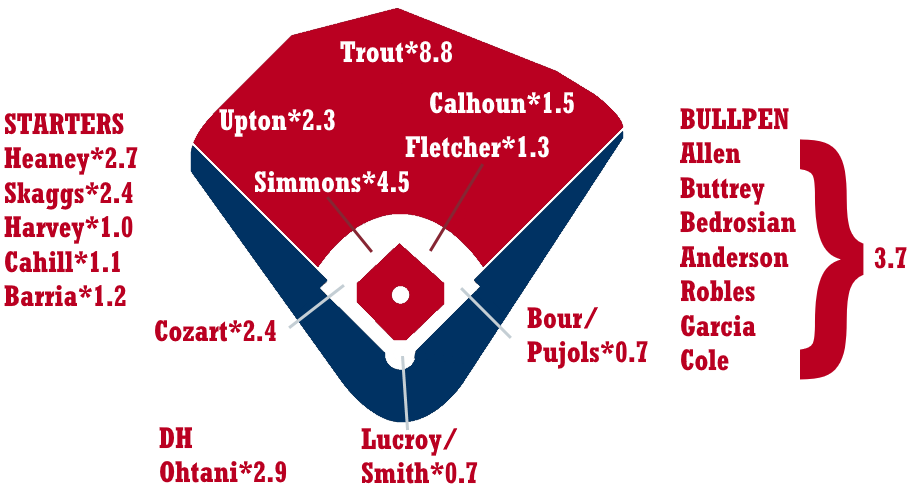
You may have heard of Mike Trout; he’s pretty good. I’m amazed that Andrelton Simmons still seems to be underrated by the media and fans. When was the last time a shortstop with a crazily hyped glove was underrated? You’d almost think that he was Adam Everett or Mark Belanger or Omar Vizquel when in fact he’d have been worth just under eight WAR over the last two seasons if he were a league-average defensive shortstop. Simmons has already snuck into the Top 50 all-time by my colleague Jay Jaffe’s JAWS metric, just a season from catching Dave Concepcion, Rafael Furcal, Vizquel, and the fringe Hall of Famer Rabbit Maranville. ZiPS projects Simmons to finish his career as the No. 14 shortstop by JAWS, just behind Derek Jeter and Barry Larkin, and just ahead of Bobby Wallace and Lou Boudreau. Andrelton is a superstar.

Albert Pujols is no longer a major league-caliber baseball player. He’s collected his 3000th hit and his 600th home run, but pretending that Pujols, at his best one of the greatest hitters of our generation, deserves a spot on the roster, let alone significant playing time, is becoming increasingly untenable. At some point, the Angels have to approach him with a plan to make as graceful and quick an exit from his playing career as they can manage, because in a world where the team was serious about fielding the best possible roster, they would be contemplating Pujols’ unconditional release. Even the creators of AfterMASH only needed two seasons to figure out they could only taint M*A*S*H’s legacy. The Angels have let three hitters go overseas this winter who project as more useful than Pujols (Jefry Marte, Jabari Blash, and the much-maligned Jose Miguel Fernandez).

I wouldn’t be quick to think of Shohei Ohtani’s offensive performance as fluky; in some ways, it’s just a natural power improvement from his previous year in Japan. ZiPS translated Ohtani’s final two seasons in Japan at .289/.356/.485, which looks a lot like his .285/.361/.564 with the Angels, with the power growth you hope to see from a talented young player with relatively few professional at-bats (he’s only at 1536 total now). ZiPS thinks he’ll have a lower average than in 2018, but he’s a real major league hitter.

Pitchers

If the Angels could keep all five of their starting pitchers healthy, the rotation would at least be acceptable. Problem is, essentially the entire rotation has an injury history, and many of its members have an extensive one. What’s frustrating about the Angels is that they have such highs in certain areas, but also several holes they’ve barely made a meaningful effort to go about fixing. ZiPS doesn’t see very high ceilings for any of the pitchers actually on the roster. If any team needed to go after Jake Arrieta last year or Dallas Keuchel this year, it’s the Angels. It would only take a few injuries for the Angels to have to turn to Dillon Peters or JC Ramirez (after he returns), which no contending team should be excited about.

Bench and Prospects

And here is why the Angels will fall short of the ZiPS seasonal simulation of the win total on their depth chart: the team’s plan B’s are absolutely atrocious around the field. The exceptions in the short-term are Jose Suarez and Griffin Canning, though I expect the Angels to give both a consolidation year at Triple-A (Suarez is still very young and Canning still has relatively little professional experience). Let’s put it this way: NRI Jarrett Parker is projected as the team’s fourth-best outfielder.

Things will get better. Jo Adell’s long-term projections are bananas, and the upside projections for Jahmai Jones and Brandon Marsh are at least…an apple? With a Brennon, two Brandons, and a Brendon in the projections, the Angels might as well sign Brennan Boesch to complete the set. The farm system has been steadily improving, but if the Angels want to stop wasting the prime of the best player they have ever had, and possibly will ever have, they really need to do better than dip a toe into free agency while they wait for the prospects to save them.

One pedantic note for 2019: for the WAR graphic, I’m using FanGraphs’ depth chart playing time, not the playing time ZiPS spits out, so there will be occasional differences in WAR totals.

Ballpark graphic courtesy Eephus League. Depth charts constructed by way of those listed here at site.

Batters – Counting Stats
Player B Age PO G AB R H 2B 3B HR RBI BB SO SB CS
Mike Trout R 27 CF 145 495 105 144 26 4 38 92 118 134 25 5
Andrelton Simmons R 29 SS 150 561 66 156 28 3 10 66 37 51 11 3
Shohei Ohtani L 24 DH 120 330 56 89 19 1 20 63 37 111 9 3
Justin Upton R 31 LF 141 518 76 122 23 1 28 85 61 180 9 3
Zack Cozart R 33 3B 90 339 48 84 17 3 11 36 31 62 2 1
Jabari Blash R 29 RF 112 352 55 76 16 1 22 59 46 147 5 4
Kole Calhoun L 31 RF 140 520 72 124 22 3 18 68 54 133 5 2
David Fletcher R 25 2B 128 520 57 132 25 4 5 44 25 65 10 3
Justin Bour L 31 1B 120 381 45 90 14 1 21 69 52 113 1 0
Jose Miguel Fernandez L 31 1B 114 416 51 108 19 0 12 47 30 52 2 2
Jonathan Lucroy R 33 C 120 413 43 102 18 2 7 46 32 69 1 0
Luis Rengifo B 22 SS 132 544 66 130 24 7 9 51 46 106 27 16
Jo Adell R 20 CF 99 408 50 89 19 3 16 52 23 140 11 4
Jarrett Parker L 30 LF 85 275 36 58 10 1 13 39 29 116 4 3
Wilfredo Tovar R 27 SS 116 399 40 95 16 1 5 32 22 62 14 7
Jefry Marte R 28 1B 106 319 41 73 15 1 14 45 25 77 4 2
Jose Briceno R 26 C 89 312 31 66 11 1 10 33 14 80 3 2
Zach Houchins R 26 3B 113 434 46 96 17 2 14 52 21 108 2 3
Kevan Smith R 31 C 84 289 30 73 12 0 5 31 15 49 0 0
Ben Revere L 31 LF 90 310 39 82 11 3 3 24 16 31 12 3
Taylor Ward R 25 3B 127 486 58 109 15 0 13 49 49 133 9 1
Ryan Schimpf L 31 2B 101 341 46 69 13 1 17 54 42 152 1 2
Cesar Puello R 28 LF 90 315 41 74 13 1 7 32 28 89 8 4
Dustin Garneau R 31 C 73 246 26 50 11 0 7 27 18 64 0 2
Julian Leon R 23 C 70 243 29 45 9 0 8 27 27 97 0 2
Tommy La Stella L 30 3B 104 195 21 47 9 0 3 19 19 34 0 1
Chris B. Young R 35 RF 75 181 24 38 8 1 7 19 18 50 2 1
Michael Hermosillo R 24 CF 104 382 46 82 16 3 10 38 31 125 11 8
Roberto Pena R 27 C 59 203 17 43 7 0 3 15 8 41 0 1
Peter Bourjos R 32 CF 118 290 33 63 12 5 5 25 16 79 3 4
Matt Thaiss L 24 1B 124 516 59 120 24 4 12 56 40 123 6 5
Albert Pujols R 39 1B 114 455 42 110 16 0 15 69 26 69 1 0
Sherman Johnson L 28 3B 104 363 40 70 15 2 6 31 41 112 7 3
Brennon Lund L 24 CF 106 441 47 100 15 3 6 37 31 126 16 5
Jared Walsh L 25 1B 119 456 53 98 25 1 16 56 34 164 1 1
Jahmai Jones R 21 2B 126 520 60 113 19 5 12 49 43 150 19 8
Eric Young Jr. B 34 CF 122 388 44 83 13 4 5 32 27 94 16 6
Bo Way L 27 CF 100 358 33 79 10 3 1 22 22 78 10 9
Stephen McGee R 28 C 55 170 19 30 7 0 4 15 23 70 0 0
Jose Rojas L 26 1B 110 426 45 96 18 2 11 45 23 112 6 5
Jack Kruger R 24 C 99 405 39 88 15 1 5 30 24 100 7 4
Brandon Marsh L 21 CF 119 499 56 103 19 4 11 49 44 191 10 5
Connor Justus R 24 SS 118 428 44 75 13 2 6 30 44 142 6 7
David MacKinnon R 24 1B 117 423 50 85 17 1 5 33 60 127 0 0
Roberto Baldoquin R 25 SS 81 302 24 60 7 2 2 20 15 92 4 5
Brandon Sandoval R 24 RF 101 383 37 85 10 2 3 24 25 105 14 10
Brendon Sanger L 25 RF 106 379 41 76 15 1 8 35 41 121 4 3


Batters – Rate Stats
Player PA BA OBP SLG OPS+ ISO BABIP RC/27 Def WAR No. 1 Comp
Mike Trout 628 .291 .433 .590 180 .299 .328 10.1 1 8.3 Willie Mays
Andrelton Simmons 608 .278 .325 .392 97 .114 .292 4.9 17 4.2 Luke Appling
Shohei Ohtani 370 .270 .343 .515 133 .245 .347 6.6 0 2.2 Carlos May
Justin Upton 588 .236 .321 .446 109 .210 .303 5.1 1 2.1 Bob Bailey
Zack Cozart 378 .248 .315 .413 99 .165 .274 4.7 3 1.5 Rick Schu
Jabari Blash 407 .216 .317 .455 110 .239 .295 4.9 1 1.5 Karl Pagel
Kole Calhoun 583 .238 .312 .396 94 .158 .287 4.4 5 1.4 Jacque Jones
David Fletcher 556 .254 .293 .346 76 .092 .282 3.8 7 1.2 Alberto Gonzalez
Justin Bour 437 .236 .327 .444 111 .207 .279 5.2 -2 1.1 Paul Sorrento
Jose Miguel Fernandez 453 .260 .316 .392 95 .132 .273 4.5 3 0.7 Jim Bowie
Jonathan Lucroy 455 .247 .304 .351 81 .104 .282 3.9 -2 0.7 Tony Pena
Luis Rengifo 601 .239 .306 .358 83 .119 .282 3.8 -6 0.6 D’Angelo Jimenez
Jo Adell 439 .218 .269 .397 81 .179 .290 3.8 0 0.5 Matt Kemp
Jarrett Parker 308 .211 .292 .396 88 .185 .308 3.9 2 0.4 Damon Mashore
Wilfredo Tovar 427 .238 .280 .321 66 .083 .271 3.2 4 0.3 Alex Prieto
Jefry Marte 351 .229 .293 .414 93 .185 .259 4.3 -1 0.3 Ricky Freeman
Jose Briceno 330 .212 .246 .349 62 .138 .252 2.9 4 0.3 Jim Horner
Zach Houchins 461 .221 .260 .366 71 .145 .263 3.2 5 0.2 Clay Bellinger
Kevan Smith 313 .253 .298 .346 78 .093 .289 3.7 -3 0.2 Joe Azcue
Ben Revere 330 .265 .301 .348 79 .084 .286 4.1 2 0.1 Tike Redman
Taylor Ward 543 .224 .299 .335 76 .111 .282 3.6 -4 0.0 Carlos Villalobos
Ryan Schimpf 391 .202 .297 .396 89 .194 .302 3.9 -9 0.0 Shanie Dugas
Cesar Puello 359 .235 .316 .349 84 .114 .306 3.9 -2 -0.1 Domingo Michel
Dustin Garneau 271 .203 .263 .333 64 .130 .246 2.8 0 -0.1 Chad Moeller
Julian Leon 280 .185 .282 .321 67 .136 .268 2.8 -2 -0.1 Nicholas Derba
Tommy La Stella 217 .241 .313 .333 80 .092 .278 3.6 -4 -0.2 Johnny Burnett
Chris B. Young 203 .210 .287 .381 83 .171 .250 3.7 -2 -0.2 Mike Devereaux
Michael Hermosillo 432 .215 .290 .351 76 .136 .291 3.4 -4 -0.2 Xavier Paul
Roberto Pena 216 .212 .248 .291 49 .079 .252 2.4 3 -0.2 Pedro Grifol
Peter Bourjos 312 .217 .265 .345 67 .128 .282 3.0 1 -0.2 Dewayne Wise
Matt Thaiss 564 .233 .291 .364 80 .132 .283 3.6 2 -0.4 Willie Upshaw
Albert Pujols 486 .242 .284 .376 81 .134 .256 3.8 0 -0.4 Ray Knight
Sherman Johnson 411 .193 .279 .295 59 .102 .261 2.8 0 -0.5 Mike Hickey
Brennon Lund 482 .227 .285 .315 66 .088 .304 3.3 -4 -0.5 Chris Duffy
Jared Walsh 498 .215 .272 .379 78 .164 .297 3.5 1 -0.5 Jay Kirkpatrick
Jahmai Jones 572 .217 .282 .342 72 .125 .282 3.4 -8 -0.6 Desi Relaford
Eric Young Jr. 425 .214 .271 .307 60 .093 .270 3.0 -1 -0.6 Calvin Murray
Bo Way 392 .221 .275 .274 53 .053 .280 2.4 4 -0.7 Anthony Iapoce
Stephen McGee 196 .176 .281 .288 58 .112 .271 2.7 -6 -0.7 Jeff Ontiveros
Jose Rojas 455 .225 .267 .354 70 .129 .281 3.2 4 -0.7 Larry Barnes
Jack Kruger 435 .217 .267 .296 56 .079 .277 2.7 -2 -0.7 Mike Knapp
Brandon Marsh 547 .206 .272 .327 65 .120 .310 3.0 -2 -0.7 Xavier Paul
Connor Justus 487 .175 .267 .257 46 .082 .246 2.1 3 -0.9 Niuman Romero
David MacKinnon 494 .201 .306 .281 65 .080 .275 2.9 -1 -1.1 Dustin Yount
Roberto Baldoquin 324 .199 .242 .255 38 .056 .279 1.9 1 -1.2 Jason Bowers
Brandon Sandoval 413 .222 .272 .282 54 .060 .298 2.5 2 -1.4 Brent Bish
Brendon Sanger 426 .201 .282 .309 64 .108 .272 2.9 -7 -1.7 Alex Miranda


Pitchers – Counting Stats
Player T Age W L ERA G GS IP H ER HR BB SO
Andrew Heaney L 28 10 8 3.95 28 28 161.7 163 71 23 38 148
Tyler Skaggs L 27 8 7 3.94 22 22 112.0 113 49 12 36 100
Jose Suarez L 21 5 5 4.18 26 26 116.3 110 54 16 46 115
Jaime Barria R 22 10 9 4.39 31 31 145.7 151 71 20 46 106
Griffin Canning R 23 8 7 4.33 23 23 114.3 111 55 14 47 99
Shohei Ohtani R 24 6 5 3.79 15 15 78.3 67 33 9 36 94
Cody Allen R 30 5 4 3.50 66 0 64.3 53 25 7 26 74
Trevor Cahill R 31 8 8 4.28 22 22 111.3 108 53 15 47 96
Matt Harvey R 30 7 8 4.56 27 24 132.3 144 67 21 30 101
Ty Buttrey R 26 3 3 3.88 49 2 67.3 61 29 6 32 71
John Lamb L 28 4 4 4.63 19 19 83.7 89 43 13 30 74
Patrick Sandoval L 22 5 6 4.75 24 19 102.3 103 54 16 45 90
Cam Bedrosian R 27 5 5 3.88 67 0 60.3 59 26 7 22 56
Alex Meyer R 29 4 4 4.43 16 11 63.0 59 31 7 34 62
Felix Pena R 29 5 6 4.73 24 22 123.7 129 65 20 45 112
Luis Garcia R 32 3 3 3.81 63 0 56.7 56 24 4 23 51
Dillon Peters L 26 7 9 4.74 24 22 117.7 133 62 16 38 77
Justin Anderson R 26 3 3 4.10 61 0 63.7 57 29 6 38 68
Taylor Cole R 29 3 3 4.19 53 0 73.0 68 34 10 33 73
Noe Ramirez R 29 5 5 4.19 61 0 73.0 68 34 11 28 77
Ivan Pineyro R 27 6 7 4.81 25 19 116.0 128 62 18 31 83
Joe Gatto R 24 6 8 5.00 25 25 113.3 123 63 10 67 67
Matt Ramsey R 29 3 2 4.08 39 1 46.3 44 21 5 20 45
Blake Wood R 33 3 3 3.95 52 0 54.7 53 24 5 24 52
Jim Johnson R 36 4 3 4.03 59 0 58.0 60 26 5 19 44
Hansel Robles R 28 4 4 4.17 63 0 69.0 65 32 9 31 67
Nick Tropeano R 28 5 7 4.98 17 17 86.7 92 48 16 35 74
John Curtiss R 26 3 3 4.30 48 0 60.7 56 29 7 31 60
JC Ramirez R 30 7 9 4.94 22 22 125.7 137 69 20 46 87
Dylan Unsworth R 26 5 7 5.07 22 16 103.0 120 58 18 21 59
Keynan Middleton R 25 2 2 4.24 50 0 51.0 49 24 7 22 51
Jeremy Rhoades R 26 6 7 4.52 52 0 71.7 77 36 10 22 52
Miguel Almonte R 26 3 4 5.25 32 9 58.3 61 34 9 30 49
Junichi Tazawa R 33 2 3 4.94 48 0 47.3 51 26 8 17 40
Deck McGuire R 30 6 8 5.22 31 19 110.3 116 64 20 48 90
Akeel Morris R 26 3 3 4.82 50 0 61.7 60 33 7 38 56
Luis Madero R 22 5 7 5.31 22 22 98.3 114 58 17 32 60
Jesus Castillo R 23 6 9 5.31 23 22 101.7 119 60 17 34 56
Ralston Cash R 27 4 6 4.92 46 0 64.0 64 35 9 36 60
Williams Jerez L 27 2 3 5.06 50 0 69.3 72 39 11 34 64
Zac Ryan R 25 4 5 4.95 40 0 63.7 64 35 6 44 50
Jake Jewell R 26 3 4 5.17 50 0 54.0 59 31 8 28 39
Daniel Procopio R 23 2 2 5.40 37 0 53.3 50 32 6 46 53
Forrest Snow R 30 5 8 5.69 27 17 104.3 119 66 24 35 82
Osmer Morales R 26 4 6 5.82 26 20 102.0 114 66 21 49 80
Luis Pena R 23 6 9 6.03 24 24 109.0 120 73 21 66 88
Ryan Clark R 25 4 7 6.39 39 7 76.0 90 54 18 37 58


Pitchers – Counting Stats
Player TBF K/9 BB/9 HR/9 BABIP ERA+ ERA- FIP WAR No. 1 Comp
Andrew Heaney 682 8.24 2.12 1.28 .300 105 95 4.00 2.5 Mark Redman
Tyler Skaggs 483 8.04 2.89 0.96 .307 106 95 3.88 1.7 Steve Trout
Jose Suarez 503 8.90 3.56 1.24 .294 100 100 4.30 1.5 Bill Pulsipher
Jaime Barria 630 6.55 2.84 1.24 .290 95 105 4.57 1.5 Don Welchel
Griffin Canning 504 7.79 3.70 1.10 .291 96 104 4.53 1.3 Walt Terrell
Shohei Ohtani 335 10.80 4.14 1.03 .299 106 94 3.70 1.2 Kerry Wood
Cody Allen 270 10.35 3.64 0.98 .286 119 84 3.57 1.1 Turk Wendell
Trevor Cahill 489 7.76 3.80 1.21 .288 94 106 4.66 1.1 Bob Buhl
Matt Harvey 566 6.87 2.04 1.43 .301 89 113 4.48 0.9 Josh Towers
Ty Buttrey 294 9.49 4.28 0.80 .302 107 93 3.76 0.8 Clay Bryant
John Lamb 367 7.96 3.23 1.40 .308 90 111 4.58 0.7 Trey Moore
Patrick Sandoval 454 7.92 3.96 1.41 .293 88 114 4.92 0.6 Bill Krueger
Cam Bedrosian 259 8.35 3.28 1.04 .301 107 93 3.95 0.6 Jim Acker
Alex Meyer 281 8.86 4.86 1.00 .297 94 106 4.39 0.6 Chris Oxspring
Felix Pena 542 8.15 3.27 1.46 .304 85 117 4.68 0.6 Dennis Burtt
Luis Garcia 246 8.10 3.65 0.64 .311 106 95 3.54 0.6 Kevin Gryboski
Dillon Peters 521 5.89 2.91 1.22 .305 85 118 4.73 0.5 Jeff Mutis
Justin Anderson 286 9.61 5.37 0.85 .300 102 98 4.22 0.5 Marc Pisciotta
Taylor Cole 320 9.00 4.07 1.23 .291 99 101 4.49 0.5 Ruddy Lugo
Noe Ramirez 315 9.49 3.45 1.36 .294 99 101 4.36 0.4 Jim Dougherty
Ivan Pineyro 505 6.44 2.41 1.40 .301 84 119 4.72 0.4 Steve Lemke
Joe Gatto 528 5.32 5.32 0.79 .300 83 120 5.07 0.4 Rick Berg
Matt Ramsey 202 8.74 3.88 0.97 .300 102 98 4.03 0.4 Gabriel Dehoyos
Blake Wood 239 8.56 3.95 0.82 .308 102 98 3.86 0.4 Roger McDowell
Jim Johnson 251 6.83 2.95 0.78 .304 100 100 3.84 0.4 Fred Gladding
Hansel Robles 301 8.74 4.04 1.17 .293 97 103 4.38 0.3 Ruddy Lugo
Nick Tropeano 384 7.68 3.63 1.66 .297 84 120 5.16 0.3 Mark Thompson
John Curtiss 269 8.90 4.60 1.04 .293 97 103 4.40 0.3 Terry Bross
JC Ramirez 556 6.23 3.29 1.43 .295 82 123 5.08 0.3 Dick Fowler
Dylan Unsworth 447 5.16 1.83 1.57 .297 82 122 5.03 0.3 Daniel Griffin
Keynan Middleton 223 9.00 3.88 1.24 .298 95 105 4.35 0.2 Wayne Nix
Jeremy Rhoades 312 6.53 2.76 1.26 .299 92 109 4.60 0.2 Mike Draper
Miguel Almonte 265 7.56 4.63 1.39 .299 79 126 5.17 -0.1 Regular Bob Gibson
Junichi Tazawa 208 7.61 3.23 1.52 .303 84 119 4.80 -0.1 Jason Childers
Deck McGuire 494 7.34 3.92 1.63 .292 77 129 5.37 -0.1 Michael Smith
Akeel Morris 282 8.17 5.55 1.02 .298 84 119 4.80 -0.2 Heathcliff Slocumb
Luis Madero 439 5.49 2.93 1.56 .299 76 132 5.34 -0.2 Matt O’Brien
Jesus Castillo 456 4.96 3.01 1.50 .297 76 132 5.40 -0.2 Matt O’Brien
Ralston Cash 291 8.44 5.06 1.27 .301 82 122 4.93 -0.2 Ryan Henderson
Williams Jerez 313 8.31 4.41 1.43 .305 82 122 5.01 -0.3 Jimmy Hamilton
Zac Ryan 298 7.07 6.22 0.85 .299 82 123 5.07 -0.3 Lloyd Allen
Jake Jewell 249 6.50 4.67 1.33 .300 81 124 5.41 -0.3 Sean Green
Daniel Procopio 255 8.94 7.76 1.01 .299 75 134 5.38 -0.5 Heathcliff Slocumb
Forrest Snow 465 7.07 3.02 2.07 .299 73 137 5.75 -0.5 Jason Roach
Osmer Morales 467 7.06 4.32 1.85 .299 71 140 5.88 -0.6 Jeff Schmidt
Luis Pena 511 7.27 5.45 1.73 .300 69 145 6.02 -0.9 Joel Santo
Ryan Clark 353 6.87 4.38 2.13 .305 63 159 6.32 -1.3 Phil Dumatrait


Disclaimer: ZiPS projections are computer-based projections of performance. Performances have not been allocated to predicted playing time in the majors — many of the players listed above are unlikely to play in the majors at all in 2019. ZiPS is projecting equivalent production — a .240 ZiPS projection may end up being .280 in AAA or .300 in AA, for example. Whether or not a player will play is one of many non-statistical factors one has to take into account when predicting the future.

Players are listed with their most recent teams, unless I have made a mistake. This is very possible, as a lot of minor-league signings go generally unreported in the offseason.

ZiPS’ projections are based on the American League having a 4.29 ERA and the National League having a 4.15 ERA.

Players who are expected to be out due to injury are still projected. More information is always better than less information, and a computer isn’t the tool that should project the injury status of, for example, a pitcher who has had Tommy John surgery.

Both hitters and pitchers are ranked by projected zWAR — which is to say, WAR values as calculated by me, Dan Szymborski, whose surname is spelled with a z. WAR values might differ slightly from those which appear in full release of ZiPS. Finally, I will advise anyone against — and might karate chop anyone guilty of — merely adding up WAR totals on a depth chart to produce projected team WAR.


2019 ZiPS Projections – Pittsburgh Pirates

After having typically appeared in the hallowed pages of Baseball Think Factory, Dan Szymborski’s ZiPS projections have now been released at FanGraphs for more than half a decade. The exercise continues this offseason. Below are the projections for the Pittsburgh Pirates.

Batters

The depth chart graphic for the Pirates (as seen below) pulls off a neat little trick. In this case, it manages to highlight both the strengths and weaknesses of the Pirates in one bite-sized scoop. Pittsburgh is excellent at finding just below average to average talent for peanuts, and average or better talent for whatever is a little bit better than that (perhaps Chex Mix?). It keeps the Pirates from ever truly returning to the Kingdom of Reekdom they reigned over from 1993 to about 2010. Having a roster Ryanfull of free one-win players, two-win players who are paid like one-win players, and three-win players who are paid like two-win players means you have a highly efficient roster. But it’s a highly efficient roster that will generally win between 77-85 games.

What the Pirates missed in their best days, and largely are missing today, was the willingness to add stars. The low payrolls of the rebuilding era never really gave way to short-term payroll ceilings well above the team’s long-term comfort levels. Everyone who has read me over the last five years knows I’m not a Royals apologist, but Kansas City did do this one thing much better than the Pirates did, even if the players Kansas City chose weren’t exactly my favorite. Chris Archer has star upside, but the Pirates had to trade players with star potential to bring him in. If the small market model doesn’t have a path to league-average payrolls, it necessitates an immense amount of success on the player development side. Sometimes, you just need to spend money instead of prospects.

There aren’t a lot of surprises in the hitting projections, but it is a very deep group. ZiPS has an amusing tendency with Pittsburgh to pick unnecessarily cruel, Pirates-related comps. Jung Ho Kang and Kevin Kramer are projected to be able to replace any injured Pirates infielders without the team losing a beat, and ZiPS remains a fan of Starling Marte over the long haul. This team may have the smallest gap between their ideal starting lineup and a starting lineup comprised of their Plan B’s of any team in baseball.

Pitchers

ZiPS is still optimistic about Chris Archer, but it’s now at the point where it expects him to fall short of his projected FIP. He’s only underperformed by 0.22 runs of ERA over his career, but ZiPS believes that given his defenses, he should have been over-performing his FIP, not falling short of it. The projections are increasingly optimistic about Trevor Williams, believing that he’ll continue to do better with home runs than most pitchers do with his hit profile. But it’s understandably not buying his .261 BABIP allowed in 2018 as near his actual ability.

Of the low-key reliever breakouts from 2018, ZiPS is a believer in Richard Rodriguez, a skeptic about Edgar Santana, and on the fence about ex-Giant Kyle Crick. The computer still does not understand why Michael Feliz isn’t much better at preventing the other team from scoring than his results to date have been.

Bench and Prospects

ZiPS uses a Total Zone-esque approach for minor-league defense, and it continues to back up the scouting reports for Ke’Bryan Hayes that rave about his defense. It doesn’t show up in the projections yet, but ZiPS sees a strong probability that Cole Tucker develops into a 10-12 home run hitter just as Royce Clayton, his top comp, did for awhile. Ryne Sandberg and Eric Young, Classic Edition, round out his top three. No, he doesn’t actually have a one-in-three chance of becoming a Hall of Famer. As sleepers go, the favorite of ZiPS may be Dario Agrazal, a well-built righty with a hard sinker but no real pitch that puts away batters (strikeouts are better than grounders). He’s not really on the prospect radar — the Pirates would not have snuck him off the 40-man roster if he were — but he does interest ZiPS and remains worth keeping an eye on. Groundball pitchers with hard sinkers who don’t strike guys out sometimes work out surprisingly well.

One pedantic note for 2019: for the WAR graphic, I’m using FanGraphs’ depth chart playing time, not the playing time ZiPS spits out, so there will be occasional differences in WAR totals.

Ballpark graphic courtesy Eephus League. Depth charts constructed by way of those listed here at site.

Batters – Counting Stats
Player B Age PO G AB R H 2B 3B HR RBI BB SO SB CS
Starling Marte R 30 CF 136 524 73 144 28 4 15 64 28 105 31 12
Corey Dickerson L 30 LF 141 522 65 148 36 5 18 61 26 100 5 3
Gregory Polanco L 27 RF 132 479 71 123 30 4 19 73 53 114 14 4
Adam Frazier L 27 2B 139 449 61 123 26 5 8 50 38 71 6 7
Jung Ho Kang R 32 3B 99 328 43 82 17 1 13 48 30 89 3 3
Josh Bell B 26 1B 150 525 74 138 28 5 17 76 71 107 3 5
Ke’Bryan Hayes R 22 3B 121 469 55 114 22 6 5 44 45 102 12 5
Colin Moran L 26 3B 126 429 52 113 20 2 13 59 36 98 0 2
Francisco Cervelli R 33 C 98 321 38 81 13 2 7 42 44 80 2 3
Kevin Newman R 25 SS 130 518 59 135 28 3 4 45 32 73 16 6
Kevin Kramer L 25 2B 131 485 58 119 25 4 10 54 36 130 9 5
Jose Osuna R 26 3B 137 431 56 111 31 2 12 58 29 87 3 3
Elias Diaz R 28 C 91 302 33 77 15 1 7 36 20 53 1 1
Cole Tucker B 22 SS 130 523 61 121 21 8 6 47 47 128 29 13
Josh Harrison R 31 2B 116 424 52 111 21 2 8 44 21 80 7 3
Lonnie Chisenhall L 30 RF 97 303 36 81 19 2 8 42 24 58 4 1
Jacob Stallings R 29 C 79 277 29 66 18 1 3 32 15 60 1 2
Jason Martin L 23 CF 130 490 59 120 25 6 13 56 38 130 10 11
Pablo Reyes R 25 LF 126 443 52 109 22 3 9 47 35 92 12 9
Erik Gonzalez R 27 2B 118 346 40 86 17 2 7 34 12 92 8 4
Arden Pabst R 24 C 67 238 24 54 10 1 5 23 13 56 1 2
Bryan Reynolds B 24 CF 99 390 47 89 18 4 8 42 32 106 3 2
Sean Rodriguez R 34 2B 97 211 28 42 8 1 8 25 23 79 2 1
Jared Oliva R 23 CF 106 409 47 91 16 5 5 36 30 112 21 9
Patrick Kivlehan R 29 RF 125 390 47 93 20 3 13 50 26 108 5 3
Wyatt Mathisen R 25 1B 99 322 38 75 15 2 7 34 31 83 2 2
Erich Weiss L 27 1B 102 348 38 80 17 4 6 36 27 92 4 2
Stephen Alemais R 24 2B 107 382 40 89 15 4 3 31 31 80 12 9
Will Craig R 24 1B 124 467 54 101 23 2 12 55 41 143 4 3
Steve Baron R 28 C 60 204 19 44 7 0 2 14 13 55 1 1
Daniel Nava B 36 LF 60 154 15 37 6 0 2 14 16 34 1 0
Christian Kelley R 25 C 90 320 31 68 11 1 4 26 24 84 0 3
Jackson Williams R 33 C 52 178 16 35 5 0 2 11 14 44 0 0
Jason Delay R 24 C 63 218 20 41 5 1 1 13 16 57 1 0
Eric Wood R 26 RF 106 361 45 80 19 3 11 48 31 111 5 2
JB Shuck L 32 LF 119 334 34 80 16 3 3 25 26 43 7 3
Logan Hill R 26 LF 106 381 43 76 14 2 13 46 34 151 3 4

Batters – Rate Stats
Player PA BA OBP SLG OPS+ ISO BABIP RC/27 Def WAR No. 1 Comp
Starling Marte 552 .275 .326 .429 102 .155 .319 5.4 5 3.2 Bake McBride
Corey Dickerson 548 .284 .320 .475 111 .192 .322 5.7 5 2.8 Garret Anderson
Gregory Polanco 532 .257 .331 .455 109 .198 .301 5.6 3 2.5 Troy O’Leary
Adam Frazier 487 .274 .335 .408 100 .134 .311 4.9 2 2.2 Joe Randa
Jung Ho Kang 358 .250 .332 .427 103 .177 .305 5.0 1 1.9 Steve Buechele
Josh Bell 596 .263 .349 .432 110 .170 .302 5.4 -3 1.8 Sid Bream
Ke’Bryan Hayes 514 .243 .311 .348 78 .104 .301 3.9 9 1.8 D’Angelo Jimenez
Colin Moran 465 .263 .321 .410 96 .147 .314 4.7 1 1.7 Scott Cooper
Francisco Cervelli 365 .252 .357 .371 97 .118 .316 4.6 -3 1.6 Al Lopez
Kevin Newman 550 .261 .307 .349 77 .089 .297 4.0 4 1.5 Freddy Sanchez
Kevin Kramer 521 .245 .303 .375 82 .130 .316 4.0 2 1.3 Ty Wigginton
Jose Osuna 460 .258 .306 .422 94 .165 .298 4.6 -3 1.2 Jeffrey Baisley
Elias Diaz 322 .255 .302 .381 83 .126 .289 4.1 1 1.1 Sandy Alomar
Cole Tucker 570 .231 .298 .337 71 .105 .296 3.6 3 1.1 Royce Clayton
Josh Harrison 445 .262 .309 .377 84 .116 .307 4.3 -1 1.0 Manny Trillo
Lonnie Chisenhall 327 .267 .324 .422 100 .155 .308 5.1 -1 0.9 Mike Brown
Jacob Stallings 292 .238 .282 .343 68 .105 .294 3.3 5 0.7 Mike DiFelice
Jason Martin 528 .245 .299 .400 87 .155 .308 4.0 -4 0.7 Daryl Boston
Pablo Reyes 478 .246 .302 .370 81 .124 .292 3.9 6 0.7 Reed Peters
Erik Gonzalez 358 .249 .277 .370 73 .121 .320 3.7 2 0.4 Pat Meares
Arden Pabst 251 .227 .268 .340 63 .113 .277 3.0 4 0.4 Joe Depastino
Bryan Reynolds 422 .228 .289 .356 73 .128 .293 3.6 0 0.3 Craig Cooper
Sean Rodriguez 234 .199 .289 .360 74 .161 .274 3.5 0 0.3 Dave Matranga
Jared Oliva 439 .222 .285 .323 64 .100 .295 3.3 3 0.2 Maiko Loyola
Patrick Kivlehan 416 .238 .293 .405 86 .167 .297 4.2 -3 0.2 Keith Williams
Wyatt Mathisen 353 .233 .311 .357 80 .124 .293 3.8 1 0.2 Chris Pritchett
Erich Weiss 375 .230 .289 .353 73 .124 .296 3.6 4 0.1 Johan Limonta
Stephen Alemais 413 .233 .291 .317 64 .084 .288 3.1 2 0.0 Brett Harrison
Will Craig 508 .216 .293 .351 73 .135 .285 3.5 3 -0.2 Julio Vinas
Steve Baron 217 .216 .269 .279 49 .064 .286 2.5 1 -0.2 Scott Sandusky
Daniel Nava 170 .240 .324 .318 75 .078 .297 3.7 -4 -0.4 Brian Jordan
Christian Kelley 344 .213 .278 .291 54 .078 .276 2.6 -1 -0.4 Jose Molina
Jackson Williams 192 .197 .258 .258 40 .062 .250 2.2 0 -0.4 Chad Moeller
Jason Delay 234 .188 .261 .234 36 .046 .250 2.1 1 -0.5 Brian Moon
Eric Wood 392 .222 .286 .382 79 .161 .289 3.8 -5 -0.5 Edgardo Baez
JB Shuck 360 .240 .294 .332 69 .093 .267 3.5 -6 -1.1 Doug Dascenzo
Logan Hill 415 .199 .275 .349 67 .150 .290 3.1 -5 -1.1 Jim Betzsold

Pitchers – Counting Stats
Player T Age W L ERA G GS IP H ER HR BB SO
Jameson Taillon R 27 11 9 3.53 30 30 173.3 168 68 21 33 154
Chris Archer R 30 10 8 3.72 30 30 169.3 162 70 19 53 185
Trevor Williams R 27 11 10 4.06 28 28 155.3 153 70 16 53 116
Joe Musgrove R 26 9 8 4.05 26 21 126.7 131 57 17 24 108
Felipe Vazquez L 27 4 2 2.89 71 0 71.7 58 23 5 26 88
Keone Kela R 26 5 3 2.82 54 0 51.0 38 16 4 19 67
Richard Rodriguez R 29 4 3 3.53 56 0 71.3 64 28 8 22 80
Chad Kuhl R 26 7 7 4.39 23 23 119.0 121 58 14 52 109
Mitch Keller R 23 7 8 4.59 25 25 129.3 132 66 16 59 104
Dario Agrazal R 24 5 6 4.45 18 17 91.0 106 45 12 17 49
Kyle Crick R 26 3 3 3.73 66 0 60.3 52 25 5 34 63
Steven Brault L 27 5 6 4.53 39 13 107.3 108 54 12 57 93
Blake Weiman L 23 3 3 3.84 38 0 61.0 63 26 7 11 49
Clay Holmes R 26 7 8 4.68 31 22 117.3 118 61 12 67 98
Michael Feliz R 26 3 3 4.22 56 0 59.7 56 28 8 26 70
Roberto Gomez R 29 4 5 4.76 32 9 75.7 82 40 10 28 57
Tyler Lyons L 31 2 2 4.22 44 0 53.3 52 25 8 17 54
Jordan Lyles R 28 4 5 4.72 39 11 93.3 99 49 13 31 75
Aaron Slegers R 26 7 9 5.11 22 21 116.3 133 66 19 32 69
Nick Kingham R 27 7 10 4.95 27 25 123.7 135 68 22 38 97
Brandon Waddell L 25 7 9 4.94 26 22 116.7 125 64 12 61 82
Geoff Hartlieb R 25 5 5 4.50 45 0 56.0 57 28 6 28 45
James Marvel R 25 7 10 5.17 25 24 134.0 154 77 17 52 76
Johnny Hellweg R 30 1 1 4.18 24 0 23.7 22 11 1 17 20
J.T. Brubaker R 25 6 9 5.02 26 26 132.7 148 74 19 54 96
Nick Burdi R 26 1 1 4.40 14 0 14.3 14 7 2 9 14
Edgar Santana R 27 3 3 4.55 62 0 65.3 69 33 10 18 54
Damien Magnifico R 28 3 4 4.82 45 3 61.7 59 33 4 49 51
Cam Vieaux L 25 7 10 5.34 23 23 121.3 141 72 19 45 76
Bo Schultz R 33 1 1 4.85 35 0 39.0 40 21 5 17 27
Brandon Maurer R 28 4 4 4.76 60 0 58.7 60 31 7 29 51
Scooter Hightower R 25 4 5 4.76 63 0 64.3 70 34 10 19 49
Eduardo Vera R 24 7 9 5.19 27 25 137.0 163 79 23 35 76
Dovydas Neverauskas R 26 2 3 4.92 59 0 67.7 66 37 9 40 67
Alex McRae R 26 6 9 5.28 27 21 124.3 145 73 17 52 79
Vicente Campos R 26 3 5 5.70 17 12 66.3 77 42 12 35 43
Luis Escobar R 23 6 10 5.64 24 23 113.3 119 71 15 80 90
Matt Eckelman R 25 3 5 5.96 37 2 51.3 58 34 9 29 37
Elvis Escobar L 24 2 4 5.93 37 0 54.7 55 36 7 50 51
Jesus Liranzo R 24 2 4 6.71 40 3 53.7 56 40 13 46 57


Pitchers – Rate Stats
Player TBF K/9 BB/9 HR/9 BABIP ERA+ ERA- FIP WAR No. 1 Comp
Jameson Taillon 715 8.00 1.71 1.09 .293 113 89 3.62 3.1 Brad Radke
Chris Archer 716 9.83 2.82 1.01 .314 110 91 3.43 3.0 Kevin Millwood
Trevor Williams 668 6.72 3.07 0.93 .288 98 102 4.17 1.8 John Denny
Joe Musgrove 533 7.67 1.71 1.21 .302 101 99 3.92 1.7 Dave Eiland
Felipe Vazquez 299 11.05 3.27 0.63 .301 138 73 2.86 1.6 Al Hrabosky
Keone Kela 208 11.82 3.35 0.71 .291 145 69 2.72 1.2 Troy Percival
Richard Rodriguez 299 10.09 2.78 1.01 .303 116 86 3.46 0.9 Rich Bordi
Chad Kuhl 527 8.24 3.93 1.06 .308 91 110 4.28 0.9 Todd Eggertsen
Mitch Keller 576 7.24 4.11 1.11 .297 87 115 4.68 0.7 Jim Clancy
Dario Agrazal 392 4.85 1.68 1.19 .303 89 112 4.48 0.7 Rick Wise
Kyle Crick 267 9.40 5.07 0.75 .292 107 94 4.03 0.6 Mark Acre
Steven Brault 486 7.80 4.78 1.01 .303 88 114 4.66 0.5 Brad Weis
Blake Weiman 255 7.23 1.62 1.03 .303 104 96 3.72 0.5 Chris Key
Clay Holmes 534 7.52 5.14 0.92 .302 85 118 4.68 0.5 Mike Torrez
Michael Feliz 259 10.56 3.92 1.21 .314 97 103 3.95 0.3 Glenn Dooner
Roberto Gomez 335 6.78 3.33 1.19 .305 86 116 4.63 0.3 Jeff Farnsworth
Tyler Lyons 228 9.11 2.87 1.35 .301 94 106 4.20 0.2 Brian Shouse
Jordan Lyles 408 7.23 2.99 1.25 .303 84 119 4.51 0.2 Bert Bradley
Aaron Slegers 510 5.34 2.48 1.47 .297 80 124 5.07 0.2 Dave Eiland
Nick Kingham 542 7.06 2.77 1.60 .299 80 124 4.99 0.2 Jared Gothreaux
Brandon Waddell 533 6.33 4.71 0.93 .304 81 124 4.80 0.2 Greg Kubes
Geoff Hartlieb 253 7.23 4.50 0.96 .300 91 110 4.65 0.1 Joe Davenport
James Marvel 605 5.10 3.49 1.14 .303 79 126 5.01 0.1 Jake Joseph
Johnny Hellweg 109 7.61 6.46 0.38 .300 95 105 4.29 0.1 Ted Abernathy
J.T. Brubaker 598 6.51 3.66 1.29 .306 79 126 4.97 0.1 Jake Joseph
Nick Burdi 66 8.79 5.65 1.26 .300 93 107 5.10 0.0 Jeff Smith
Edgar Santana 282 7.44 2.48 1.38 .301 88 114 4.50 0.0 Jeff Tam
Damien Magnifico 292 7.44 7.15 0.58 .299 83 121 4.92 -0.1 Hal Reniff
Cam Vieaux 547 5.64 3.34 1.41 .305 77 130 5.22 -0.1 Jason Cromer
Bo Schultz 172 6.23 3.92 1.15 .287 82 122 4.82 -0.1 Milo Candini
Brandon Maurer 263 7.82 4.45 1.07 .305 84 120 4.55 -0.2 Jose Segura
Scooter Hightower 281 6.85 2.66 1.40 .302 84 120 4.72 -0.2 Ken Clay
Eduardo Vera 606 4.99 2.30 1.51 .302 77 130 5.16 -0.2 Heath Totten
Dovydas Neverauskas 307 8.91 5.32 1.20 .303 81 124 4.81 -0.3 Heathcliff Slocumb
Alex McRae 568 5.72 3.76 1.23 .311 75 133 5.10 -0.3 Matt Achilles
Vicente Campos 309 5.83 4.75 1.63 .301 72 139 5.92 -0.4 Kevin Hodges
Luis Escobar 538 7.15 6.35 1.19 .301 71 142 5.59 -0.7 Edwin Morel
Matt Eckelman 240 6.49 5.08 1.58 .302 67 150 5.86 -0.8 Sean Green
Elvis Escobar 269 8.40 8.23 1.15 .306 67 149 5.91 -0.9 Steve Rosenberg
Jesus Liranzo 262 9.56 7.71 2.18 .301 59 169 6.91 -1.3 Wilson Guzman


Disclaimer: ZiPS projections are computer-based projections of performance. Performances have not been allocated to predicted playing time in the majors — many of the players listed above are unlikely to play in the majors at all in 2019. ZiPS is projecting equivalent production — a .240 ZiPS projection may end up being .280 in AAA or .300 in AA, for example. Whether or not a player will play is one of many non-statistical factors one has to take into account when predicting the future.

Players are listed with their most recent teams, unless I have made a mistake. This is very possible, as a lot of minor-league signings go generally unreported in the offseason.

ZiPS’ projections are based on the American League having a 4.29 ERA and the National League having a 4.15 ERA.

Players who are expected to be out due to injury are still projected. More information is always better than less information, and a computer isn’t the tool that should project the injury status of, for example, a pitcher who has had Tommy John surgery.

Both hitters and pitchers are ranked by projected zWAR — which is to say, WAR values as calculated by me, Dan Szymborski, whose surname is spelled with a z. WAR values might differ slightly from those which appear in full release of ZiPS. Finally, I will advise anyone against — and might karate chop anyone guilty of — merely adding up WAR totals on a depth chart to produce projected team WAR.


Sunday Notes: Payton Henry Pins His Hopes on Brewers Catching Job

Payton Henry grew up in a wrestling family in a wrestling town. That’s not the sport he settled on. The 21-year-old native of Pleasant Grove, Utah cast his lot with baseball, and went on to be selected in the sixth round of the 2016 draft by the Milwaukee Brewers. He’s seen by many as the NL Central club’s catcher of the future.

His backstory is one of Greco-Roman lineage. Henry’s paternal grandfather, Darold, won 10 state championships as a coach, and is a member of Utah’s Wrestling Hall of Fame. The patriarch coached 65 individual champions, including his son Darrin — Payton’s father — who captured a pair of titles. And while it eventually rolled away, the greenest of the apples tumbled from the same tree.

“I was kind of born to grow up a wrestler,” said Henry. “But then I fell in love with baseball. Once I realized I had a future in it, and started traveling a lot for baseball tournaments, I stopped wrestling. I didn’t have the time for it anymore.”

Being physically strong — weight training has long been part of his workout routine — and well-schooled in the sport’s technical aspects, he probably could have followed in his father’s footsteps. The coaches at Pleasant Grove High School certainly thought so. At the start of each year they would approach him and say,“Are you sure you don’t want to come out and wrestle?” Read the rest of this entry »


Top 38 Prospects: New York Yankees

Below is an analysis of the prospects in the farm system of the New York Yankees. Scouting reports are compiled with information provided by industry sources as well as from our own (both Eric Longenhagen’s and Kiley McDaniel’s) observations. For more information on the 20-80 scouting scale by which all of our prospect content is governed you can click here. For further explanation of the merits and drawbacks of Future Value, read this.

All of the numbered prospects here also appear on The Board, a new feature at the site that offers sortable scouting information for every organization. That can be found here.

Yankees Top Prospects
Rk Name Age Highest Level Position ETA FV
1 Estevan Florial 21.2 A+ CF 2020 50
2 Jonathan Loaisiga 24.2 MLB RHP 2018 45+
3 Deivi Garcia 19.7 AA RHP 2021 45+
4 Antonio Cabello 18.3 R CF 2023 45+
5 Roansy Contreras 19.2 A RHP 2022 45
6 Albert Abreu 23.3 AA RHP 2019 45
7 Everson Pereira 17.8 R CF 2023 45
8 Anthony Seigler 19.6 R C 2022 45
9 Luis Gil 20.7 A- RHP 2021 45
10 Clarke Schmidt 22.9 A- RHP 2020 45
11 Luis Medina 19.7 R RHP 2022 45
12 Kevin Alcantara 16.6 None CF 2024 40+
13 Trevor Stephan 23.2 AA RHP 2019 40+
14 Osiel Rodriguez 17.2 None RHP 2022 40+
15 Nick Nelson 23.2 AA RHP 2020 40
16 Raimfer Salinas 18.1 R CF 2023 40
17 Anthony Garcia 18.4 R RF 2023 40
18 Alexander Vargas 17.3 None SS 2024 40
19 Josh Breaux 21.3 A- C 2021 40
20 Ryder Green 18.7 R RF 2023 40
21 Josh Stowers 21.9 A- CF 2021 40
22 Oswaldo Cabrera 19.9 A 2B 2021 40
23 Antonio Gomez 17.2 None C 2024 40
24 Ezequiel Duran 19.7 R 2B 2022 40
25 Matt Sauer 20.0 A- RHP 2021 40
26 Thairo Estrada 22.9 AAA SS 2019 40
27 Garrett Whitlock 22.6 AA RHP 2020 40
28 Pablo Olivares 21.0 A+ CF 2021 40
29 Michael King 23.7 AAA RHP 2019 40
30 Yoendrys Gomez 19.3 R RHP 2022 40
31 Juan Then 19.0 R RHP 2022 40
32 Frank German 21.4 A- RHP 2021 40
33 Freicer Perez 22.9 A+ RHP 2021 40
34 Oswald Peraza 18.6 R SS 2022 35+
35 Roberto Chirinos 18.4 R SS 2022 35+
36 Ronny Rojas 17.4 R 2B 2022 35+
37 Angel Rojas 18.2 R SS 2023 35+
38 Dermis Garcia 21.1 A 1B 2021 35+
Reading Options
Detail Level
Data Only
Full
Position Filter
All

50 FV Prospects

Signed: July 2nd Period, 2014 from Haiti (NYY)
Age 21.2 Height 6′ 1″ Weight 185 Bat / Thr L / R FV 50
Tool Grades (Present/Future)
Hit Raw Power Game Power Run Fielding Throw
30/40 60/60 30/55 60/60 45/50 80/80

Even those casually exposed to public facing prospect analysis become familiar with a few key concepts and player archetypes, and an early lesson often addresses the volatility of players like Florial, who have several elite tools that will lead to star-level performance if they hit enough, but who also carry significant risk that they will strike out too much to matter at all. Of course, the reason each individual player has strikeout issues can vary. Some hitters have feckless, over-aggressive approaches, while others can’t recognize breaking balls or have a problem with lever length and get tied up inside. Florial’s issues — his strikeout rate has fallen between 27% and 32% each of the last three years — appear to stem from his bat path and limited bat control. Stiff wrists cause his bat head to drag into the zone, which can cause him to be tardy on fastballs at the letters and, more frequently, flail at soft stuff dipping down and away from him. Yoan Moncada has similar issues that have yet to be remedied.

Florial does enough other stuff that, even if the strike outs remain an issue, he could still be a valuable big leaguer. He crushes anything down and in, has sufficient plate coverage to hit fastballs middle away, and has enough power to do damage to the opposite field. He also has good ball/strike recognition so, again like Moncada, there should be power, walks, and up-the-middle defense. We think Florial is likely to be an exciting but flawed everyday player, though it’s not audacious to think his relative youth (he was a 20-year-old at Hi-A in 2018) and inexperience (he also missed a year of reps due to a suspension for bad paperwork) leave more room for growth than we anticipate.

45+ FV Prospects

Signed: July 2nd Period, 2012 from Nicaragua (NYY)
Age 24.2 Height 5′ 11″ Weight 165 Bat / Thr R / R FV 45+
Tool Grades (Present/Future)
Fastball Slider Changeup Command Sits/Tops
60/60 60/65 50/55 50/55 93-97 / 98

If evaluating purely on stuff, Loaisiga belongs in the overall Top 100 pretty easily. He holds 94-97 for six innings, his upper-80s slider with vertical break is reminiscent of early-career Brad Lidge, and he has somehow found changeup feel and command despite few career in-game reps. But while Loaisiga has mid-rotation, big league stuff, his career has been beset by constant, often severe, injury. Since entering pro ball in 2013, Loaisiga has only thrown about 200 career innings due to repeated injury and rehab, and his 68 innings pitched for the DSL Giants during his first pro campaign remain his single-season high. He missed all of 2014 with injury, then was released, and out of pro baseball for all of 2015. The Yankees unearthed him during the 2016 23U World Championships in Venezuela and after a frantic late-night call from scout Ricardo Finol, signed Loaisiga immediately. Just two innings into his first 2016 start, Loaisiga’s velocity dropped into the mid-80s and he left the mound pointing at his elbow. He rehabbed quickly enough that he was able to make 11 short starts with Staten Island the following year.

Because Loaisiga signed in 2012, he would have been Rule 5 eligible in the winter of 2017. The Yankees added him to the 40-man even though he had never completed a healthy start in full-season ball. In 2018, Loaisiga ascended quickly and showed flashes of brilliance against big league hitters, but he also made two more trips to the disabled list, including a late-season stint due to shoulder inflammation. Shoulder issues have sidelined Loaisiga pretty frequently during his career, and while he may have some years where he peaks in the 3-4 WAR range, we also think he’ll have some years where he barely pitches, or that he may just move to the bullpen.

Signed: July 2nd Period, 2015 from Dominican Republic (NYY)
Age 19.7 Height 5′ 10″ Weight 163 Bat / Thr R / R FV 45+
Tool Grades (Present/Future)
Fastball Curveball Changeup Command Sits/Tops
55/55 60/65 40/50 45/50 91-95 / 96

At this time last year, Garcia was a 40 FV and an interesting prospect to monitor. He was a slightly-built, shorter righty with a knockout fastball/curveball combination, who was moved very quickly as Garcia saw 2017 action in the DSL, GCL, and Appy league levels at age 18. We were eager to see if he could continue to perform like that in full-season ball as a 19-year-old and boy, did he. Garcia had an xFIP under 3.00 at each of his three stops last year: eight Low-A starts, five in Hi-A (one of which is the linked video), and one in Double-A. Garcia’s changeup and command both ended up playing better than we expected, with his changeup regularly flashing average to above — confirming he has starter’s stuff — and his command sufficient to deal with A-ball hitters. The concerns about his durability tied to his stature are still there. He’s 5-foot-10 and anywhere from 163 to 175 pounds. He threw 74.0 innings last year and even scouts who love Garcia concede he may not be a 170 to 200-inning type of arm. Instead, he may be in the Rich Hill or Lance McCullers Jr. mold, where you’ll get 125 – 135 innings and hopefully have him healthy enough to fill whatever role fits the staff best in the playoffs. Hill and McCullers are 55 or 60 FV types, so that’s likely Garcia’s upside if things break right.

Garcia is a very good athlete, which is what allows him to repeat his delivery, throw so many strikes, and have at least average command despite a delivery that has crossfire, recoil, and effort at release. We’re hesitant to knock Garcia’s delivery simply because it’s unusual, or due to his size, because his performance at this age has also been remarkable. He has a rising fastball with which he operates up in the zone, and he knows exactly how to use his high spin curveball, which has been over 3000 rpm at times. A well-located fastball up, a high-spin curveball down, and a changeup down to keep hitters honest is a good combo, and Garcia knows how to use them in sequence to set up hitters. There’s some question about his approach being too simplistic to work at the big league level, but again, we would bet on Garcia figuring out how to make it work. He’ll open 2019 in Double-A and could be good enough to crack the Bombers bullpen late in the season.

Signed: July 2nd Period, 2017 from Venezuela (NYY)
Age 18.3 Height 5′ 10″ Weight 160 Bat / Thr R / R FV 45+
Tool Grades (Present/Future)
Hit Raw Power Game Power Run Fielding Throw
25/55 55/55 30/50 65/60 45/50 55/55

Cabello was in the Others of Note section on this list last year, third amongst the 2017 July 2nd signees, none of whom had played a pro game at the time. But Cabello had the strongest 2018 of the group, and he arguably already had the loudest tools. He was one of the best performing amateur hitters from Venezuela in his signing class (just ahead of Everson Pereira, who’s further down this list), and he was also a plus runner who could’ve been converted to catcher given his quickness, arm strength, and squatty, powerful frame. But the Yankees didn’t want to slow down his bat by asking him to learn to catch. Some scouts who had a one or two game look at this summer didn’t love Cabello’s non-projectable frame, and they rounded down if he didn’t hit in those short looks. But those who saw him for more than a few games saw the advanced bat amateur scouts saw.

One enthusiastic scout described Cabello’s running as plus, though he’s not the typically graceful, long striding plus runner. That scout he said had a “grinding gait, full effort, kicking up grass as he runs like the rooster tail of a speed boat.” In addition to potential plus hit and run tools, there’s above-average arm strength and raw power, and now the start of a strong statistical performance record. And if things go askew at the plate, the notion that Cabello could catch is interesting. One Yankee source described him as an 80 makeup guy, often a prerequisite to consider sending a player behind the plate. He’s a well-rounded offensive player who looks like an up-the-middle defensive fit of some kind. He may be a top 100 prospect by mid season.

45 FV Prospects

Signed: July 2nd Period, 2016 from Dominican Republic (NYY)
Age 19.2 Height 6′ 0″ Weight 175 Bat / Thr R / R FV 45
Tool Grades (Present/Future)
Fastball Curveball Changeup Command Sits/Tops
60/60 55/60 40/50 35/45 92-96 / 97

Many of the teenage prospects on this list received big bonuses or were flagged after a season in the DSL as a prospect to watch; it’s unsurprising when those types move up this list. Contreras wasn’t one of those. He didn’t appear on last year’s list, which had 65 players in total — he wasn’t even in the Others of Note section. Contreras sat 90-92 mph with a curveball that flashed above average, but was still in the early stages of knowing how to use those weapons while pitching in the DSL and GCL in 2017. We first heard his name when he was wowing pro scouts who saw him in Staten Island last summer. The first scout we spoke with said Contreras had a Luis Severino starter kit, flashing two plus pitches and a starter’s delivery, though the changeup and command were understandably a bit behind. Those things progressed throughout the summer and he got a taste of Low-A at the end of the year. Yankees officials love Contreras’ makeup and competitive fire, and think he’s got a chance to be the 200-inning starter who comes out of this system, as the other pitchers on the list have one or more of the typical concerns (durability, command, arm surgery, less experience, or a standout pitch that fits best in relief). Contreras could grab a spot in next year’s Top 100 with a full healthy season of performance like his breakout 2018 campaign.

Signed: July 2nd Period, 2013 from Dominican Republic (HOU)
Age 23.3 Height 6′ 2″ Weight 175 Bat / Thr R / R FV 45
Tool Grades (Present/Future)
Fastball Slider Curveball Changeup Command Sits/Tops
65/65 55/60 55/60 55/60 40/45 95-99 / 101

A February appendectomy began Abreu’s roller coaster of a 2018, a fitting campaign for one of the more frustrating pitching prospects in baseball. Abreu, who was acquired from Houston as part of the Brian McCann deal, will regularly touch 101 with his fastball and has plus secondary stuff across the board. Career-long issues with strike-throwing, coupled with two consecutive years of multiple DL stints, continue to funnel Abreu toward a bullpen role despite the depth of his repertoire. The appendicitis set back Abreu’s spring preparation and he was DL’d for most of April while he caught up. He felt elbow discomfort at the end of June (he had elbow and shoulder issues in 2017, too), missed a month, made some nightmarish rehab starts in the GCL, then bounced back and had his usual stuff late in the year. While we believe it’s increasingly likely that Abreu eventually winds up in relief, he has the stuff to work in a multi-inning, Josh Hader-like role in that scenario, and could become one of the top 20 or 30 relievers in the game. He may see his first big league action in 2019 but we don’t expect he’ll be up for good until 2020.

Signed: July 2nd Period, 2017 from Venezuela (NYY)
Age 17.8 Height 6′ 0″ Weight 190 Bat / Thr R / R FV 45
Tool Grades (Present/Future)
Hit Raw Power Game Power Run Fielding Throw
25/55 45/50 20/45 55/55 45/55 55/55

Pereira was probably the least exciting of the top three prospects from the Yankees 2017 July 2nd haul, behind Raimfer Salinas and Antonio Cabello. Pereira falls into the bucket of heady, up-the-middle Venezuelan players with solid tools to go along with excellent in-game amateur performance. He is an above-average runner with an above-average arm and plus center field instincts, which makes him an above-average defender there. He’ll likely grow into average raw power, but below-average game power due to a more gap-to-gap approach. Pereira has advanced feel to hit and held his own despite a higher strike out rate than expected in Pulaski as a 17-year-old, underlining the Yankees’ confidence in his ability to make adjustments. The reasonable upside is a 2-3 WAR, solid regular in center field, which may not excite Yankees fans but would be an amazing return on his $1.5 million bonus.

Drafted: 1st Round, 2018 from Cartersville HS (GA) (NYY)
Age 19.6 Height 6′ 0″ Weight 190 Bat / Thr S / S FV 45
Tool Grades (Present/Future)
Hit Raw Power Game Power Run Fielding Throw
25/55 45/50 20/50 50/45 50/55 65/65

Entering summer showcase season, Seigler was known as something of an oddity: a switch-hitting, switch-throwing catcher who was also an ambidextrous reliever when needed. As the summer wore on, Seigler grew on scouts, was chosen as the backup catcher for Team USA, and quickly took the starting job from eventual Marlins second rounder Will Banfield. Seigler was able to do this (and eventually become a first round pick) due to his innate present feel for contact at the plate and receiving behind it. In addition to solid contact skills, Seigler also started to lift the ball in games closer to the draft and get to all of his fringy raw power. This polish helped to make teams less worried about his advanced age relative to his prep peers, and some scouts thought he was among the top 5-10 players in the entire draft.

Seigler had a solid pro debut that was in line with the expectations of any of the pro scouts we talked to who watched the Yankees’ GCL club. He’s an average runner and an above-average athlete for the position, projecting as an above-average defender with a 65-grade arm. Some clubs don’t like the recent track record of prep catchers and considered taking Seigler and then moving him to third base, but his feel for catching is too advanced to throw away. There are some similarities to another prep catcher from the prior draft: M.J. Melendez of the Royals. Melendez is a little twitchier while Seigler is a little more advanced in terms of skills. Seigler’s mother is Navajo and he would be the first Native American big leaguer to debut since Joba Chamberlain and the second ever from the Navajo Nation, joining Jacoby Ellsbury.

9. Luis Gil, RHP
Signed: July 2nd Period, 2014 from Dominican Republic (MIN)
Age 20.7 Height 6′ 3″ Weight 175 Bat / Thr R / R FV 45
Tool Grades (Present/Future)
Fastball Slider Curveball Changeup Command Sits/Tops
60/70 50/60 45/50 40/50 40/50 93-97 / 100

The effortless grace with which Gil generates upper-90s velocity is absurd. Even more absurd is that the Yankees were able to pilfer a perfectly-built teenager with this kind of arm strength from Minnesota in exchange for a recently DFA’d Jake Cave. Perhaps it’s because, despite the comical ease of his delivery, Gil is extremely wild. Scouts often project heavily on the command of athletic pitchers, as well as pitchers with with good deliveries; those traits often go hand in hand. But the aesthetic pleasure one derives from Gil’s velvety mechanics is subverted by release inconsistency, a dichotomy also displayed by frustrating Dodgers prospect Yadier Alvarez throughout his young career. It also might simply be unreasonable to expect an inexperienced 20-year-old with this kind of velocity to have any idea where it’s going. Gil missed all of 2016 due to a shoulder surgery and has thrown just over 100 career innings. His secondary stuff is not as visually explosive as his fastball, but there’s plus-plus pure spin here, and Gil is in an org adept at altering deliveries to help enable their guys’ secondary stuff. Many players ranked below Gil in this system have a much better chance of reaching the majors than he does, but very few have the ceiling he has if his issues are resolved.

Drafted: 1st Round, 2017 from South Carolina (NYY)
Age 22.9 Height 6′ 1″ Weight 205 Bat / Thr R / R FV 45
Tool Grades (Present/Future)
Fastball Slider Curveball Changeup Command Sits/Tops
50/55 55/55 50/55 45/55 40/50 91-94 / 96

In 2017, Schmidt turned a corner in his draft spring for South Carolina and looked likely to land in the middle of the first round, flashing four above average pitches and starter command for a No. 3 to 4 starter profile. His elbow blew out before the draft, and he had Tommy John surgery a month before the Yankees eventually took him in the middle of the first round, though for nearly $1.5 million below slot. Schmidt came back in 2018 from his surgery and essentially picked right up where he left off, hitting 96 mph and showing the same stuff as before, though it understandably was not quite as consistent. Schmidt was almost sent to the Arizona Fall league to rack up innings but instead will make his full season debut in 2019, likely starting in Hi-A and probably getting some time at Double-A, with a chance for a big league debut in 2020 if all goes to plan.

11. Luis Medina, RHP
Signed: July 2nd Period, 2015 from Dominican Republic (NYY)
Age 19.7 Height 6′ 1″ Weight 175 Bat / Thr R / R FV 45
Tool Grades (Present/Future)
Fastball Curveball Changeup Command Sits/Tops
60/65 55/65 45/55 30/40 95-97 / 101

Medina was up to 96 mph as an 15-year-old amateur, eventually going unsigned on July 2nd due in part to 20 command. Then he hit 100 mph as an amateur with improved feel, which is when the Yankee scooped him up for $300,000. He was the highest variance player on last year’s version of this list and is once again. The pure stuff hasn’t change and it’s top of the line: a 95-97 mph heater that has hit 101 mph, a power curveball that’s anywhere from 60 to 70 depending on the day, and a changeup that flashes 55 or 60 at its best. His command is now a 30 that we project to be a 40. But he’s still a teenager, so there’s a chance that things click for him and he finds 45 command and 50 control, which would be the minimum to stick as a starter with this kind of stuff. Medina’s issues aren’t physical — his delivery is fine and his arm stroke is clean. Instead, the problem appears to be mostly mental. He’ll throw well in the bullpen only to have things will snowball for him in game situations. One source described his issues as stemming from a need for greater mental maturity and to not be so hard on himself, which are exactly the kinds of traits that come with general social maturity. That said, this sort of stuff rarely comes with starter command, so Medina is probably either a high-wire act reliever with bonkers stuff or a starter with the stuff ratcheted down a bit, similar to what Touki Toussaint has done the last couple seasons.

40+ FV Prospects

Signed: July 2nd Period, 2018 from Dominican Republic (NYY)
Age 16.6 Height 6′ 5″ Weight 175 Bat / Thr R / R FV 40+
Tool Grades (Present/Future)
Hit Raw Power Game Power Run Fielding Throw
20/50 50/60 20/55 60/55 45/55 55/55

We ranked Alcantara fourth among the 2018 international amateurs because he has some of the group’s more advanced in-game feel to hit, he has a really good chance of not only staying in center field but might also be great there, and he has the best physical projection in the entire class. The more recently a source has seen Alcantara, the nuttier the reports get. Now that he has access to pro-quality athletic facilities, he’s already put on some good weight and has been hitting for more power during batting practice in the Dominican Republic. At one point he hit several BP homers, not just over the outfield fence, but over the fence that encloses the complex itself.

Built like Lewis Brinson and Cody Bellinger were at the same age, Alcantara has better feel for contact than either of them did as teens. Hitters this size often struggle with strikeouts due to lever length, and while Alcantara hasn’t faced much pro quality velocity to stress test this aspect of his offense, there are no early indications that strikeouts are going to be an issue for him. It may take physical maturation and little else to enable a breakout, and the comps industry personnel are placing on Alcantara (Devon White, Dexter Fowler, and Alex Rios to name a few) are very strong. It will be interesting to see how the Yankees handle his 2019 assignment, as it sounds like his skillset is ready for the GCL but it may behoove the team to leave him in the less-scouted DSL as a way of hiding him from clubs who don’t scout pro ball there.

Drafted: 3rd Round, 2017 from Arkansas (NYY)
Age 23.2 Height 6′ 4″ Weight 210 Bat / Thr R / R FV 40+
Tool Grades (Present/Future)
Fastball Slider Changeup Command Sits/Tops
60/60 55/60 40/45 40/50 91-95 / 96

Stephan’s cross-bodied delivery compares closely to that of Brewers righty Freddy Peralta, as both get way down the mound (Stephan gets nearly 7 feet of extension on his fastballs) and have lower arm slots that make right-handed hitters very uncomfortable. He makes heavy use of a hard slider that at times looks like a cutter. It has enough movement to miss bats if Stephan leaves it in the zone and he’s been able to back foot it to lefties. Changeup development is paramount, and a fair number of scouts think Stephan ends up in the bullpen both because his change is quite a bit behind the typical 23-year-old’s and because he throws exclusively from the stretch. While that’s a possibility, the way Stephan’s delivery enables his stuff to play up could make him viable in a multi-inning role. He reached Double-A in 2018 and has a chance to debut in 2019.

14. Osiel Rodriguez, RHP
Signed: July 2nd Period, 2018 from Cuba (NYY)
Age 17.2 Height 6′ 3″ Weight 205 Bat / Thr R / R FV 40+
Tool Grades (Present/Future)
Fastball Slider Curveball Changeup Command Sits/Tops
60/60 45/55 50/60 45/55 35/50 91-95 / 97

For a 16-year-old, high bonus pitcher, Rodriguez was a rarity in a number of ways. Since he defected from Cuba, he had a pretty long track record of high-level international competition. He pitched as a 14-year-old for the 15-and-under Cuban team, and posted a 69 IP, 32 H, 2 XBH, 20 BB, 102 K line. Then, at 15 years old, he pitched for the 18-and-under team and posted a 21 IP, 16 H, 4 BB, 25 K line. He also struck out five of the six batters he faced in the MLB showcase in February, which is the linked video. On top of that, Rodriguez flashes four above average to plus pitches, has hit 97 mph, and has starter-caliber feel to pitch. He’s also 6-foot-3 and 205 pounds, and has some room to add muscle. If you’re looking for things to nitpick, there’s some effort to his delivery that should be ironed out, and he does vary his arm slot, though it’s by choice. The Yankees will try to limit him to two breaking balls and one slot, but recognize that Rodriguez could be one of those rare pitchers like El Duque who can be effective throwing the kitchen sink from a half dozen different arm slots. Going back to what’s rare about Rodriguez, he seems to have it all, except for maybe an ideal present delivery and, obviously, stateside pro performance. This is about as high as we can rank a teenage pitching prospect who has only been seen a handful of times and hasn’t really faced many hitters who can handle his stuff, but there’s lots of room to grow on this 40+ FV if this trajectory continues.

40 FV Prospects

15. Nick Nelson, RHP
Drafted: 4th Round, 2016 from Gulf Coast JC (FL) (NYY)
Age 23.2 Height 6′ 1″ Weight 195 Bat / Thr R / R FV 40
Tool Grades (Present/Future)
Fastball Curveball Splitter Cutter Command Sits/Tops
60/65 50/55 45/55 45/50 40/45 94-97 / 98

Nelson was probably a little underrated as a fourth round pick in 2016 out of a Florida panhandle junior college. He didn’t start focusing exclusively on pitching until JUCO, and was up to 95 mph with an above average curveball, so he was seen more as an upside relief type, but it’s gone better than most clubs expected in pro ball. Nelson sits 94-97 and hits 98 mph even as a starter, and mixes in the same above-average curveball, but has also added a 55-flashing splitter, and, starting in instructs, added a 88-91 mph cutter that flashed average. The overall command is still a bit below average, mostly due to below average command of his off-speed stuff. Nelson can sometimes get cute and pitch backwards rather than focusing on developing fastball command and throwing his best pitch more often. There’s still a shot that he can turn into a traditional starting pitcher, but it looks more likely that he’ll be some kind of multi-inning middle relief or setup guy. After a solid 2018 that ended with a taste of Double-A, Nelson should begin 2019 there and may be in line for a big league look at the end of the year if the team needs some bullpen help in the Bronx.

Signed: July 2nd Period, 2017 from Venezuela (NYY)
Age 18.1 Height 6′ 0″ Weight 175 Bat / Thr R / R FV 40
Tool Grades (Present/Future)
Hit Raw Power Game Power Run Fielding Throw
25/50 50/55 20/50 60/55 45/55 60/60

For some international scouts, Salinas was ahead of Cabello and Pereira, and was the top prospect in their 2017 signing class; he got the biggest bonus of the group at $1.85 million. Nothing has fundamentally changed since then, as Salinas’ 2018 season was ruined by a broken ring finger and knee bursitis that limited him to 11 games. You can see why scouts were so excited when you run down the tools: a plus runner with a plus arm and a chance for plus defense in center field, along with above average raw power potential and a shot at a 50 or better hit tool. Salinas likely heads back to extended spring training and the complex leagues to get bulk at-bats to catch up on reps, but there’s upside to shoot up this list with a healthy 2019.

Signed: July 2nd Period, 2017 from Dominican Republic (NYY)
Age 18.4 Height 6′ 5″ Weight 205 Bat / Thr S / R FV 40
Tool Grades (Present/Future)
Hit Raw Power Game Power Run Fielding Throw
20/40 70/80 30/60 50/40 40/45 55/55

Garcia signed for $500,000, which puts him behind the top tier of signees in the 2017 class for the Yankees. But his tools are arguably just as exciting, though riskier. He’s 6-foot-5 or 6-foot-6 depending on whom you ask and is only listed at 205 pounds, but is north of that and will get bigger. If he doesn’t have 80 raw power now, he will in the next few years, and he’s actually an average runner underway, though his first step isn’t great and he’ll lose a step or two with maturity. Garcia has the arm to profile in right field, but down the road, he’ll likely be an average glove there at best. There’s obvious leverage to his swing and he hit 10 homers in 44 games in the GCL as a 17-year-old, so it’s not like he’s sushi raw at tapping into his best tool. Dermis Garcia had similar tools at this stage, so that’s one way this can go. Another would be former Tigers prospect Steven Moya, who played last year in Japan. There are also two massive corner outfielders with 80 raw power currently in the big leagues for the Yankees, so you know what Garcia looks like if everything goes perfectly, but a 42% strikeout rate in Rookie ball isn’t the best starting place from which to get there.

Signed: July 2nd Period, 2018 from Cuba (NYY)
Age 17.3 Height 6′ 0″ Weight 150 Bat / Thr S / R FV 40
Tool Grades (Present/Future)
Hit Raw Power Game Power Run Fielding Throw
20/50 35/45 20/40 60/55 45/55 50/55

All the teams we’ve spoken with about Vargas over the last year or so had multi-million dollar evaluations of him based on how he looked in workouts. He ran a 6.4 60-yard dash, had infield actions and a plus arm, and had a surprising ability to hit despite his stature, at the time weighing just 143 pounds. He was twitchy, projectable, looked fantastic at shortstop, and was old enough to sign immediately. We believe Vargas was originally slated to wait until 2019 to sign a pro contract (sources have indicated to us that it was to be with Cincinnati) but the Yankees had enough pool space to convince him to change his mind and sign a year earlier for about the same money. He’s a potential everyday shortstop, though we may not see him at a U.S. affiliate until 2020 due to his size.

Drafted: 2nd Round, 2018 from McLennan JC (TX) (NYY)
Age 21.3 Height 6′ 1″ Weight 220 Bat / Thr R / R FV 40
Tool Grades (Present/Future)
Hit Raw Power Game Power Run Fielding Throw
20/40 60/65 30/50 30/30 40/45 65/65

Nick Swisher’s eyes lit up when he was told that the last name of the player he was set to announce as the Yankees’ second round pick is pronounced “bro,” a word Swish uses as linguistic filler the way most of us use ‘um’ or ‘like’ more than we want to. While some teams preferred him on the mound (Breaux would touch 98 and his sawed off arm action and the cadence of his delivery are reminiscent of Jason Motte, himself a converted catcher) or were inclined to develop Breaux as a two-way prospect, the Yankees selected him to catch. Two-way duty in college means Breaux is currently raw as a receiver and a hitter, but he has a rare opportunity to become an impact bat behind the plate if he can start recognizing pro breaking stuff. If not, the mound is a terrific fallback option.

20. Ryder Green, RF
Drafted: 3rd Round, 2018 from Karns HS (TN) (NYY)
Age 18.7 Height 6′ 2″ Weight 195 Bat / Thr R / R FV 40
Tool Grades (Present/Future)
Hit Raw Power Game Power Run Fielding Throw
20/40 65/70 35/55 55/50 45/50 60/60

It was widely believed that the Yankees would use their 2018 second or third round pick on an over slot high schooler with a strong college commitment, perhaps someone a bit under the radar, like Adam Hackenberg or Max Marusak. It turned out to be Green, who was signed away from a Vanderbilt commitment for just shy of $1 million. Green ended up transferring to new high schools after his family had issues with the coaching staff in his original district — issues that ultimately led to a dropped lawsuit and then a countersuit for defamation. But he was an early Vanderbilt commit, scouts knew who he was, and it didn’t affect the way he was scouted. He really broke out at the 2017 Area Code games, when he took one of the most impressive BPs there and had among the best outfield arms. He hit several balls hard during the week but was clearly raw from a bat-to-ball standpoint, and many scouts thought he’d end up going to college because apprehension over his hit tool would prevent teams from paying him enough to go pro. Green didn’t face a lot of good pitching while he was in high school and his breaking ball recognition is immature. He may be a multi-year rookie ball guy, and he’s a high-risk, high-variance prospect whose body and skillset have been compared to Steven Souza’s.

Drafted: 2nd Round, 2018 from Louisville (SEA)
Age 21.9 Height 6′ 0″ Weight 205 Bat / Thr R / R FV 40
Tool Grades (Present/Future)
Hit Raw Power Game Power Run Fielding Throw
35/55 50/50 25/45 55/55 45/50 45/45

Stowers performed and steadily improved throughout his sophomore and junior years at Louisville. Most scouts who saw him early in his draft spring thought he was a 55 runner who fit best in left field but didn’t think he’d have the power to profile there. Thus, they considered Stowers to be a bit of a tweener or the wrong side of a left field platoon, which is roughly where we had him pre-draft. Scouts who stayed on him (and knew they were the high scouts, so generally kept it to themselves) saw a 60 runner who could be average in center field, where a 50 or 55 bat with 45 power would be above average offense for the position. Enough people think that the second scenario is likely that we’ve notched him up to a strong 40 FV, and if Stowers performs like the believers think he can for all of 2019, he may be a 45 FV at the end of the year. He started hitting more down the stretch when he used a flatter planed swing, so it appears lifting the ball isn’t the swing that best suits him. That may limit his offensive upside a bit, but may also help him reach the big leagues faster.

Signed: July 2nd Period, 2015 from Venezuela (NYY)
Age 19.9 Height 5′ 10″ Weight 145 Bat / Thr S / R FV 40
Tool Grades (Present/Future)
Hit Raw Power Game Power Run Fielding Throw
20/55 40/45 20/40 50/50 45/50 50/50

Cabrera spent much of 2017 in Charleston despite his lack of physicality because he was procedurally advanced for his age, especially on defense. He is athletic, fundamentally sound, and has perhaps the quickest defensive hands in the entire org. At the very least, Cabrera projects as an outstanding multi-positional defender, but he also might just be plus at shortstop at maturity and need to play there every day. He also has advanced bat-to-ball skills and even though he has been physically overmatched for about 200 Low-A games over two seasons, he has somehow managed to maintain a strikeout rate in the low teens. Cabrera has a little, 5-foot-10 frame and it’s not clear whether he’ll grow into the kind of physicality that would make him a viable offensive player. If he does, the feel for contact is already in place and he could break out. Though likely a switch-hitting utility man, Cabrera has a sneaky chance to be an everyday shortstop.

Signed: July 2nd Period, 2018 from Venezuela (NYY)
Age 17.2 Height 6′ 2″ Weight 205 Bat / Thr R / R FV 40
Tool Grades (Present/Future)
Hit Raw Power Game Power Run Fielding Throw
25/50 45/50 20/45 30/20 40/50 80/80

Gomez stood out as a 15-year-old because of his one, truely freakish ability: he has a stone-cold 80 arm (clocked in the mid-80’s with a radar gun) and a quick release that allow him to regularly post pop times below 1.80 in games, which is generally a 70-grade time. Gomez is a mature-bodied prospect and a 30 runner presently, someone who appears “unathletic” on the surface. We often talk about football and baseball athleticism as being two different things, and Gomez is not football athletic, but definitely is baseball athletic. Instead of timed speed or visible strength, he displays quick-twich movement, first step quickness, and overall explosion through strength in the forearms, wrists, and hands. Gomez is an ideal case study in the differences, as he’s got soft hands and is mobile behind the plate, and has solid average raw power with similarly graded bat control. The Yankees may have a 5 defensive catcher with a 5 bat, 5 raw power, and an 8 arm here. That would be quite a find for $600,000, especially given the current wasteland that is big league catching.

Signed: July 2nd Period, 2016 from Dominican Republic (NYY)
Age 19.7 Height 5′ 11″ Weight 185 Bat / Thr R / R FV 40
Tool Grades (Present/Future)
Hit Raw Power Game Power Run Fielding Throw
25/50 50/55 20/50 50/45 40/50 45/45

Duran was a sleeper pick to click on this list last year but things did not go well. We liked Duran’s tools and 2017 DSL performance, as well as his loud minor league spring training, complete with gaudy in-game exit velocities as high as 112 mph. His 2018 started well with that March showing, but his stateside regular season debut was a disaster, with 4% walks, 28% strikeouts, and a 48 wRC+ in 53 games at Rookie-Advanced Pulaski. The tool grades are essentially the same except for the defense at second base, as the quickly thickening Duran is not a strong athletic fit for the infield. Some of the issues Duran had in 2018 were similar to the issues a teenage Drew Waters had at the same level for the Braves in 2017, before a breakout to top 100 prospect status in 2018. After a full year of success at the plate, Duran tried to do too much, chasing pitches more than he had in the past, getting into bad counts, then facing the best pitching he’s seen and not being able to get out of the slump. His mechanics didn’t break down and he’s still a teenager with plenty of time to adjust, but now poor plate discipline is something to watch going forward, to see if those bad habits can change or end up limiting his offensive upside.

25. Matt Sauer, RHP
Drafted: 2nd Round, 2017 from Righetti HS (CA) (NYY)
Age 20.0 Height 6′ 4″ Weight 195 Bat / Thr R / R FV 40
Tool Grades (Present/Future)
Fastball Curveball Changeup Command Sits/Tops
50/60 50/55 40/50 35/45 92-95 / 96

Sauer’s velocity was way down last year, often resting 91-93 and sometimes ranging to 89-93, after he had gone long stretches of high school starts where he’d sit 93-95. His violent head whack and arm action caused considerable consternation among amateur scouts who worried about his long term arm health, but the org attributes Sauer’s 2018 velo decline to the rigors of pro ball, something it believes Sauer will be better prepared to deal with in 2019. The most electric version of Sauer has a high-leverage fastball/curveball combination, a two-pitch duo that could close games. If Sauer’s changeup and command improve, he has mid-rotation upside. He made strike-throwing strides in 2018, but the changeup is still below-average. He should be ticketed for full-season ball and see a substantial innings increase, but the key variable to watch when camp breaks is his velocity.

Signed: July 2nd Period, 2013 from Venezuela (NYY)
Age 22.9 Height 5′ 10″ Weight 185 Bat / Thr R / R FV 40
Tool Grades (Present/Future)
Hit Raw Power Game Power Run Fielding Throw
45/55 45/45 30/40 60/55 45/50 55/55

Estrada was a 45 FV on last year’s ranking, evaluated as an MLB-ready utility infielder or low-end regular at shortstop. During the offseason he was shot in the hip during a robbery in Venezuela and required surgery. The initial surgery was botched and Estrada needed a second operation during the summer, which ended his regular season. When he returned to action in the Arizona Fall League, he had clearly lost a step overall, but it was most obvious when watching Estrada play defense. There’s a chance this was just rust and that Estrada will go back to doing the things that placed him in the Yankees’ offseason infield conversation before he was shot; average range and plus actions at short, a plus arm, some speed, and feel for contact. He’ll bounce back into the 45 FV tier if those things return in the spring, but he looked like a fringe bench piece last fall.

Drafted: 18th Round, 2017 from UAB (NYY)
Age 22.6 Height 6′ 5″ Weight 190 Bat / Thr R / R FV 40
Tool Grades (Present/Future)
Fastball Slider Changeup Command Sits/Tops
50/50 50/55 45/50 50/55 90-93 / 95

When you watch Whitlock (video link above) the first things you should notice are his large stature and slightly awkward arm action and release. He has better feel than you’d guess for repeating his delivery, throwing his sinker down in the zone, and manipulating his slider, so you can see why he had good numbers across three levels in 2018 as a starter. There aren’t a ton of starters who look like this or pitch like this in the big leagues. Pitchers whose best skill is locating a good slider (like Cardinals recent first rounder Griffin Roberts, who drew Luke Gregerson comps from scouts) are often put in relief, though secondary-pitch heavy usage is now more common with guys in a rotation. The ceiling here seems like a No. 4 starter if you squint; a realistic outcome is more like a 7th inning reliever who can go multiple innings and get by with fringy velocity.

Signed: July 2nd Period, 2014 from Venezuela (NYY)
Age 21.0 Height 6′ 0″ Weight 160 Bat / Thr R / R FV 40
Tool Grades (Present/Future)
Hit Raw Power Game Power Run Fielding Throw
25/50 40/45 20/40 60/60 50/55 55/55

He’s not especially toolsy or projectable, but Olivares is so polished in all facets (especially his reads in center field) that it was he who the Yankees called up when early-season injury dominos necessitated that the they push a low-level outfielder to Hi-A. When Olivares was sent back to developmentally appropriate Low-A Charleston, he excelled. Tough to beat with only velocity because of how short his swing is, Olivares hit .322 for Charleston and would have won the Sally League batting title had he taken enough at-bats to qualify, but his hand was struck by a pitch in early July, ending his season. The general consensus is that Olivares may ultimately have limited value due to a lack of power, and end up either as a fourth outfielder or a regular on par with what Albert Almora or Manuel Margot have been to this point, and we agree that range of outcomes is most likely. But Olivares entered 2018 with a more open, upright stance that seemed to benefit his timing and enabled him to pull the ball more, so perhaps last year’s power output isn’t a complete mirage and there are some right-tail paths to everyday production.

29. Michael King, RHP
Drafted: 12th Round, 2016 from Boston College (MIA)
Age 23.7 Height 6′ 3″ Weight 210 Bat / Thr R / R FV 40
Tool Grades (Present/Future)
Fastball Slider Changeup Cutter Command Sits/Tops
55/55 45/45 45/50 50/55 45/50 90-94 / 95

Considering how much of the current Marlins regime came over from New York, one would think the two orgs would not only target similar types of talent but also have similar developmental vision for that talent. This does not appear to have been the case with King, who was a prospect afterthought when he was part of a seemingly innocuous trade between the Marlins and Yankees just after the 2017 season. King had been a Marlins 12th round pick out of Boston College a year and a half prior to the deal and, like clockwork, had only struck out about six batters per nine innings every year in college, as well as in his first two pro seasons. The Marlins altered King’s position on the rubber and made other mechanical tweaks to alter the movement profile of his pitches. After the Yankees acquired him, they let him return to what he was doing in college and he vastly exceeded even the most optimistic expectations in 2018. He led the Yankees system in strikeouts and innings while traversing three levels, reaching Triple-A.

The lynchpin of King’s success is his command of a dancing two-seam fastball that runs back onto his glove-side corner of the plate. Left-handed hitters think it’s coming at their hip, righties give up on it because they think it’s off the plate, and King gets a lot of looking strikeouts with it. There are questions about the quality of his secondary stuff. He has a quality changeup, but his breaking ball is mediocre. He seems to have added a cutter late in the year, and that pitch’s movement may better complement that of his fastball. Most teams have King evaluated as a stable backend starter; some think he should be in the 45 FV tier of this list. A purported nerd and exhaustive pre-start preparer, King is a high-probability big leaguer who we believe has limited ceiling, though if he develops 7 or 8 command, all bets are off.

Signed: July 2nd Period, 2016 from Venezuela (NYY)
Age 19.3 Height 6′ 3″ Weight 175 Bat / Thr R / R FV 40
Tool Grades (Present/Future)
Fastball Curveball Changeup Cutter Command Sits/Tops
50/55 50/55 40/50 50/55 35/45 91-94 / 96

When ‘pitchability’ is one of the first words a scout uses to describe a teenager, we don’t generally expect that teenager to also throw in the mid-90s. But such is the case with Gomez, who has a remarkable early-career ability to manipulate the shape of a fastball that touches 96. He can cut it, sink it, use variations in sequence together, and has feel for dumping in first-pitch curveballs for strikes. Gomez is still a lanky teenager who has problems repeating his delivery, so while he has obvious on-mound creativity, he doesn’t always execute, and his ability to locate needs to develop. Aside from the fastball, Gomez’s stuff is, or projects to be, close to average, and his likely long-term fit is at the back of a rotation. As soon as his command starts to improve, he’ll be capable of carving up the lower levels by mixing in all these pitches, and if it happens in 2019, he could end the year with Low-A Charleston.

31. Juan Then, RHP
Signed: July 2nd Period, 2016 from Dominican Republic (SEA)
Age 19.0 Height 6′ 1″ Weight 155 Bat / Thr R / R FV 40
Tool Grades (Present/Future)
Fastball Curveball Changeup Command Sits/Tops
50/55 50/55 50/55 35/50 92-94 / 95

The Yankees acquired Then from Seattle for 40-man bubble reliever Nick Rumbelowafter Then had just wrapped his first pro season in the DSL. He was, and remains, advanced for his age, but with just middling stuff and physical projection. He’s much more likely to end up toward the back of a rotation than in the middle of one, but the Yankees have had success developing velocity and Then’s fastball is already a little harder now than it was when he was with Seattle, so it’s possible there’ll be more heat here than we anticipate. For now, we have Then projected as a No. 4 or 5 starter.

32. Frank German, RHP
Drafted: 4th Round, 2018 from North Florida (NYY)
Age 21.4 Height 6′ 2″ Weight 195 Bat / Thr R / R FV 40
Tool Grades (Present/Future)
Fastball Slider Changeup Command Sits/Tops
55/60 40/50 40/50 40/50 92-95 / 97

German was a solid middle-round college pitching prospect going into the 2018 draft, with most clubs treating him as a 6th-8th round talent who could possibly be a target for the 11th-12th rounds and a $125,000 bonus, as cheap senior signs fill-in the latter stages of the top 10 rounds. Then German (Dominican-born and whose name is pronounced like the European country) had one of the latest pre-draft velo spikes possible, suddenly hitting 95 mph during the Atlantic Sun conference tournament in his final college game just two weeks before the draft. Velo is a dime a dozen these days, but German had the athleticism and arm action of a starter and had put on about 15 pounds in the previous 12 months, so some thought this could be coming. Clubs who had scouts at that start shot him up the board, and the Yankees jumped to the front of the line to take him in the fourth round. The velo spike held in pro ball: German sat 92-95 and hit 97 mph in fall instructional league and put on about 10 additional pounds after signing. The upside is a bit limited, as his slider and changeup still just flash average at best, but the Yankees are changing German’s slurvy college breaking ball into more of a true slider and pushing him to throw his changeup more, so it wouldn’t be shocking to see the future pitch grades move north as he continues to mature as a pitcher.

33. Freicer Perez, RHP
Signed: July 2nd Period, 2015 from Dominican Republic (NYY)
Age 22.9 Height 6′ 8″ Weight 190 Bat / Thr R / R FV 40
Tool Grades (Present/Future)
Fastball Slider Curveball Changeup Command Sits/Tops
50/55 45/50 45/50 50/55 35/45 93-96 / 97

The gargantuan Perez was still throwing hard during the spring of 2018, but his stuff appeared to be depressed once the regular season began and he was much more wild than he had been the year before. He was shut down with shoulder inflammation after just six starts, then rehabbed in Tampa throughout June before it was determined he’d need surgery to clean up bone spurs in that shoulder, which ended Perez’s season. When healthy, he sits in the mid-90s and has a bevy of average secondary pitches that could be 55s at peak, and he has pleasantly surprising command for his size. Perez has No. 4 or 5 starter upside, maybe a little more than that if you think his size helps the stuff play as plus, assuming it and the strikes comes back.

35+ FV Prospects

Signed: July 2nd Period, 2016 from Venezuela (NYY)
Age 18.6 Height 6′ 0″ Weight 176 Bat / Thr R / R FV 35+

Peraza is currently the lowest rated prospect of a quartet of Yankees that a couple of scouts grouped together as similar types: Oswaldo Cabrera, Thairo Estrada, Pablo Olivares, and Peraza. All are smaller, contact-oriented hitters with good feel for the game and up the middle defensive profiles. We’ve seen enough of this kind of prospect beat expectations and turn into steady 2-3 win players for scouts and analysts to know not dismiss them as quickly as they normally would. The hit rate is such that one of them will likely have more of a big league career than any five-game scouting look would suggest, since their abilities are often more subtle. Peraza may have the most defensive value of the group as a no-doubt shortstop, but he’s also the youngest, with the shortest track record and underwhelming performance, and a limited tools-based upside due to mostly average-ish grades. He’s seen some recent strength and power gains, although it may take longer to see those show up in his stat line.

Signed: July 2nd Period, 2017 from Venezuela (NYY)
Age 18.4 Height 5′ 11″ Weight 180 Bat / Thr R / R FV 35+

Chirinos signed for $900,000 and made his pro debut last year, mostly playing in the GCL as a 17-year-old. The underlying numbers were just okay and the top line numbers were worse, in part due to bad luck, but the tools are still loud. In 2018, Chirinos played mostly shortstop, with a few games at second base, but behind the scenes, the Yankees have worked him out at every position on the field and think there’s a real chance he could move behind the plate and profile as an everday guy back there. He has an easy plus arm and what some club officials call 80 makeup to go with 50-grade raw power and speed. Most amateur scouts didn’t have questions on Chirinos’ bat, so they expect that to come around to 50 or better in time. There’s a chance, given this makeup and tools profile, that Chirinos could work his way into the new archetype of a multi-positional catcher utilityman (think Austin Barnes, Will Smith, Kyle Farmer, Connor Wong, Isaiah Kiner-Falefa, Josh Morgan, or Garrett Stubbs) who has become fashionable as progressive clubs look to have more flexibility in lineup decision-making.

36. Ronny Rojas, 2B
Signed: July 2nd Period, 2017 from Dominican Republic (NYY)
Age 17.4 Height 6′ 1″ Weight 180 Bat / Thr S / R FV 35+

So young was Rojas compared to his July 2 peer group that he had to wait until he had turned 16 a few months after the signing period began to finalize a $1 million agreement with the Yankees. He spent his entire first pro season as a 16-year-old in the DSL and posted a shockingly high strikeout rate (40%) considering how enthused international scouts were about his bat. It’s fair to consider the extreme whiff rate a red flag if you really want to, but we caution against putting too much stock into DSL stats, and expect volatile performance from a switch-hitter this young. Purely considering physical tools, Rojas is notable. He has plus bat speed from both sides of the plate and surprising power for his age. He also has athletic defensive footwork and actions, but his boxy, semi-mature frame likely projects to second or third base. He’s a switch-hitting infielder with power whose future is dependent on developing feel for contact.

37. Angel Rojas, SS
Signed: July 2nd Period, 2017 from Dominican Republic (NYY)
Age 18.2 Height 6′ 0″ Weight 160 Bat / Thr R / R FV 35+

Rojas was one of the players the Braves signed in the months before their international scandal; he became a free agent before playing a game for the club. After keeping his voided $300,000 deal with the Braves, Rojas was scooped up by the Yankees months later for $350,000. When he signed with Atlanta, Rojas was under-the-radar and weighed about 130 pounds with some quick-twitch ability, plus speed, and the hands for shortstop, a prospect who the Braves thought would grow with physical maturity. Move about 18 months into the future, and Rojas is a plus-plus runner with a plus-plus arm who is up to about 160 pounds and has achieved in-game exit velos as high as 108 mph. It’s still a flatter-planed, contact-oriented swing, and Rojas often plays out of control as he’s still learning how to harness his newly-improved tools, but the DSL performance was solid and this is too much like a Jose Reyes starter kit to ignore.

Signed: July 2nd Period, 2014 from Dominican Republic (NYY)
Age 21.1 Height 6′ 3″ Weight 200 Bat / Thr R / R FV 35+

Garcia was one of the top talents in his July 2 class and got the biggest bonus ($3.2 million) the Yankees handed out in their pool-busting effort. Garcia was seen then as a mature-framed corner type with massive raw power, but there were questions about his contact and athleticism for defense. Those are still the issues to worry about here. Reports are that Garcia has slimmed and will continue playing third base in 2019, where his plus arm has a chance to play, unlike at first base, which is his most likely destination long-term. There was some chatter of developing Garcia on the mound, either exclusively or as a two-way player, but nothing came of it. In his age-19 and 20 seasons at Low-A, he hit 23 homers in 488 plate appearances, so he can already get to his grade-70 or 80 raw power in games (one source mentioned a 117 mph exit velo), but he also struck out over 30% of the time during that stretch. This is starting to feel like a Quad-A power hitter who only gets a big league cup of coffee or has a short-lived platoon/bench role, but he’s also still just 21, so we’ll give the raw tools and pedigree the benefit of the doubt for one more year.

Other Prospects of Note

Grouped by type and listed in order of preference within each category.

Tools Goofs
Juan De Leon, RF
Alexander Palma, RF
Isiah Gilliam, LF
Miguel Marte, SS
Stanley Rosario, LF
Isaiah Pasteur, CF

De Leon got $2 million in the 2014 July 2nd class and still has the loud tools — 70 bat speed, 60 raw, 55 speed, 60 arm — that had scouts so excited, but his conditioning and quality of play have fluctuated. Palma, 23, signed for $800,000 in the 2012 July 2nd class and was having a breakout year at Hi-A until he broke both his fibula and tibia. Much of his 2017 season was lost to injury, as well. He’s a 55 runner with above-average hit and raw power, and the power was starting to play in games. Gilliam has 65-grade raw power from both sides of the plate but is limited defensively and instinctually. Marte signed for $200,000 in 2017 and was arguably the best Yankees prospect in the DSL. He’s a legit shortstop with a plus arm, plus speed, instincts, and some contact skill. Rosario is a poor man’s version of Anthony Garcia; he takes a healthy hack but there’s not a whole lot else yet. Pasteur was a 13th rounder in 2018 out of George Washington (he transferred from Indiana) and he’ll turn 23 next season so he’ll need to perform, but he’s an 80 runner and freak athlete with a weird swing and a chance to play the infield.

Potential Reserves/Platoon Types
Hoy Jun Park, SS
Diego Castillo, SS
Ben Ruta, LF
Jason Lopez, C
Saul Torres, C

Park, recently passed over in the Rule 5 Draft, originally signed out of Korea for $1,000,000. He’s a bit passive at the plate and doesn’t have much game power, but he’s a plus runner with some contact skills and can play at least an average shortstop. He turns 23 in April. Castillo is a gritty, plus makeup shortstop with great instincts and middling raw tools. Ruta is a grinder reserve outfield type who one scout compared to Sam Fuld. Lopez is a prototypical potential backup catcher who converted from the infield, and it looks like he’s going stick back there, but probably not have much offensive impact. Torres has a 70-grade arm and is a 50 or 55 defender with 50 raw power, but has a lot of trouble making hard contact.

Power Arms with Likely Bullpen Futures
Glenn Otto, RHP
Domingo Acevedo, RHP
Chance Adams, RHP
Raynel Espinal, RHP
Alexander Vizcaino, RHP

Otto was a reliever at Rice (winces) who the Yankees wanted to develop a changeup and try to start, but he missed nearly the whole season with a blood clot issues in his shoulder. He’s up to 96 mph and flashes a 70 curveball in short stints, so relief wouldn’t be such a bad thing, but it sounds like they’ll give starting one more try. Acevedo has solid middle relief stuff and command but can’t stay healthy. He’s up to 98 mph and could be a two-pitch reliever (the changeup is the best secondary). Adams was drafted as a power reliever and was asked to start, and his stuff held up for a while, but then it slowly backed up last year. It may now make sense to put him in the bullpen and see if it bounces back. Espinal was passed over in the Rule 5 Draft but he’s got a funky three-quarters delivery, a good slider, and his velo was up last year, as was his K%. Sources we spoke with have varied opinions of Vizcaino’s secondary stuff, which could just be evidence of inconsistency. His fastball is into the upper-90s, sitting 93-97, and he’s shown an above-average slider.

Starter Types at the Lower Levels
Miguel Yajure, RHP
Denny Larrondo, RHP
Jhonatan Munoz, RHP
Rony Garcia, RHP
Nolan Martinez, RHP
Dalton Lehnen, LHP
Harold Cortijo, RHP

Yajure (pronounced yah-HOOR-ray) has command of above-average offspeed, which gives him a chance to be a backend starter. Larrondo is a 16-year-old Cuban who signed for $550,000 last summer. He sits 89-92 mph with touch and feel, is athletic, and can spin it. Munoz is a 5-foot-11 bulldog reliever with solid average stuff. He came right at hitters and had success in 50-pitch outings during extended and short-season ball last year. Garcia is another potential backend starter who’s up to 95 mph with a solid average curveball. Martinez was an overslot third rounder in 2016 but has had trouble adding weight and staying healthy, so his above average stuff has backed up. Lehnen is a finesse lefty who may benefit from a new weapon, perhaps a cutter, a pitch this system has more of than is usual. Cortijo is 5-foot-9 and has a fringy slider but he’s up to 95 mph and gets good extension, and he has an above average changeup.

System Overview

Perhaps no team’s talent cup runneth over quite like the Yankees. Since 2015, they have had 11 players selected from their org in the Rule 5 draft and made countless trades sending away viable major leaguers who couldn’t crack their 40-man roster. As they’ve enacted this 40-man churn, the Yankees have specifically targeted players far away from the big leagues, guys who don’t have to be added to their crowded 40-man for several years.

Because more and more teams have placed value on certainty and player proximity to the majors, the Yankees have been able to flip a bunch of relievers in their mid-20s for young, high-variance players who have sizable upside if things click. Our prospect asset values put big numbers on 50 FV or higher guys, and the Yankees only have one of those, so they won’t rank highly in our farm system rankings. But they definitely have the most of the high ceiling, high-variance sorts, including a few who, as we point out in the scouting reports, could be Top 100 caliber by midseason, giving the Yankees a high likelihood of moving into the top half of systems during 2019, barring trades.

When we spoke with scouts who were excited about talent from the low levels of this system, we asked why their team hadn’t traded for one of those players. The answer? The Yankees won’t discuss them. Their 40-man crunch, big payroll, and talented major league roster have driven the youth movement at the lower levels. This is interesting to contrast with the Rays, who have one of baseball’s smallest payrolls, have stocked their big league team with pre-arbitration talent, and have a farm system clogged with prospects at Double- and Triple-A.

A few other teams have begun to experience a similar 40-man crunch (San Diego and Tampa Bay come to mind) but the Yankees have been employing this methodology for a few years now, and it has had a drastic impact on the shape of their farm system. This, combined with a strong international program and a willingness to acquire additional pool space in recent years, has helped lead to a whopping 58% of the players on this prospect list being teenagers. On average, this is the youngest farm system we’ve written up so far, with players in the 35+ FV or better tiers averaging 20.2 years old, two years younger than in most other systems.

Last year’s Brandon Drury saga is a great example of why that strategy is necessary. Perfectly fine big leaguers are hard for the Yankees to roster right now. They have stars, who will need to be usurped by other players of similar caliber. 25-year-old relievers and utility infielders may be viable big leaguers, but they don’t often suddenly turn into stars. Some of these teenagers might.


2019 ZiPS Projections – New York Mets

After having typically appeared in the hallowed pages of Baseball Think Factory, Dan Szymborski’s ZiPS projections have now been released at FanGraphs for more than half a decade. The exercise continues this offseason. Below are the projections for the New York Mets.

Batters

The lineup feels a lot like one fielded by the St. Louis Cardinals. There are no bonafide superstar projections on the offense (Robinson Cano‘s projections don’t look like they used to, though ZiPS thinks he’ll still be a good player) but there’s a surprising amount of depth, providing a number of solid options for those times when stuff hits the fan. That approach is a smart way for a team in contention to construct its roster, given that teams with serious playoff aspirations should be more risk-averse than middling or rebuilding teams are; depth is certainly a preferable strategy to hoping injuries somehow pass you by. There’s one thing St. Louis has that the New York Mets have lacked, however: a track record of actually doing a good job shuffling their offensive talent around. The Cardinals very rarely bury players, but the Mets have been known to do all sorts of weird things, such as going into seasons without an obvious starting job for Michael Conforto, signing Jose Reyes and then playing him way too often, prioritizing Jay Bruce’s playing time, and needing some bad luck on the injury front to actually give Brandon Nimmo a full-time job coming off a .379 on-base percentage in 69 games in 2017. Whether you want to blame their managers or ownership, the Mets have made some real head-scratching decisions.

And so while are a lot of options here, the Mets will have to prove that they can deploy their talent effectively. Jeff McNeil doesn’t have an obvious starting role, so the team has to demonstrate that they want to find at-bats for him, not just give them to him grudgingly as they did in 2018, only after the obviously worse options played very obviously worse. Once Peter Alonso is down in the minors just long enough to get another year of cost control for the Mets … errr … I mean once Peter Alonso is finished polishing his game coincidentally in just enough games to delay his free agency for a year, getting him playing time should be the priority over the more expensive Todd Frazier. Yoenis Cespedes‘ heel surgeries will likely keep the Mets from having to make any tricky outfield decisions (his ZiPS projection is mostly theoretical) for a while, but that won’t last forever.

Pitchers

I like Jed Lowrie, but if you could buy baseball players from a catalog, I’d be calling customer service and telling the agent “Yeah, there’s nothing wrong with him, and he works fine and everything, but do you have him in pitcher?” The front four looks very solid, but the team has given every indication that Jason Vargas will take the fifth starter job if no other options are acquired this winter. Remember what I said about how contending teams should be risk-averse? Vargas is an extremely risky pitcher, and even though it hasn’t been so long since he pretended to be Greg Maddux for a few months in early 2017, I’d really like the team to do better here, given the noise they’ve made about contending and the very real improvements in other parts of the roster.

Edwin Diaz is a significant addition, and it’s surprising how cheaply they were able to add Diaz and Cano to the roster, both in terms of money and prospects. Of all the ZiPS teams to go up on FanGraphs so far, Diaz has the highest projected WAR of any relief pitcher and the lowest ERA, by three-tenths of a run. And that’s not just because I’ve run bad teams; Craig Kimbrel, Kenley Jansen, Andrew Miller, and Brad Hand have already gone live. Signing Luis Avilan to just a minor league contract with a non-roster invitation to spring training may go down as one of the best low-key deals of the winter, and the back end of the bullpen is better than many think.

Bench and Prospects

Perhaps my favorite projection for the Mets this year is the league-average projection for minor league reliever Stephen Villines, who I suspect would attract the interest of my friend/mortal enemy/ex-FanGraphs editor Carson Cistulli. He’s not really on the prospect radar much, but he had an interesting first professional season, striking out 54 of 138 batters in the Sally League, 25 of 77 for Hi-A St. Lucie, and then after a final promotion to Double-A Binghamton, striking out 17 of 43 batters. That’s 96 strikeouts against just 13 walks and three homers in 66.2 innings. Now, if he was doing this by blowing batters away with a 95 mph fastball, he’d be on prospects lists. But he doesn’t — he’s a soft-tosser who gets by on changing speeds and a slow slider. But he’s also a sidearmer, with a motion that looks like he wants to throw submarine but gives up halfway and just whips it around, kinda like Terry Leach’s delivery (I’m dating myself). We’ve seen sidearmers/submariners survive with slower stuff than you’d expect was sustainable — guys like Chad Bradford and Mike Myers come to mind — so while Villines could blow up in a bad way against Triple-A hitters, I’m intrigued.

ZiPS already gives Andres Gimenez a win per 600 PA in 2019 and projects enough growth from him to make for an interesting decision for the Mets at shortstop in a few years. ZiPS has come off its love for Dominic Smith, but still thinks Dilson Herrera would at least be a good role player if he can stay healthy. Believe it or not, Herrera is still just 24 (he turns 25 in March) even though it feels like he’s been around forever. There’s really no room for him on the Mets the way the team is currently constructed, but he could still resurface elsewhere and have some type of major league career — people wrote off Jose Peraza at way too young an age, too.

One pedantic note for 2019: for the WAR graphic, I’m using FanGraphs’ depth chart playing time, not the playing time ZiPS spits out, so there will be occasional differences in WAR totals.

Ballpark graphic courtesy Eephus League. Depth charts constructed by way of those listed here at site.

Batters – Counting Stats
Player B Age PO G AB R H 2B 3B HR RBI BB SO SB CS
Michael Conforto L 26 LF 145 495 77 124 26 1 28 86 72 148 3 3
Jeff McNeil L 27 2B 144 551 76 151 26 8 14 63 37 79 11 3
Robinson Cano L 36 2B 115 456 59 124 24 1 16 66 36 68 0 1
Brandon Nimmo L 26 CF 135 445 67 107 23 5 13 47 71 138 7 5
Yoenis Cespedes R 33 LF 96 360 51 93 18 2 20 63 28 96 4 1
Jed Lowrie B 35 2B 135 502 61 123 27 2 13 61 58 102 0 0
Amed Rosario R 23 SS 156 583 77 155 26 10 11 55 29 117 25 10
Peter Alonso R 24 1B 122 460 64 110 23 1 24 71 49 134 1 3
Todd Frazier R 33 3B 127 455 60 102 21 0 21 72 51 120 8 5
Wilson Ramos R 31 C 112 394 38 102 18 0 15 63 26 78 0 0
J.D. Davis R 26 3B 126 473 58 113 24 1 17 60 37 139 3 2
Travis d’Arnaud R 30 C 94 316 35 76 14 1 11 42 23 64 0 0
Luis Guillorme L 24 SS 121 423 45 103 17 2 2 31 41 68 3 2
Christian Colon R 30 2B 93 294 31 70 12 0 3 23 27 45 7 3
Juan Lagares R 30 CF 97 250 30 62 10 3 3 19 11 51 6 3
Keon Broxton R 29 CF 129 399 49 79 14 4 14 41 42 180 24 6
Andres Gimenez L 20 SS 120 455 48 99 17 4 7 36 26 121 22 13
Dilson Herrera R 25 2B 113 379 44 84 15 2 12 43 29 116 4 5
Dominic Smith L 24 1B 147 542 63 132 28 2 14 60 38 134 2 0
T.J. Rivera R 30 3B 113 399 43 104 19 1 8 46 16 67 1 1
Patrick Mazeika L 25 C 90 325 36 74 15 0 6 31 31 55 1 1
Gavin Cecchini R 25 2B 113 434 48 106 20 2 6 38 31 73 3 3
Ali Sanchez R 22 C 90 327 30 70 13 1 5 27 14 54 3 3
Will Toffey L 24 3B 87 314 35 60 13 1 6 25 42 102 1 1
Tomas Nido R 25 C 100 354 35 77 17 1 7 38 14 81 0 0
Devin Mesoraco R 31 C 77 216 20 45 8 1 8 24 22 49 0 0
Jose Reyes B 36 3B 104 329 44 76 14 3 7 31 28 55 12 4
Rymer Liriano R 28 LF 107 384 46 79 12 2 13 44 35 147 8 6
Sam Haggerty B 25 3B 101 362 41 70 16 4 4 27 45 121 20 7
Colton Plaia R 28 C 61 199 20 39 8 0 4 18 16 70 0 0
Rajai Davis R 38 CF 100 235 35 50 9 1 2 9 14 58 20 6
Joey Terdoslavich B 30 1B 95 342 38 77 15 1 9 37 33 77 1 1
Adrian Gonzalez L 37 1B 58 187 14 44 9 0 4 26 14 38 0 0
Austin Jackson R 32 CF 102 333 34 79 17 2 4 31 26 104 4 3
Matt den Dekker L 31 CF 101 331 35 66 13 3 9 35 24 111 7 4
Johnny Monell L 33 C 79 261 27 52 10 1 5 26 21 77 1 1
David Wright R 36 3B 44 167 18 34 6 0 3 14 20 55 1 1
Braxton Lee L 25 RF 112 406 41 91 13 2 2 26 36 94 9 10
David Thompson R 25 3B 111 401 42 86 20 1 9 42 21 110 5 3
Ty Kelly B 30 2B 120 347 39 74 15 3 5 34 37 88 2 2
Cody Asche L 29 3B 107 351 39 74 16 2 10 39 32 106 1 3
Kevin Kaczmarski L 27 CF 102 355 37 78 13 4 2 26 32 92 8 7
Kevin Taylor L 27 LF 120 429 42 98 16 2 3 32 32 72 1 1
Luis Carpio R 21 2B 124 458 44 90 17 1 10 37 37 125 10 10
Desmond Lindsay R 22 CF 98 347 33 61 10 4 6 28 34 142 6 8
Jhoan Urena B 24 RF 128 458 48 95 19 3 11 48 38 146 3 3
Gregor Blanco L 35 CF 111 301 37 66 11 3 4 20 30 82 8 3
Tim Tebow L 31 LF 97 333 28 58 12 1 7 25 21 145 1 1

Batters – Rate Stats
Player BA OBP SLG OPS+ ISO BABIP RC/27 Def WAR No. 1 Comp
Michael Conforto .251 .352 .477 125 .226 .301 6.0 3 3.7 Steve Kemp
Jeff McNeil .274 .329 .426 106 .152 .299 5.3 -4 2.8 Todd Zeile
Robinson Cano .272 .329 .434 107 .162 .290 5.2 0 2.5 George Kell
Brandon Nimmo .240 .359 .402 109 .162 .320 5.1 -6 2.5 Andy Van Slyke
Yoenis Cespedes .258 .314 .486 115 .228 .299 5.6 5 2.3 Cleon Jones
Jed Lowrie .245 .325 .384 94 .139 .284 4.5 1 2.3 Joe Randa
Amed Rosario .266 .303 .401 91 .136 .316 4.6 -1 2.3 Garry Templeton
Peter Alonso .239 .324 .450 110 .211 .285 5.1 3 2.2 Justin Morneau
Todd Frazier .224 .310 .409 95 .185 .258 4.4 2 2.1 Ed Sprague
Wilson Ramos .259 .302 .419 95 .160 .289 4.6 -2 1.7 Javy Lopez
J.D. Davis .239 .297 .402 90 .163 .303 4.2 0 1.5 Eddie Williams
Travis d’Arnaud .241 .297 .396 88 .155 .270 4.2 0 1.3 Nelson Santovenia
Luis Guillorme .243 .312 .307 71 .064 .286 3.4 2 1.0 Jeff Treadway
Christian Colon .238 .310 .310 71 .071 .272 3.4 6 1.0 Ted Sizemore
Juan Lagares .248 .286 .348 73 .100 .301 3.6 7 0.9 Rufino Linares
Keon Broxton .198 .278 .358 73 .160 .317 3.7 1 0.9 D.J. Dozier
Andres Gimenez .218 .278 .319 64 .101 .281 3.0 7 0.8 Chris Moritz
Dilson Herrera .222 .283 .367 77 .145 .287 3.4 3 0.8 Nick Green
Dominic Smith .244 .296 .380 84 .137 .299 4.1 4 0.7 Adam Lind
T.J. Rivera .261 .296 .373 82 .113 .296 4.0 -1 0.7 Terry Tiffee
Patrick Mazeika .228 .309 .329 76 .102 .258 3.5 -3 0.5 Paul Ellis
Gavin Cecchini .244 .297 .341 75 .097 .282 3.5 -2 0.3 Chris Demetral
Ali Sanchez .214 .245 .306 50 .092 .243 2.5 6 0.2 Rogelio Arias
Will Toffey .191 .289 .296 61 .105 .262 2.8 2 0.1 Ronald Bourquin
Tomas Nido .218 .249 .331 57 .113 .263 2.8 2 0.0 Jeff Winchester
Devin Mesoraco .208 .295 .366 80 .157 .233 3.7 -6 0.0 Dave Valle
Jose Reyes .231 .290 .356 76 .125 .258 3.7 -4 0.0 Spike Owen
Rymer Liriano .206 .278 .349 71 .143 .295 3.2 3 -0.1 Jed Hansen
Sam Haggerty .193 .286 .293 60 .099 .278 3.0 -1 -0.3 Joe Redfield
Colton Plaia .196 .258 .296 52 .101 .280 2.6 -1 -0.3 Ray Stephens
Rajai Davis .213 .265 .285 51 .072 .274 2.9 0 -0.3 Lou Brock
Joey Terdoslavich .225 .293 .354 77 .129 .266 3.6 -1 -0.3 Chris Pritchett
Adrian Gonzalez .235 .286 .348 73 .112 .276 3.5 -1 -0.4 Glenn Adams
Austin Jackson .237 .293 .336 72 .099 .333 3.4 -6 -0.4 Gino Cimoli
Matt den Dekker .199 .256 .338 61 .139 .270 2.9 -2 -0.5 Nate Murphy
Johnny Monell .199 .262 .303 55 .103 .263 2.6 -3 -0.5 Chad Moeller
David Wright .204 .289 .293 61 .090 .284 2.8 -4 -0.6 Charlie Hayes
Braxton Lee .224 .289 .281 58 .057 .287 2.5 6 -0.7 Mike Kingery
David Thompson .214 .261 .337 63 .122 .273 3.0 -3 -0.7 Ronald Garth
Ty Kelly .213 .290 .317 67 .104 .272 3.1 -8 -0.7 Kevin Stocker
Cody Asche .211 .282 .353 73 .142 .272 3.3 -8 -0.7 Dave Baker
Kevin Kaczmarski .220 .290 .296 62 .076 .291 2.8 -4 -0.8 Deron McCue
Kevin Taylor .228 .285 .296 60 .068 .268 2.9 2 -0.9 Andre David
Luis Carpio .197 .256 .303 53 .107 .248 2.4 2 -0.9 Vicente Garcia
Desmond Lindsay .176 .254 .280 46 .104 .276 2.0 2 -1.0 Jason Knoedler
Jhoan Urena .207 .269 .334 64 .127 .279 3.0 -3 -1.2 Brian Suarez
Gregor Blanco .219 .291 .316 67 .096 .288 3.2 -13 -1.3 Andy Van Slyke
Tim Tebow .174 .231 .279 39 .105 .282 2.1 -12 -3.1 Colin Porter

Pitchers – Counting Stats
Player T Age W L ERA G GS IP H ER HR BB SO
Jacob deGrom R 31 13 7 2.75 30 30 196.3 164 60 18 45 223
Noah Syndergaard R 26 11 7 3.06 26 26 159.0 148 54 12 38 165
Zack Wheeler R 29 10 8 3.59 27 27 163.0 151 65 16 54 152
Edwin Diaz R 25 4 2 2.36 74 0 72.3 48 19 8 22 115
Steven Matz L 28 7 7 4.07 26 26 132.7 131 60 19 48 126
Jeurys Familia R 29 7 4 2.96 67 0 67.0 55 22 3 27 72
Justin Wilson L 31 5 3 3.21 66 0 53.3 41 19 4 29 71
Walker Lockett R 25 7 9 4.54 26 25 142.7 151 72 21 39 109
Seth Lugo R 29 5 5 4.30 40 12 104.7 105 50 17 29 95
Franklyn Kilome R 24 6 7 4.54 26 26 127.0 128 64 11 71 97
Corey Taylor R 26 4 4 3.80 49 2 68.7 70 29 5 22 47
Luis Avilan L 29 2 2 3.47 67 0 49.3 44 19 4 20 52
Drew Smith R 25 4 4 3.86 52 0 63.0 61 27 5 25 51
Stephen Villines R 23 5 4 3.69 46 0 61.0 53 25 8 22 71
Robert Gsellman R 25 4 4 3.95 71 0 79.7 79 35 8 29 65
Ian Krol L 28 2 2 3.92 51 0 59.7 56 26 6 28 58
Daniel Zamora L 26 2 2 3.79 51 0 54.7 48 23 6 24 61
Chris Flexen R 24 6 8 4.61 21 17 93.7 98 48 14 34 76
AJ Ramos R 32 2 2 3.92 49 0 43.7 36 19 4 26 52
Drew Gagnon R 29 6 7 4.74 31 23 138.7 137 73 22 56 130
Anthony Kay L 24 8 10 4.76 23 23 113.3 114 60 12 69 92
Hector Santiago L 31 5 7 4.81 37 15 112.3 105 60 19 62 108
Jerry Blevins L 35 2 2 3.96 61 0 38.7 35 17 4 19 42
Joshua Torres R 25 4 4 4.18 43 0 56.0 52 26 6 27 55
Eric Hanhold R 25 2 2 4.21 43 0 51.3 50 24 6 22 46
Ryan O’Rourke L 31 1 1 4.28 41 0 33.7 30 16 5 14 39
Tyler Bashlor R 26 3 3 4.25 46 0 53.0 48 25 6 30 55
Arquimedes Caminero R 32 2 2 4.24 46 0 46.7 44 22 6 23 47
Matt Purke L 28 2 3 4.47 40 0 52.3 48 26 4 38 48
Joe Zanghi R 24 2 2 4.35 40 0 60.0 61 29 5 28 43
Tim Peterson R 28 3 3 4.37 50 0 59.7 58 29 11 17 64
Jason Vargas L 36 7 10 5.08 22 22 106.3 113 60 22 33 92
Buddy Baumann L 31 2 2 4.65 35 1 40.7 39 21 6 22 41
Jacob Rhame R 26 3 3 4.45 55 0 62.7 61 31 11 20 67
Zach Lee R 27 7 10 5.00 24 23 126.0 144 70 19 39 77
Joshua Torres R 25 4 5 4.70 39 2 59.3 58 31 9 28 58
Paul Sewald R 29 4 5 4.57 55 0 65.0 64 33 10 22 65
Logan Taylor R 27 1 2 4.91 33 4 47.7 47 26 6 29 43
David Peterson R 29 2 2 4.70 35 0 46.0 51 24 5 17 27
P.J. Conlon L 25 5 8 5.04 25 22 121.3 136 68 19 44 80
Ryder Ryan R 24 3 4 4.70 44 0 51.7 51 27 7 25 48
Cody Martin R 29 4 6 5.24 23 17 91.0 95 53 16 40 79
Kyle Dowdy R 26 8 11 5.25 27 19 111.3 121 65 19 47 87
Chris Mazza R 29 3 5 5.16 21 14 83.7 96 48 13 30 49
Corey Oswalt R 25 6 8 5.19 26 22 111.0 121 64 21 41 88
Aaron Laffey L 34 3 4 5.37 17 9 58.7 69 35 9 21 31
A.J. Griffin R 31 4 6 5.56 19 18 87.3 90 54 20 36 73
Vance Worley R 31 4 6 5.44 25 12 81.0 95 49 13 33 47
Stephen Nogosek R 24 2 3 5.50 42 0 52.3 52 32 8 36 52
David Roseboom L 27 2 3 5.51 43 0 50.7 53 31 10 27 47
Harol Gonzalez R 24 6 11 5.70 23 22 124.7 147 79 23 51 71

Pitchers – Rate Stats
Player TBF K/9 BB/9 HR/9 BABIP ERA+ ERA- FIP WAR No. 1 Comp
Jacob deGrom 789 10.22 2.06 0.83 .292 140 71 2.80 5.0 Kevin Brown
Noah Syndergaard 656 9.34 2.15 0.68 .311 126 79 2.85 3.5 Roy Halladay
Zack Wheeler 691 8.39 2.98 0.88 .293 108 93 3.70 2.6 Bob Rush
Edwin Diaz 289 14.31 2.74 1.00 .288 169 59 2.53 2.5 Antonio Osuna
Steven Matz 575 8.55 3.26 1.29 .299 95 105 4.36 1.3 Doug Davis
Jeurys Familia 281 9.67 3.63 0.40 .294 131 77 2.88 1.3 Claude Jonnard
Justin Wilson 228 11.98 4.89 0.68 .301 124 80 3.15 0.9 Marshall Bridges
Walker Lockett 614 6.88 2.46 1.32 .297 85 118 4.50 0.7 Nick Blackburn
Seth Lugo 445 8.17 2.49 1.46 .293 90 111 4.39 0.6 Danny Graves
Franklyn Kilome 577 6.87 5.03 0.78 .299 85 117 4.59 0.6 Mike Torrez
Corey Taylor 297 6.16 2.88 0.66 .297 102 98 3.86 0.6 Pedro Borbon
Luis Avilan 211 9.49 3.65 0.73 .301 111 90 3.43 0.6 Tippy Martinez
Drew Smith 274 7.29 3.57 0.71 .296 103 97 3.94 0.5 Ray Herbert
Stephen Villines 258 10.48 3.25 1.18 .294 105 95 3.81 0.5 Jorge Julio
Robert Gsellman 346 7.34 3.28 0.90 .297 98 102 4.10 0.5 Chad Kimsey
Ian Krol 263 8.75 4.22 0.91 .299 102 98 4.12 0.4 Tippy Martinez
Daniel Zamora 235 10.04 3.95 0.99 .298 102 98 3.83 0.4 Grant Jackson
Chris Flexen 411 7.30 3.27 1.35 .298 84 119 4.72 0.3 Michael Macdonald
AJ Ramos 192 10.72 5.36 0.82 .296 99 101 3.88 0.3 Heathcliff Slocumb
Drew Gagnon 606 8.44 3.63 1.43 .294 82 123 4.70 0.3 Dan Petry
Anthony Kay 522 7.31 5.48 0.95 .298 81 123 4.91 0.2 Greg Kubes
Hector Santiago 501 8.65 4.97 1.52 .280 83 121 5.22 0.2 Ray Searage
Jerry Blevins 170 9.78 4.42 0.93 .304 98 102 4.03 0.2 Marshall Bridges
Joshua Torres 247 8.84 4.34 0.96 .297 92 108 4.24 0.2 Joe Hudson
Eric Hanhold 225 8.06 3.86 1.05 .297 92 109 4.34 0.1 Casey Daigle
Ryan O’Rourke 144 10.43 3.74 1.34 .294 93 107 4.10 0.1 Bob McClure
Tyler Bashlor 237 9.34 5.09 1.02 .296 91 110 4.47 0.1 Clay Bryant
Arquimedes Caminero 207 9.06 4.44 1.16 .297 91 110 4.48 0.1 Dennis Higgins
Matt Purke 242 8.25 6.54 0.69 .295 89 112 4.66 0.0 Jim Roland
Joe Zanghi 268 6.45 4.20 0.75 .298 89 113 4.40 0.0 Gary Ross
Tim Peterson 253 9.65 2.56 1.66 .297 88 113 4.41 0.0 Jack Krawczyk
Jason Vargas 461 7.79 2.79 1.86 .294 79 127 5.15 0.0 Chris Michalak
Buddy Baumann 182 9.07 4.87 1.33 .297 86 117 4.82 0.0 Tim Adkins
Jacob Rhame 267 9.62 2.87 1.58 .299 87 115 4.35 0.0 Rick Anderson
Zach Lee 558 5.50 2.79 1.36 .300 77 129 4.98 -0.1 A.J. Sager
Joshua Torres 264 8.80 4.25 1.37 .297 82 122 4.78 -0.1 Joe Davenport
Paul Sewald 279 9.00 3.05 1.38 .300 85 118 4.26 -0.1 Brian Edmondson
Logan Taylor 219 8.12 5.48 1.13 .297 79 127 5.00 -0.2 Ken Wright
David Peterson 204 5.28 3.33 0.98 .301 82 122 4.63 -0.2 Jim Todd
P.J. Conlon 540 5.93 3.26 1.41 .299 77 131 5.10 -0.2 Jason Dickson
Ryder Ryan 231 8.36 4.35 1.22 .299 82 122 4.74 -0.2 Joe Davenport
Cody Martin 406 7.81 3.96 1.58 .297 76 131 5.18 -0.2 Robert Ellis
Kyle Dowdy 501 7.03 3.80 1.54 .299 76 132 5.26 -0.3 Peter Bauer
Chris Mazza 375 5.27 3.23 1.40 .299 75 134 5.25 -0.3 Jim Owens
Corey Oswalt 494 7.14 3.32 1.70 .297 74 134 5.32 -0.4 Sean Lawrence
Aaron Laffey 264 4.76 3.22 1.38 .300 72 139 5.31 -0.4 Jose Santiago
A.J. Griffin 387 7.52 3.71 2.06 .277 72 140 5.86 -0.5 Jackson Todd
Vance Worley 368 5.22 3.67 1.44 .303 71 141 5.45 -0.6 Karl Drews
Stephen Nogosek 244 8.94 6.19 1.38 .303 72 138 5.39 -0.6 Jeff Kennard
David Roseboom 231 8.35 4.80 1.78 .299 70 143 5.64 -0.7 Wes Pierorazio
Harol Gonzalez 569 5.13 3.68 1.66 .297 68 148 5.81 -1.2 Mark Mangum

Disclaimer: ZiPS projections are computer-based projections of performance. Performances have not been allocated to predicted playing time in the majors — many of the players listed above are unlikely to play in the majors at all in 2019. ZiPS is projecting equivalent production — a .240 ZiPS projection may end up being .280 in AAA or .300 in AA, for example. Whether or not a player will play is one of many non-statistical factors one has to take into account when predicting the future.

Players are listed with their most recent teams, unless I have made a mistake. This is very possible, as a lot of minor-league signings go generally unreported in the offseason.

ZiPS’ projections are based on the American League having a 4.29 ERA and the National League having a 4.15 ERA.

Players who are expected to be out due to injury are still projected. More information is always better than less information, and a computer isn’t the tool that should project the injury status of, for example, a pitcher who has had Tommy John surgery.

Both hitters and pitchers are ranked by projected zWAR — which is to say, WAR values as calculated by me, Dan Szymborski, whose surname is spelled with a z. WAR values might differ slightly from those which appear in full release of ZiPS. Finally, I will advise anyone against — and might karate chop anyone guilty of — merely adding up WAR totals on a depth chart to produce projected team WAR.


2019 ZiPS Projections – Los Angeles Dodgers

After having typically appeared in the hallowed pages of Baseball Think Factory, Dan Szymborski’s ZiPS projections have now been released at FanGraphs for more than half a decade. The exercise continues this offseason. Below are the projections for the Los Angeles Dodgers.

Batters

Overall, the Dodgers still project as being among the best teams in baseball, but something feels curiously unsatisfying about the team’s offseason. The team appears to be shuffling the outfield again, but is the Cody Bellinger/A.J. Pollock/Guy in CF While A.J. Pollock is Injured/Maybe Alex Verdugo configuration really any better than the Bellinger/Joc Pederson/Yasiel Puig option — while still having Alex Wood and Kyle Farmer but not the Reds prospects — would have been? Maybe it is, maybe it isn’t. Pollock is a better player than Pederson, but riskier given his health history, and ZiPS has always been slightly underwhelmed by Verdugo. Given the team’s positional flexibility and their theoretical pocketbook, this depth chart could still change considerably over the next month; despite the tea leaves suggesting they’re out on Bryce Harper, I remain less than 100% convinced.

One wonders how much of Los Angeles’ apparent lack of interest in a big name isn’t a matter of feeling miserly, but is simply a reflection of the state of the NL West, which looks a lot less dangerous for the reigning champs than last year. Barring big changes, Arizona’s in a mostly-rebuilding phase, the Giants probably saw their last real opportunity to compete with their current core end last summer, and only part of San Diego’s prospect crop will be reaped this year, though a move for Manny Machado or J.T. Realmuto could accelerate the Padres’ timeline. That just leaves the Rockies, who while improved with Daniel Murphy at first, are unlikely to get quite as much awesomeness from their best players as they received in 2018. Colorado’s the biggest threat to the Dodgers in the division, but they’re also a passive team apparently content with their holes.

ZiPS is sold on Max Muncy, in large part due to his velocity data, the magnitude of his 2018 breakout, and the fact that his translated 2017 performance of .264/.351/.420 was more-than-adequate. That’s enough to effectively counteract his disappointing prior major league performance and meh-minus minor league translations of .218/.317/.346 and .219/.282/.359. In the end, ZiPS sees a lot more downside risk in Muncy’s batting average than his power, power being a difficult trick to fake.

Pitchers
Clayton Kershaw’s projection has to be the best OMG THAT’S HORRIBLE projection that ZiPS has ever spat out. The fact is, he’s missed time due to injury in four of the last five seasons and while no individual injury has been of the severe variety — the sort where ligaments are replaced or shoulders reconstructed — there’s evidence that he’s just not at the same level as he was from 2013-2016. ZiPS is still projecting him to be a star, but you can’t ignore his continued velocity decline and the loss of 20% of his strikeouts. That was enough to drop his yearly top comp from Sandy Koufax to “only” Tom Glavine. A brief aside: Kershaw was actually slightly easier to make contact against in 2018 than the average pitcher, which is really weird.

The bottom-line WAR projections aren’t generally in the stratosphere for the Dodgers, but that’s in large part due to the fact that the pitching staff has a checkered health record and ZiPS is only projecting Kershaw to qualify for the rate stat leaderboard. What the Dodgers don’t have in health they’ve been forced to make up for in depth, and of the pitchers on the 40-man roster, ZiPS projects a shocking 15 to have a league-average ERA or better (when adjusting for park, of course). Just on the major league roster, ZiPS sees both Caleb Ferguson and Ross Stripling as perfectly adequate fallback options if (when?) the rotation starts making DL trips.

I believe that Kenley Jansen is the first player to get a top comp of a prime Mariano Rivera (a few have gotten him as a minor-league starter). Seems kinda poetic given Jansen’s cutter, which ZiPS doesn’t actually know about, though he’s unlikely to retire as the best reliever in major league history. From a comp standpoint, a team shouldn’t be able to complain too much when a quarter of their pitching staff has Hall of Famers — easy ones rather than guys that just happened to be Frankie Frisch’s teammates — as their top comparisons.

Bench and Prospects

ZiPS doesn’t see the Dodger farm system as being as strong as it did in the last few years, but there’s still a lot of future major league value here. ZiPS isn’t on the Alex Verdugo star bandwagon, but at least sees him as an above-average starter in his prime, and the projections for Keibert Ruiz are of a similar level of quality. ZiPS thinks that both Dustin May and Dennis Santana wouldn’t embarrass themselves if dragooned into duty on the major league roster, and even Yadier Alvarez, a pitching prospect who a set of algorithms ought to have issues properly appreciating, gets a projection in the same zip code as league-average. ZiPS thinks that both Will Smith and Gavin Lux will be league-average regulars, but sees a significant quality dropoff after that pair. That’s not including Jeter Downs, who will get a projection for ZiPS Top 100 list, but I avoid giving official seasonal projections for players who’ve only played in the Midwest League outside of rookie ball unless I’m forced to by circumstance.

One pedantic note for 2019: for the WAR graphic, I’m using FanGraphs’ depth chart playing time, not the playing time ZiPS spits out, so there will be occasional differences in WAR totals.

Ballpark graphic courtesy Eephus League. Depth charts constructed by way of those listed here at site.

Batters – Counting Stats
Player B Age PO G AB R H 2B 3B HR RBI BB SO SB CS
Manny Machado R 26 SS 156 618 88 174 36 2 34 112 60 110 11 3
Cody Bellinger L 23 1B 156 545 92 147 29 6 34 101 73 149 14 2
Corey Seager L 25 SS 129 499 72 140 32 3 17 77 47 111 4 1
Justin Turner R 34 3B 118 409 60 119 27 1 15 63 46 64 4 1
A.J. Pollock R 31 CF 114 425 65 112 24 4 16 57 32 90 16 4
Chris Taylor R 28 SS 148 523 76 130 30 7 15 63 50 154 13 7
Joc Pederson R 27 CF 136 386 62 92 24 2 22 62 56 108 3 5
Max Muncy L 28 1B 131 385 63 94 18 2 23 66 64 124 3 1
Keibert Ruiz B 20 C 107 407 47 107 19 1 10 45 22 57 0 1
Alex Verdugo L 23 CF 138 474 59 130 25 2 11 50 40 67 8 3
Kiké Hernandez R 27 CF 145 361 55 89 19 2 16 48 44 87 3 0
Russell Martin R 36 C 94 314 44 67 11 0 12 40 48 92 1 3
Austin Barnes R 29 C 102 262 38 63 13 1 5 30 37 65 7 2
Will D. Smith R 24 C 88 327 39 64 14 1 12 39 31 122 4 1
David Freese R 36 3B 111 335 39 82 14 1 10 50 31 97 0 0
Gavin Lux L 21 SS 120 493 61 117 20 7 13 53 44 125 11 10
DJ Peters R 23 CF 133 517 65 103 21 4 23 66 40 235 1 3
Matt Beaty L 26 1B 101 388 45 101 21 1 7 44 25 68 2 2
Chase Utley L 40 2B 94 203 24 46 12 2 3 20 19 41 4 1
Andrew Toles R 27 LF 95 327 40 82 18 2 7 39 15 76 7 5
Jake Peter L 26 2B 117 426 46 96 16 2 8 41 30 126 6 4
Rob Segedin R 30 1B 85 282 37 68 13 2 9 41 21 69 1 1
Rocky Gale R 31 C 98 324 29 72 13 2 3 29 15 65 1 1
Angelo Mora B 26 2B 105 370 36 87 16 4 6 40 20 94 4 3
Edwin Rios L 25 3B 109 406 47 95 22 1 13 54 22 144 1 2
Travis Taijeron R 30 RF 116 397 50 84 21 2 16 55 41 165 1 2
Connor Wong R 23 C 100 383 46 80 15 1 15 46 27 158 5 3
Paulo Orlando R 33 RF 106 369 39 87 17 2 7 36 13 86 4 1
Josh Thole L 32 C 34 98 8 19 3 0 1 6 9 23 1 0
Shane Peterson L 31 LF 120 390 42 91 21 3 9 49 23 114 3 0
Zach McKinstry L 24 2B 94 325 35 67 12 3 4 27 32 103 3 3
Jeren Kendall L 23 CF 110 438 42 84 13 5 10 36 35 181 22 17
Cameron Perkins R 28 1B 108 389 44 93 23 2 9 48 21 77 6 3
Tyler Goeddel R 26 LF 99 322 35 70 11 3 5 30 27 89 7 3
Cristian Santana R 22 3B 128 536 56 123 19 1 18 68 15 163 1 2
Zach Reks L 25 LF 84 297 31 69 10 2 4 24 24 99 5 4
Errol Robinson R 24 SS 107 417 44 91 15 2 7 36 29 127 14 6
Kyle Garlick R 27 RF 110 407 47 85 20 2 17 54 21 160 2 0
Omar Estevez R 21 SS 133 538 57 111 26 2 11 53 33 171 2 2
Michael Ahmed R 27 3B 86 298 32 57 10 2 7 27 28 122 4 4
Logan Landon R 26 LF 108 381 41 80 15 1 10 38 25 131 14 4

Batters – Rate Stats
Player BA OBP SLG OPS+ ISO BABIP RC/27 Def WAR No. 1 Comp
Manny Machado .282 .344 .511 128 .230 .295 6.7 -4 5.3 Adrian Beltre
Cody Bellinger .270 .357 .532 137 .262 .312 7.2 4 4.8 Johnny Callison
Corey Seager .281 .346 .459 116 .178 .332 6.0 3 4.0 Troy Tulowitzki
Justin Turner .291 .376 .472 128 .181 .315 6.8 3 4.0 George Kell
A.J. Pollock .264 .320 .452 106 .188 .301 5.5 3 2.7 Jackie Brandt
Chris Taylor .249 .320 .419 98 .170 .325 4.8 -2 2.4 Robby Thompson
Joc Pederson .238 .342 .482 120 .244 .273 5.7 -5 2.3 Jon Nunnally
Max Muncy .244 .355 .481 124 .236 .298 6.1 -3 2.1 Johnny Briggs
Keibert Ruiz .263 .308 .388 88 .125 .285 4.3 3 1.8 Mike Lieberthal
Alex Verdugo .274 .332 .405 99 .131 .301 5.1 -4 1.7 Nick Markakis
Kiké Hernandez .247 .328 .443 107 .197 .283 5.3 -3 1.7 Scott Hairston
Russell Martin .213 .329 .363 88 .150 .262 3.9 1 1.5 Rick Dempsey
Austin Barnes .240 .344 .355 91 .115 .302 4.5 1 1.4 Al Lopez
Will D. Smith .196 .277 .355 70 .159 .269 3.4 7 1.3 Rick Wilkins
David Freese .245 .324 .382 91 .137 .316 4.4 1 1.2 Tony Graffanino
Gavin Lux .237 .301 .385 85 .148 .293 3.9 -3 1.1 D’Angelo Jimenez
DJ Peters .199 .272 .389 77 .190 .309 3.5 -2 0.4 Brent Clevlen
Matt Beaty .260 .310 .374 84 .113 .300 4.2 3 0.3 Tommy Gregg
Chase Utley .227 .310 .350 79 .123 .270 3.9 -1 0.3 Craig Counsell
Andrew Toles .251 .288 .382 80 .131 .307 3.9 4 0.3 Rod Allen
Jake Peter .225 .281 .329 65 .103 .301 3.2 5 0.3 Mendy Lopez
Rob Segedin .241 .298 .397 86 .156 .289 4.2 1 0.2 Marlin McPhail
Rocky Gale .222 .261 .302 52 .080 .270 2.7 6 0.1 Izzy Molina
Angelo Mora .235 .275 .349 68 .114 .300 3.3 1 0.0 Juan Melo
Edwin Rios .234 .278 .389 78 .155 .329 3.7 -4 -0.1 Roy Howell
Travis Taijeron .212 .295 .395 85 .184 .315 3.9 -5 -0.2 Dustan Mohr
Connor Wong .209 .271 .371 72 .162 .310 3.4 -9 -0.3 Bob Geren
Paulo Orlando .236 .268 .350 66 .114 .290 3.4 4 -0.3 Dave Augustine
Josh Thole .194 .266 .255 43 .061 .243 2.4 -2 -0.4 Charlie Greene
Shane Peterson .233 .280 .372 75 .138 .307 3.7 -2 -0.4 Jalal Leach
Zach McKinstry .206 .288 .298 60 .092 .289 2.8 -1 -0.4 Abel Nieves
Jeren Kendall .192 .253 .313 52 .121 .300 2.4 8 -0.4 Jimmy White
Cameron Perkins .239 .285 .378 78 .139 .277 3.8 -2 -0.5 Virgil Chevalier
Tyler Goeddel .217 .287 .317 64 .099 .285 3.2 0 -0.6 Casey Craig
Cristian Santana .229 .252 .369 66 .140 .296 3.2 -3 -0.7 Matthew Moses
Zach Reks .232 .291 .320 66 .088 .335 3.2 -1 -0.7 Angelo Cuevas
Errol Robinson .218 .271 .314 58 .096 .297 3.0 -5 -0.7 Brian Bixler
Kyle Garlick .209 .253 .393 72 .184 .296 3.5 -3 -0.8 Brian McFall
Omar Estevez .206 .255 .323 56 .117 .281 2.8 -2 -0.9 Ricky Magdaleno
Michael Ahmed .191 .266 .309 55 .117 .296 2.6 -3 -1.0 Frank Kremblas
Logan Landon .210 .261 .333 60 .123 .292 3.1 -3 -1.2 Juan Piniella

Pitchers – Counting Stats
Player T Age W L ERA G GS IP H ER HR BB SO
Clayton Kershaw L 31 11 6 2.91 26 26 164.0 138 53 18 27 170
Walker Buehler R 24 9 6 3.31 28 27 141.3 118 52 16 46 163
Kenta Maeda R 31 12 8 3.63 36 24 143.7 131 58 17 43 149
Rich Hill L 39 9 7 3.81 22 22 115.7 98 49 17 40 128
Caleb Ferguson L 22 8 6 3.53 39 9 109.7 99 43 10 48 115
Ross Stripling R 29 7 6 3.92 32 17 105.7 105 46 16 25 103
Kenley Jansen R 31 3 2 2.95 64 0 64.0 50 21 9 15 81
Hyun-jin Ryu L 32 6 5 3.89 17 17 88.0 89 38 14 21 82
Dustin May R 21 7 7 4.45 24 24 131.3 142 65 19 35 96
Scott Alexander L 29 3 2 3.61 67 0 67.3 63 27 5 26 57
Ryan Madson R 38 4 3 3.28 52 0 49.3 44 18 5 13 50
Joe Kelly R 31 3 2 3.56 65 0 60.7 51 24 4 29 64
Dennis Santana R 23 5 5 4.24 18 16 87.0 83 41 11 35 87
Yadier Alvarez R 23 3 3 4.43 21 14 67.0 62 33 6 45 65
Daniel Corcino R 28 4 4 4.55 29 16 95.0 94 48 13 43 87
Pedro Baez R 31 4 3 3.72 59 0 58.0 51 24 7 22 62
Josh Sborz R 25 4 3 3.72 55 0 58.0 51 24 5 27 61
Joe Broussard R 28 5 4 3.84 53 0 65.7 63 28 8 22 63
Zach McAllister R 31 3 2 3.79 49 0 54.7 53 23 7 16 54
Josh Fields R 33 2 2 3.75 53 0 48.0 45 20 6 14 47
Mitchell White R 24 6 6 4.68 22 22 98.0 102 51 13 43 78
Brock Stewart R 27 4 4 4.70 26 20 103.3 108 54 17 35 87
Tony Cingrani L 29 2 1 3.66 45 0 39.3 32 16 5 17 50
JT Chargois R 28 3 3 3.97 50 0 45.3 41 20 4 24 45
Tony Gonsolin R 25 6 6 4.87 26 26 118.3 123 64 20 53 103
John Axford R 36 3 2 3.94 46 0 48.0 44 21 4 23 47
Dylan Floro R 28 4 4 4.28 52 0 67.3 72 32 9 18 48
Julio Urias L 22 1 1 4.25 12 9 36.0 33 17 5 16 38
Shea Spitzbarth R 24 4 4 4.24 43 0 68.0 63 32 10 31 74
Kevin Quackenbush R 30 3 3 4.18 55 0 56.0 54 26 8 20 53
Daniel Hudson R 32 3 3 4.18 53 0 51.7 48 24 6 24 52
Logan Bawcom R 30 6 7 5.08 25 14 85.0 91 48 13 38 62
Logan Salow L 24 4 4 4.32 39 0 50.0 48 24 6 26 49
Nolan Long R 25 4 4 4.41 46 0 63.3 58 31 8 39 69
C.C. Lee R 32 2 2 4.31 27 0 31.3 29 15 5 12 34
Adam McCreery L 26 3 3 4.58 41 0 55.0 48 28 4 45 59
Logan Ondrusek R 34 2 2 4.42 38 0 38.7 38 19 6 15 36
Yimi Garcia R 28 2 2 4.43 42 0 40.7 43 20 8 7 37
Adam Liberatore L 32 3 3 4.54 38 0 33.7 33 17 5 14 30
Zach Neal R 30 5 6 5.28 29 15 105.7 123 62 21 16 56
Erik Goeddel R 30 2 2 4.69 46 0 48.0 45 25 8 23 52
Marshall Kasowski R 24 2 2 4.71 42 0 49.7 37 26 5 50 72
Ben Holmes L 27 3 4 5.22 25 10 70.7 76 41 11 35 54
Jaime Schultz R 28 4 5 5.36 41 11 80.7 74 48 16 53 97
Tyler Pill R 29 5 7 5.36 22 17 99.0 114 59 18 32 61
Parker Curry R 25 6 8 5.26 38 10 87.3 95 51 16 40 75
Andre Scrubb R 24 4 5 5.05 38 0 57.0 55 32 6 46 52
Dylan Baker R 27 3 5 5.67 30 1 33.3 38 21 6 17 20
Justin de Fratus R 31 5 8 5.70 24 18 109.0 131 69 23 30 63

Pitchers – Rate Stats
Player TBF K/9 BB/9 HR/9 BABIP ERA+ ERA- FIP WAR No. 1 Comp
Clayton Kershaw 648 9.33 1.48 0.99 .278 139 72 3.03 4.1 Tom Glavine
Walker Buehler 586 10.38 2.93 1.02 .288 122 82 3.44 2.9 John Smoltz
Kenta Maeda 601 9.33 2.69 1.06 .295 115 87 3.64 2.8 Mark Gubicza
Rich Hill 486 9.96 3.11 1.32 .276 109 92 4.09 2.0 Al Leiter
Caleb Ferguson 475 9.44 3.94 0.82 .301 114 88 3.72 1.8 Terry Forster
Ross Stripling 442 8.77 2.13 1.36 .301 103 97 3.94 1.4 Gil Heredia
Kenley Jansen 255 11.39 2.11 1.27 .277 137 73 3.24 1.4 Mariano Rivera
Hyun-jin Ryu 370 8.39 2.15 1.43 .299 104 96 4.14 1.2 Zane Smith
Dustin May 569 6.58 2.40 1.30 .299 91 110 4.55 1.1 Rick Wise
Scott Alexander 288 7.62 3.48 0.67 .293 115 87 3.67 1.0 Harry Perkowski
Ryan Madson 205 9.12 2.37 0.91 .291 127 79 3.41 0.9 Todd Jones
Joe Kelly 261 9.49 4.30 0.59 .292 117 86 3.48 0.9 Jim Hughes
Dennis Santana 378 9.00 3.62 1.14 .300 95 105 4.17 0.9 Denny Bautista
Yadier Alvarez 307 8.73 6.04 0.81 .299 94 106 4.57 0.6 J.R. Richard
Daniel Corcino 420 8.24 4.07 1.23 .298 89 113 4.61 0.6 Johnny Klippstein
Pedro Baez 244 9.62 3.41 1.09 .289 108 92 3.77 0.6 Mike DeJean
Josh Sborz 251 9.47 4.19 0.78 .297 108 92 3.72 0.6 Clay Bryant
Joe Broussard 280 8.63 3.02 1.10 .299 105 95 3.96 0.6 Joe Grahe
Zach McAllister 231 8.89 2.63 1.15 .303 110 91 3.83 0.6 Danny Patterson
Josh Fields 201 8.81 2.63 1.13 .293 111 90 3.75 0.5 Terry Leach
Mitchell White 437 7.16 3.95 1.19 .299 86 116 4.75 0.5 Ed Wojna
Brock Stewart 450 7.58 3.05 1.48 .297 86 117 4.77 0.5 Mickey Callaway
Tony Cingrani 167 11.44 3.89 1.14 .290 110 91 3.71 0.4 Yorkis Perez
JT Chargois 201 8.93 4.76 0.79 .296 105 95 4.10 0.4 George Smith
Tony Gonsolin 529 7.83 4.03 1.52 .298 83 121 5.13 0.4 Tom Griffin
John Axford 210 8.81 4.31 0.75 .299 102 98 3.84 0.4 Turk Lown
Dylan Floro 289 6.42 2.41 1.20 .297 97 103 4.35 0.4 Tom Morgan
Julio Urias 156 9.50 4.00 1.25 .292 95 105 4.26 0.3 Trevor Wilson
Shea Spitzbarth 298 9.79 4.10 1.32 .296 95 105 4.43 0.3 Anthony Chavez
Kevin Quackenbush 239 8.52 3.21 1.29 .293 97 104 4.24 0.3 Jose Silva
Daniel Hudson 226 9.06 4.18 1.05 .298 96 104 4.21 0.3 Marc Wilkins
Logan Bawcom 381 6.56 4.02 1.38 .295 82 122 5.16 0.2 Blue Moon Odom
Logan Salow 224 8.82 4.68 1.08 .300 93 107 4.49 0.2 Mike Murphy
Nolan Long 287 9.81 5.54 1.14 .299 92 109 4.65 0.1 Anthony Chavez
C.C. Lee 135 9.77 3.45 1.44 .293 94 107 4.39 0.1 Jason Childers
Adam McCreery 257 9.65 7.36 0.65 .301 91 110 4.57 0.1 Clay Bryant
Logan Ondrusek 167 8.38 3.49 1.40 .294 91 110 4.55 0.1 Ricky Barlow
Yimi Garcia 171 8.19 1.55 1.77 .299 91 110 4.55 0.1 Jeff Tam
Adam Liberatore 148 8.02 3.74 1.34 .289 89 113 4.72 0.0 Mike Venafro
Zach Neal 452 4.77 1.36 1.79 .288 79 127 5.27 0.0 Tim McClaskey
Erik Goeddel 211 9.75 4.31 1.50 .294 86 116 4.71 0.0 Mike Cook
Marshall Kasowski 236 13.05 9.06 0.91 .302 86 117 4.76 -0.1 Rafael Pimentel
Ben Holmes 322 6.88 4.46 1.40 .298 77 129 5.30 -0.1 Wade Blasingame
Jaime Schultz 369 10.82 5.91 1.79 .293 78 129 5.48 -0.2 Leslie Brea
Tyler Pill 441 5.55 2.91 1.64 .296 75 133 5.43 -0.3 Don August
Parker Curry 396 7.73 4.12 1.65 .304 77 130 5.36 -0.3 David Potts
Andre Scrubb 271 8.21 7.26 0.95 .299 80 125 5.27 -0.3 Lloyd Allen
Dylan Baker 154 5.40 4.59 1.62 .294 73 136 6.00 -0.3 Tom Dukes
Justin de Fratus 486 5.20 2.48 1.90 .298 71 141 5.76 -0.7 Allen Davis

Disclaimer: ZiPS projections are computer-based projections of performance. Performances have not been allocated to predicted playing time in the majors — many of the players listed above are unlikely to play in the majors at all in 2019. ZiPS is projecting equivalent production — a .240 ZiPS projection may end up being .280 in AAA or .300 in AA, for example. Whether or not a player will play is one of many non-statistical factors one has to take into account when predicting the future.

Players are listed with their most recent teams, unless I have made a mistake. This is very possible, as a lot of minor-league signings go generally unreported in the offseason.

ZiPS’ projections are based on the American League having a 4.29 ERA and the National League having a 4.15 ERA.

Players who are expected to be out due to injury are still projected. More information is always better than less information, and a computer isn’t the tool that should project the injury status of, for example, a pitcher who has had Tommy John surgery.

Both hitters and pitchers are ranked by projected zWAR — which is to say, WAR values as calculated by me, Dan Szymborski, whose surname is spelled with a z. WAR values might differ slightly from those which appear in full release of ZiPS. Finally, I will advise anyone against — and might karate chop anyone guilty of — merely adding up WAR totals on a depth chart to produce projected team WAR.


Let’s Fix MLB’s Salary Arbitration System: Evidence and Admissibility

Perhaps the most commonly discussed issue with the current arbitration system is the pervasiveness of traditional metrics, like home runs and runs batted in, over more advanced metrics like WAR and wRC+. Last time, we talked about how arbitrators use those metrics, and how they have slowly begun to garner greater acceptance as part of arbitration decisions, despite misgivings from agents some agents about whether or not they are properly understood or used by arbitrators. This time, we’re going to explore in greater detail the metrics and evidence itself – and see where there might be a possibility for improvement.

The Collective Bargaining Agreement provides a fairly straightforward list of criteria arbitrators are allowed to consider when ruling on a player’s salary.

The criteria will be the quality of the Player’s contribution to his Club during the past season (including but not limited to his overall performance, special qualities of leadership and public appeal), the length and consistency of his career contribution, the record of the Player’s past compensation, comparative baseball salaries . . ., the existence of any physical or mental defects on the part of the Player, and the recent performance record of the Club including but not limited to its League standing and attendance as an indication of public acceptance . . . . Except as set forth in subsections 10(b) and 10(c) below, any evidence may be submitted which is relevant to the above criteria, and the arbitration panel shall assign such weight to the evidence as shall appear appropriate under the circumstances. The arbitration panel shall, except for a Player with five or more years of Major League service, give particular attention, for comparative salary purposes, to the contracts of Players with Major League service not exceeding one annual service group above the Player’s annual service group. This shall not limit the ability of a Player or his representative, because of special accomplishment, to argue the equal relevance of salaries of Players without regard to service, and the arbitration panel shall give whatever weight to such argument as is deemed appropriate.

Helpfully, the CBA also gives us evidentiary rules outlining what criteria is not admissible:

(i) The financial position of the Player and the Club;

(ii) Press comments, testimonials or similar material bearing on the performance of either the Player or the Club, except that recognized annual Player awards for playing excellence shall not be excluded;

(iii) Offers made by either Player or Club prior to arbitration;

(iv) The cost to the parties of their representatives, attorneys, etc.;

(v) Salaries in other sports or occupations.

Here’s further detail on what can be used:

Only publicly available statistics shall be admissible. For purposes of this provision, publicly available statistics shall include data available through subscription-only websites (e.g., Baseball Prospectus). Statistics and data generated through the use of performance technology, wearable technology, or “STATCAST”, whether publicly available or not, shall not be admissible.

Read the rest of this entry »


Top 32 Prospects: Baltimore Orioles

Below is an analysis of the prospects in the farm system of the Baltimore Orioles. Scouting reports are compiled with information provided by industry sources as well as from our own (both Eric Longenhagen’s and Kiley McDaniel’s) observations. For more information on the 20-80 scouting scale by which all of our prospect content is governed you can click here. For further explanation of the merits and drawbacks of Future Value, read this.

All of the numbered prospects here also appear on The Board, a new feature at the site that offers sortable scouting information for every organization. That can be found here.

**Editor’s note** Rule 5 pick Drew Jackson was originally ranked 26th on this list but was removed after he was returned to Los Angeles.

Orioles Top Prospects
Rk Name Age Highest Level Position ETA FV
1 DL Hall 20.4 A LHP 2020 50
2 Yusniel Diaz 22.3 AA RF 2019 50
3 Ryan Mountcastle 21.9 AA LF 2019 50
4 Grayson Rodriguez 19.2 R RHP 2023 45
5 Austin Hays 23.6 AA RF 2019 45
6 Keegan Akin 23.8 AA LHP 2020 45
7 Ryan McKenna 22.0 AA CF 2020 45
8 Zac Lowther 22.7 A+ LHP 2019 45
9 Dean Kremer 23.1 AA RHP 2019 45
10 Brenan Hanifee 20.7 A RHP 2021 40+
11 Adam Hall 19.7 A- SS 2022 40+
12 Brett Cumberland 23.6 AA C 2019 40
13 D.J. Stewart 25.2 MLB LF 2019 40
14 Jean Carlos Encarnacion 21.0 A 3B 2021 40
15 Cadyn Grenier 22.2 A SS 2020 40
16 Richie Martin 24.1 AA SS 2019 40
17 Zach Pop 22.4 AA RHP 2019 40
18 Blaine Knight 22.6 A- RHP 2021 40
19 Cody Carroll 26.3 AAA RHP 2019 40
20 Branden Kline 27.3 AA RHP 2019 40
21 Lamar Sparks 20.3 R CF 2022 40
22 Hunter Harvey 24.1 AA RHP 2019 40
23 Dillon Tate 24.7 AA RHP 2019 40
24 Evan Phillips 24.4 MLB RHP 2019 40
25 Matthias Dietz 23.4 A+ RHP 2020 35+
26 Rylan Bannon 22.8 AA 3B 2020 35+
27 Michael Baumann 23.4 A+ RHP 2021 35+
28 Jean Carmona 19.2 A- 3B 2022 35+
29 Drew Rom 19.1 R LHP 2023 35+
30 Luis Ortiz 23.3 AAA RHP 2019 35+
31 Jake Zebron 19.0 R RHP 2023 35+
Reading Options
Detail Level
Data Only
Full
Position Filter
All

50 FV Prospects

1. DL Hall, LHP
Drafted: 1st Round, 2017 from Valdosta HS (GA) (BAL)
Age 20.4 Height 6′ 0″ Weight 185 Bat / Thr L / L FV 50
Tool Grades (Present/Future)
Fastball Curveball Changeup Command Sits/Tops
55/60 55/60 50/55 40/50 92-96 / 97

Though he’d flash three plus pitches and at times look like a top 10 pick, teams had the kind of pre-draft concerns about Hall that are typical of high school pitchers (holding stuff deep into starts, command), and some teams rounded down due to perceived off-field issues, concerns that have proven to be unfounded, or at least were quickly remedied, in pro ball. Hall has also made on-field progress throughout 2018. Early in the season, he was wild. As it wore on, some mechanical issues were ironed out, and his changeup feel turned a corner through increased use. He dominated for long stretches of games during the second half of the season, including a commanding July during which he allowed just 10 hits and struck out 39 in 26.2 innings. The strike-throwing is still not great, but it has gotten better, and Hall’s stuff is really good. At around 6-feet even, Hall is short but he’s thick and strong, and scouts aren’t worried his durability. He has mid-rotation upside if his command continues to progress. He’s in the midst of answering every pre-draft question asked of him and has a chance to be an All-Star.

Signed: July 2nd Period, 2015 from Cuba (LAD)
Age 22.3 Height 6′ 1″ Weight 195 Bat / Thr R / R FV 50
Tool Grades (Present/Future)
Hit Raw Power Game Power Run Fielding Throw
45/55 50/50 40/50 50/50 50/55 55/55

Diaz was a prominent and expensive part of the Dodgers ’15-’16 international spending spree that is now the subject of a Department of Justice investigation. He signed for a $15 million bonus — the Dodgers paid a dollar-for-dollar tax on his deal for exceeding their pool limit — during a CBA era that was more lucrative for international players. So advanced was Diaz that at age 19, the Dodgers saw fit to send him directly to Hi-A Rancho Cucamonga the following year, and he performed admirably for what amounted to a season and a half before enjoying a statistical breakout at Double-A Tulsa starting late in 2017. His stock and performance reached a pinnacle in 2018; Diaz slashed .314/.428/.477 with Tulsa, homered twice and won MVP at the Futures Game in July. Shortly thereafter he was traded to Baltimore as the headline prospect in the Manny Machado deal.

Diaz has a well-rounded collection of average tools that, in aggregate, promise to make him a valuable everyday big leaguer. He has slowly whittled down what was once a pretty big leg kick into something more simplistic, and it seems to have benefitted Diaz’s timing without subtracting from his power. He can open up and get the bat head on pitches in, and he has feel for opposite-field contact if he’s a little late on something away from him. We’d be surprised if Diaz became a 3-plus win annual WAR producer, but we think he’s a very stable everyday outfield prospect who’ll be big league ready in the next year and a half or so.

Drafted: 1st Round, 2015 from Hagerty HS (FL) (BAL)
Age 21.9 Height 6′ 3″ Weight 185 Bat / Thr R / R FV 50
Tool Grades (Present/Future)
Hit Raw Power Game Power Run Fielding Throw
50/55 60/60 35/50 45/40 30/40 30/30

Mountcastle was identified early in high school because he played at an Orlando-area powerhouse that had eight players drafted between 2011 and 2016, including a first rounder in Zach Eflin, and, over on the gridiron, current Bengals quarterback Jeff Driskel. His high school coach, Jered Goodwin, now a FIU assistant, ran arguably the top travel program in Florida at the time, so Mountcastle had year-round reps in front of scouts for years. He’s still largely the same player he was in high school in terms of raw tools: plus bat control, plus raw power, with fringy speed and no clear defensive home because he has issues throwing. He’s played mostly shortstop and third base in pro ball but scouts keep comparing his profile to Nick Castellanos‘ and think he ends up in left field.

There’s some optimism that his arm will improve with a throwing program, or that he could play second base (which is worth a try), but usually these situations end with the player at the lower end of the defensive spectrum. Like Castellanos, Mountcastle is a little too aggressive at the plate but has the bat control to keep his strikeout rates from getting too high. The projection here is something like a 55 bat and 55 power, maybe a bit less if the approach doesn’t continue to improve, with below average speed and defensive value, wherever he ends up playing. We wish he were a little choosier at the dish — that’s a lower-risk, 2 WAR-type prospect. Mountcastle will start 2019 in Triple-A, so the wait shouldn’t be long.

45 FV Prospects

Drafted: 1st Round, 2018 from Central Heights HS (TX) (BAL)
Age 19.2 Height 6′ 5″ Weight 230 Bat / Thr L / R FV 45
Tool Grades (Present/Future)
Fastball Slider Curveball Changeup Command Sits/Tops
60/60 55/60 50/60 40/50 40/50 93-96 / 99

Rodriguez was an early-velo guy in his draft class, notable as an underclassman because of his prodigious size and arm strength. Then he plateaued a bit and was sitting mostly 90-92 in short stints on the showcase circuit leading into his draft year. But right out of the gate the next spring, Rodriguez began running his heater up to 98, and was instantly in the first round conversation as soon as teams got in to watch him dominate pretty weak competition in Nacogdoches, TX. Rodriguez fits the mold of a first round prep righty, a player demographic increasingly perceived as risky on draft day. He has a big frame that remains relatively projectable, has big velocity and a great breaking ball, and shows other starter traits often enough that he projects as part of a rotation. Some scouts thought the changeup and command would progress, but not be weapons of their own; they had Rodriguez toward the back of the first round. Others thought the curveball and slider both flashed plus and didn’t care about the change, or thought his delivery only needed small tweaks. Those teams thought he could become a No. 2 or 3 starter.

Drafted: 3rd Round, 2016 from Jacksonville (BAL)
Age 23.6 Height 6′ 0″ Weight 205 Bat / Thr R / R FV 45
Tool Grades (Present/Future)
Hit Raw Power Game Power Run Fielding Throw
45/50 60/60 45/50 55/55 50/55 60/60

It’s hard to get a grip on Hays, who has hovered at the edge of the 45/50 FV line here at FanGraphs since his breakout 2017. The tools are for real: plus raw power, plus arm strength, above-average bat control, speed and defense in right field and, until 2018, an unassailable record of performance. Still, corner-only hitters with approach issues — Hays is a free swinger with a pull-heavy approach — run the risk of having their lack of discernment taken advantage of in the majors with little defensive value left to fall back on. After reaching Baltimore in 2017, 2018 was a nightmare for Hays: he struggled out of the gate, had his approach tinkered with to try to fix things only to have it not work, then injured his ankle and needed surgery. He missed two months and continued struggling when he returned. Some rival clubs see a buy-low opportunity and would love to take a chance on Hays’ tools, but the Orioles probably aren’t selling low, with the rebuilding club offering an easy road to MLB playing time for the foreseeable future. There’s big offensive talent here if Hays can bounce back and find an approach that works in the big leagues. He’s volatile, though, and will be 24 in July, so this spring and early season are pretty important.

6. Keegan Akin, LHP
Drafted: 2nd Round, 2016 from Western Michigan (BAL)
Age 23.8 Height 6′ 0″ Weight 225 Bat / Thr L / L FV 45
Tool Grades (Present/Future)
Fastball Slider Changeup Command Sits/Tops
55/55 45/50 55/60 45/50 92-95 / 98

The first thing you notice about Akin is his hefty frame. He’s listed at 6-feet and 225 pounds, but he’s a bit north of that and has come into the last two spring training camps larger than expected. That said, Akin’s build isn’t seen as a huge problem going forward, as it hasn’t impacted his stuff, and most think he just needs to keep it in check a bit. Sources indicated to us that had he not hit his innings limit late in 2018, he would’ve gotten a big league look in September. The condition of Baltimore’s pitching staff is certainly favorable for a soonish Akin debut, and he’ll likely open 2019 in Triple-A.

He has above-average big league stuff, especially for a lefty: he sits 92-95 and hits 98 mph, mixing in a solid average slider and a plus changeup. His command ranges from 40 to 60 depending on the start, and Akin’s build often leads scouts to believe this is due to his conditioning. We’re wary of discounting a player just because he doesn’t fit traditional rubrics for success, and baseball is littered with unusual frames and mechanics, but Akin has also had hamstring and oblique issues. The stuff is of the No. 3/4 starter and, considering Baltimore’s current predicament, we expect him to be developed as a starter for as long as possible, though there is some bullpen risk. He’ll likely be up in 2019.

Drafted: 4th Round, 2015 from St. Thomas Aquinas HS (NH) (BAL)
Age 22.0 Height 5′ 11″ Weight 185 Bat / Thr R / R FV 45
Tool Grades (Present/Future)
Hit Raw Power Game Power Run Fielding Throw
40/50 45/45 30/40 70/70 55/60 50/50

McKenna’s 2018 Arizona Fall League showing took those who had seen him during the spring and summer a bit by surprise. Even as he was hitting a raucous and unsustainable .377/.467/.556 at Hi-A Frederick, McKenna dealt with a myriad of lower body ailments that clouded his speed and defensive abilities in center field. In the autumn though, he was posting 70 and 80-grade run times to first base, and his range is center field is perhaps the best Baltimore will have seen since Ed Reed. Offensively, McKenna’s abilities fall somewhere between that incredible first half and his lousy late-summer showing at Double-A Bowie. He doesn’t have much raw power but he may hit an awful lot of doubles by slashing balls down each baseline, and by turning dribbling gap liners into hustle doubles. Big league pitching may eventually find locations to attack McKenna that prevent him from getting to his brand of power — he struggled to do anything with pitches down and in during Fall League, for instance — and if that’s true, he may end up as a fourth outfielder, but we tentatively have him projected as a low-end regular in center field.

8. Zac Lowther, LHP
Drafted: 2nd Round, 2017 from Xavier (BAL)
Age 22.7 Height 6′ 2″ Weight 235 Bat / Thr L / L FV 45
Tool Grades (Present/Future)
Fastball Curveball Changeup Command Sits/Tops
55/55 55/60 45/50 45/55 88-91 / 94

Lowther is the kind of prospect who grows on you the more you watch him and once you see his Trackman readout. At first blush, he’s an unimpressive athlete who sits around 90 mph with his fastball, and throws from a lower slot that makes you wonder if he’s an obvious reliever. Sure, the curveball flashes plus and you’ve noticed he commands all of his pitches, which might enable an average changeup to be a successful third weapon. As you dig a little deeper, you notice that Lowther hides his arm behind his body for much of his delivery and that he has nearly seven feet of down-mound extension, which screws with hitters’ feel for timing his fastball and helps it play up.

Most scouts don’t like pitchers who work up in the strike zone, but there is a specific type who can make this work and we think Lowther is exactly that type. The formula is to get down the mound, throw from a lower release point, and have a fastball that “rises” — that’s rare to create from a low slot — and command it to parts of the zone where hitters are vulnerable; Lowther does all of these things. He has below-average velocity, but we think the fastball is a 55 pitch with these separators, and some scouts think his changeup plays up for the same reason. With all that in mind, you see Lowther in a different light: as a durable innings-eating starter with a long track record of success, three 55-to-60 grade pitches and command, along with the pitchability and deception qualities that help ensure he’ll still stick in a rotation if his raw stuff takes a step backward. Lowther turns 23 in April and likely starts the season in Double-A, but he may be one of the top five starters in the Orioles organization by midseason. He’s about as low risk of a pitching prospect as you’ll see among those who haven’t been above A-ball. We often under-rank these types, as there is sneaky No. 3 or 4 starter (55 FV) upside lurking beneath the surface.

9. Dean Kremer, RHP
Drafted: 14th Round, 2016 from UNLV (LAD)
Age 23.1 Height 6′ 3″ Weight 180 Bat / Thr R / R FV 45
Tool Grades (Present/Future)
Fastball Curveball Changeup Command Sits/Tops
50/50 55/60 45/55 45/50 90-94 / 96

Some international evaluators had a longer history of seeing Kremer than area scouts did, as Kremer spent his freshman and draft-eligible sophomore seasons at two different schools, but he’s been pitching for Israel’s national team since 2014. A dual citizen, Kremer was the first ever Israeli to have his name called during baseball’s draft. His stuff drastically improved once he began to be nurtured by the Dodgers’ player development machine, and Kremer K’d more hitters over 131 innings of work in 2018 than he did during his entire college career. His fastball has middling velocity but it’s lively, and Kremer’s arm slot is tough on righties. Both of his secondaries are capable of missing bats and while Kremer lacks pinpoint command, he throws enough strikes to start. Before he was part of the Manny Machado trade, Kremer projected as a No. 4 or 5 starter or multi-inning reliever. We think he’s best suited for the latter role, but given the rebuilding nature of the Orioles, he’ll likely begin his big league career as a starter.

40+ FV Prospects

Drafted: 4th Round, 2016 from Ashby HS (VA) (BAL)
Age 20.7 Height 6′ 5″ Weight 180 Bat / Thr R / R FV 40+
Tool Grades (Present/Future)
Fastball Slider Changeup Command Sits/Tops
55/60 45/50 45/50 45/50 91-93 / 95

Baltimore had originally planned on taking Hanifee, who grew up an Orioles fan, in the third round of the 2016 draft but instead took the surprisingly available Austin Hays. Hanifee was still on the board the next time Baltimore was on the clock and he signed for $500,000. A terrific on-mound athlete built like an NFL quarterback, Hanifee relies heavily on a sinking mid-90s fastball. The rest of his profile is pretty raw. He doesn’t have great natural feel for spin, and it probably behooves him and the Orioles to focus on changeup development if his mediocre strikeout rate is going to climb. But the sinker, and high-volume strike throwing ability, provide the foundation for an innings-eating backend starter at the least, and you can feel free to project heavily on much of the rest of Hanifee’s profile because of his prototypical frame and athleticism, though it’s becoming more evident that spin isn’t a teachable quality. There’s risk Hanifee is forced into the bullpen due to the lack of repertoire depth, but if his velo ticks up in max-effort, single-innings stints, he could be dominant. He should be developed as a starter to get reps with the change and refine the fastball command.

11. Adam Hall, SS
Drafted: 2nd Round, 2017 from Lucas HS (CAN) (BAL)
Age 19.7 Height 6′ 0″ Weight 170 Bat / Thr R / R FV 40+
Tool Grades (Present/Future)
Hit Raw Power Game Power Run Fielding Throw
30/50 50/50 20/40 60/60 45/50 55/55

Hall left his family in Bermuda at age 12 to pursue high-level baseball in Canada. As an amateur prospect, he was on the radar pretty early; the Canadian Junior National Team plays a strong schedule that includes a spring training tilt against the Blue Jays, so they typically travel with their top underclassmen. Hall was a middle-round prospect for most scouts, who saw him as more of a second baseman and questioned his ability to hit, but still liked the plus speed and average raw power. Enthusiasts rounded up on the hitting skills because of his cold weather background. Baltimore popped Hall in the second round in 2017, but he didn’t play an extended run of regular season professional games until the summer of 2018.

Sources tell us he was excellent in the lightly-scouted extended spring training camp early in 2018, then struggled early in the New York-Penn League season as he had a red light on stealing bases and also on swinging in some counts. Later in that season, we’re told that Hall ignored that directive; he swiped 15 bases in August alone, then had a strong instructional league showing. Other clubs noticed and hoped they could snatch him in a minor trade during Baltimore’s regime change. He now looks more like a viable shortstop. He’s bigger and stronger, with a better sense of the strike zone and what kind of swing and approach works for him. We’ve moved him up pretty aggressively as there’s a story to his improvement that makes sense and he’s from a demographic that’s usually later to peak.

40 FV Prospects

Drafted: 2nd Round, 2016 from Cal (ATL)
Age 23.6 Height 6′ 0″ Weight 188 Bat / Thr S / R FV 40
Tool Grades (Present/Future)
Hit Raw Power Game Power Run Fielding Throw
40/50 55/55 30/55 40/35 40/50 50/50

As an amateur at Cal, Cumberland was seen as an fringe-to-average bat with above average power, questionable catcher defense, and arm strength that may push him to first base. The Braves drafted him in the second compensation round for an overslot bonus, using the pick they bought from Baltimore in exchange for Brian Matusz‘s contract. Eventually, and ironically, Atlanta traded him to Baltimore as part of the multi-player return for Kevin Gausman and Darren O’Day’s contract. Since signing, Cumberland’s defense and pop times have improved, due in part to a slimmed-down physique and in part to improved throwing mechanics that make the most of his average arm strength. We think he’ll be able to catch regularly and also have enough of a bat to contribute at first base, DH, or as a pinch hitter. He’s moved down a bit for us since last season as his strong start and improved defense early in 2018 tailed off a bit later in the season, which is somewhat common for players who are dealing with physical change during the longest full-time catching spell of their career. Some scouts questioned Cumberland’s bat control and thus his hit tool and game power in late 2018 looks, so looks early in 2019 may tell us if this was a slight regression in tools, or just temporary fatigue he can get past. The likely upside looks like a valuable switch-hitting backup catcher whose bat you want to get in the lineup most days, which we value the same we would a low-end regular.

Drafted: 1st Round, 2015 from Florida State (BAL)
Age 25.2 Height 6′ 0″ Weight 230 Bat / Thr L / L FV 40
Tool Grades (Present/Future)
Hit Raw Power Game Power Run Fielding Throw
35/40 60/60 40/55 40/40 40/45 50/50

Stewart was a standout athlete at Bolles HS in Jacksonville, where he won five state titles in baseball and football. He then went to Florida State, where he put up monstrous, well-rounded numbers, but had questionable speed and defensive ability, a squatty frame, and a squatter batting stance. Baltimore took him late in the first round in 2015 and he didn’t perform as expected until a 2017 breakout and a successful big league cup of coffee late in 2018. Stewart has slowly come out of his signature crouch more and more, as nearly every scout projected he would need to as he faced better pitching. His arm strength has improved to be about average so he can play both corner outfield spots now, though he’s a 40 runner with a 45 glove at each, so first base and DH — or a platoon role — aren’t out of the question as he ages. The power and patience are still the calling cards here, with some question on the contact upside that makes him similar to Cumberland, ranked one spot higher on this list. The likely outcome for Stewart is a good multi-positional corner platoon bat, and he may get pushed to that role as soon as late 2019, with Yusniel Diaz, Ryan Mountcastle, and Austin Hays all lurking near the big leagues as better corner outfield fits with more offensive potential.

Signed: July 2nd Period, 2015 from Dominican Republic (ATL)
Age 21.0 Height 6′ 3″ Weight 195 Bat / Thr R / R FV 40
Tool Grades (Present/Future)
Hit Raw Power Game Power Run Fielding Throw
30/50 60/60 30/50 50/50 40/45 55/55

Encarnacion was a bit of an afterthought when he signed for a $10,000 bonus as a 18-year-old in 2015 and became the DSL Braves everyday shortstop. By that fall’s instructional league, the Braves realized they had a prospect on their hands and acted accordingly, pushing Encarnacion to Low-A at age 20 where he put up a 118 wRC+ as an age-appropriate prospect in a full-season league, just two years after he signed for almost nothing. The change was obvious: Encarnacion’s projection and actions turned into tools with physical development. He now shows 60 raw power in BP, above average arm strength and bat control, and average speed. Encarnacion still has some skills that require growth, as his plate approach is too aggressive to work at the upper levels. And while he has the physical tools to play third base, he’s error-prone. The raw tool package and quick-developing statistical performance are a rare combo, so Encarnacion and Cumberland headlined the Orioles’ return in the Kevin Gausman trade with Atlanta last summer. It’s not a stretch to say Encarnacion has the best tools of any Latin prospect in the Orioles’ lower minors, but that’s mostly because the Orioles have had a near non-existent international program and their three best international signees (Yusniel Diaz, Encarnacion, Jean Carmona) were all acquired from rival clubs last summer.

Drafted: 1st Round, 2018 from Oregon State (BAL)
Age 22.2 Height 5′ 10″ Weight 185 Bat / Thr R / R FV 40
Tool Grades (Present/Future)
Hit Raw Power Game Power Run Fielding Throw
30/45 50/50 20/45 70/70 45/50 60/60

Teams had $1 million evaluations on Grenier when he was in high school, just about half a million shy of what it likely would have taken to sign him. He matriculated to Oregon State, where his abilities sufficed to push phenom Nick Madrigal over to second base. Indeed Grenier is the rare college player who scouts saw as capable of playing shortstop. He’s a plus-plus runner with a plus arm, and infield-worthy footwork and actions. Neither acrobatic nor sexy in any way, Grenier’s look as a defender, and his overall profile, has been compared to J.J. Hardy’s. Like Hardy, Grenier also has some power but his college swing likely needs to be altered for him to get to it in games. With player development now firmly ensconced in the era of swing changes, it seems reasonable to anticipate that Grenier will make some adjustments. The track record for college shortstops is not great, but Grenier has everyday tools.

Drafted: 1st Round, 2015 from Florida (OAK)
Age 24.1 Height 5′ 11″ Weight 190 Bat / Thr R / R FV 40
Tool Grades (Present/Future)
Hit Raw Power Game Power Run Fielding Throw
35/50 50/50 30/40 60/60 45/50 55/55

Martin was a high profile athlete when he arrived on campus at Florida, and some scouts pegged him as the type who would go from a sub-$500,000 player in high school (basically, a talented lottery ticket) to a top two rounds guy in college, and that’s exactly what happened. Oakland took Martin in the first round when he was a plus runner with average raw power, had a good chance to stick at shortstop, and demonstrated surging contact skills. The more pessimistic projections about Martin’s bat ended up being more accurate — the speed, defense, and raw tools have held steady while he has struggled against pro pitching. In 2018, he repeated Double-A at age 23 and finally hit well, but now will jump two levels to the big leagues as the top pick in the Rule 5 Draft. Offensive expectations are low, in part because Martin has never been able to tap into his raw power in games, but also because he has needed to repeat levels to find success. That said, some clubs see these raw tools as rare even at the big league level and think there’s some low-end regular upside still here with the right coaching.

17. Zach Pop, RHP
Drafted: 7th Round, 2017 from Kentucky (LAD)
Age 22.4 Height 6′ 4″ Weight 220 Bat / Thr R / R FV 40
Tool Grades (Present/Future)
Fastball Slider Command Sits/Tops
70/70 60/60 40/45 93-97 / 99

Pop didn’t start pitching until his junior year of high school, but he was quickly into the low-90s and the Blue Jays made a late-round run at him in 2014. He didn’t sign, and instead ended up in Kentucky’s bullpen, where his velocity climbed into the mid-90s. Late in April of his junior year, Pop had forearm issues that ended his college season and drove him down draft boards, but he’s been healthy and dominant in pro ball, and had a minuscule 0.33 ERA in the Cal League before he was sent to Baltimore in the Manny Machado trade. Though he’ll occasionally snap off a plus slider, a crackling, upper-90s two-seamer is Pop’s best pitch, and he milks it for all it’s worth, throwing it nearly 70% of the time. It has devastating armside run because of his lower slot, and it’s the driving force behind his absurd 68% ground ball rate. The delivery remains a cause for concern, but of all the obvious, relief-only prospects in this system, we think Pop has the best chance to turn into a high-leverage option.

18. Blaine Knight, RHP
Drafted: 3rd Round, 2018 from Arkansas (BAL)
Age 22.6 Height 6′ 3″ Weight 170 Bat / Thr R / R FV 40
Tool Grades (Present/Future)
Fastball Slider Curveball Changeup Command Sits/Tops
50/50 50/50 55/55 45/50 45/50 91-94 / 97

Knight was an a draft eligible 21-year-old sophomore in 2017 when he starred for Arkansas, but he went in the late rounds when his high price tag didn’t match his upside on the mound, where he lacks a plus pitch. He performed about the same as a junior but had a little less leverage and opted to start his pro career when the Orioles took him in the third round. The main concern with Knight is his slight build, which makes many scouts hesitant to project him as a 180 inning starter. Everyone agrees that Knight is a performer who competes and throws four average to above pitches for strikes. He’ll hit 96 or 97 early in games then settle at 91-94 mph, relying mostly on a curveball that has a high spin rate but grades as a 55 for most scouts. Knight should perform well through the lower minors, so durability will be the main question until he hits the upper levels.

19. Cody Carroll, RHP
Drafted: 22th Round, 2015 from Southern Mississippi (NYY)
Age 26.3 Height 6′ 5″ Weight 210 Bat / Thr R / R FV 40
Tool Grades (Present/Future)
Fastball Slider Splitter Command Sits/Tops
65/70 55/60 40/45 40/45 93-97 / 99

A big league ready middle relief piece, Carroll is the highest ranked prospect acquired from the Yankees in last year’s Zach Britton trade. He grew into what is now premium velocity pretty late, and was only throwing 88 in high school and 92-95 as a starter in college. Shortly after they drafted him, the Yankees moved Carroll to the bullpen and his velocity continued to climb into the upper-90s. Though he has tried several splitter grips, Carroll remains mostly a fastball/slider, single-inning reliever. He was briefly up last year and we’d be very surprised if he were list eligible next season.

20. Branden Kline, RHP
Drafted: 2nd Round, 2012 from Virginia (BAL)
Age 27.3 Height 6′ 3″ Weight 210 Bat / Thr R / R FV 40
Tool Grades (Present/Future)
Fastball Slider Changeup Command Sits/Tops
65/65 50/55 45/50 40/45 94-98 / 99

Kline’s story is already one of perseverance. He and his fastball have hung around through multiple surgeries and two and a half years away from an affiliated mound. In 2014, he had something of a breakout and reached Double-A as 22-year-old starter. The following spring he felt elbow discomfort, had a PRP injection that didn’t work out, and finally had Tommy John in October. He missed all of 2016 rehabbing from TJ, then had two more surgeries in 2017 to remove scar tissue. When he finally pitched again in 2018, Kline was a 26-year-old Hi-A reliever. But he was throwing in the mid-to-upper-90s, his terse, upper-80s slider was flashing plus, and Baltimore saw fit to add him to the 40-man this offseason. Given his durability issues, the only real fit is in relief and he’s ready for a big league look.

21. Lamar Sparks, CF
Drafted: 5th Round, 2017 from Seven Lakes HS (TX) (BAL)
Age 20.3 Height 6′ 2″ Weight 170 Bat / Thr R / R FV 40
Tool Grades (Present/Future)
Hit Raw Power Game Power Run Fielding Throw
25/55 20/45 30/45 60/60 40/55 60/60

Twitchy and lean, Sparks looked more comfortable during his initial foray into pro ball than was expected based on his high school track record. Suddenly this raw, developmental project had feel for contact, and became one of the more interesting prospects in this system. Then Sparks missed all of 2018 — except for some time during extended spring training — due to a torn labrum. Obviously it’s not ideal for any prospect lose an entire year of development, but it’s especially bad for a prospect of this ilk for whom in-game reps are important to his development and our understanding of his abilities. And because the injury was shoulder-related, it created uncertainty around one of Sparks’ louder tools, his arm. So while we know much less about Sparks than the typical second year pro, we know enough about his athleticism, defensive profile, and the speed with which he initially adjusted to pro ball to be intrigued.

22. Hunter Harvey, RHP
Drafted: 1st Round, 2013 from Bandys HS (NC) (BAL)
Age 24.1 Height 6′ 3″ Weight 175 Bat / Thr R / R FV 40
Tool Grades (Present/Future)
Fastball Curveball Changeup Command Sits/Tops
60/60 60/60 45/45 40/45 93-96 / 97

Injuries have wreaked such havoc on Harvey’s career that his nine appearances in 2018 were the most he’s had in a single season since 2014. His career game log is freckled with clusters of two and three-inning rehab outings amid multiple shoulder and elbow ailments of varying severity. In 2018, Harvey injured his shoulder dodging a foul ball in the dugout, then was shut down in August with elbow discomfort as he tried to rehab back from the shoulder issue. Somehow, Harvey’s stuff is still excellent. His fastball/curveball pairing is standard late-inning fare and he’s likely to be fast tracked into a relief role immediately in the spring to give him a better shot at having big league success right away.

*Editor’s Note* The above paragraph initially indicated Harvey was out of options; he actually has two option years remaining. FanGraphs regrets the error. -EL

23. Dillon Tate, RHP
Drafted: 1st Round, 2015 from UC Santa Barbara (TEX)
Age 24.7 Height 6′ 2″ Weight 210 Bat / Thr R / R FV 40
Tool Grades (Present/Future)
Fastball Slider Changeup Command Sits/Tops
45/45 55/55 50/55 45/50 91-94 / 96

Tate’s stuff has never produced results commensurate with the visual evaluations of his pitches, especially his fastball. Though he has experienced fluctuations in velocity as a pro, even when his fastball is humming in at 93-96, it gets touched up. It has some sink but lives in a part of the strike zone that hitters seem able to handle. Tate still has the same quality breaking ball he had in college and he quickly developed a changeup in pro ball; we think he’ll need to pitch off of these very heavily in the big leagues because of his fastball’s limitations. That may be viable in a multi-inning relief role, but for now we have Tate projected as a No. 5 starter or multi-inning reliever.

24. Evan Phillips, RHP
Drafted: 17th Round, 2015 from UNC Wilmington (ATL)
Age 24.4 Height 6′ 2″ Weight 215 Bat / Thr R / R FV 40
Tool Grades (Present/Future)
Fastball Slider Changeup Command Sits/Tops
60/60 50/55 50/55 40/45 92-95 / 97

There’s an epidemic of baseball personnel calling one another “coach” that is believed to be derived from the lexicon of Phillips’ signing area scout. That scout finds players, coach, as Phillips is another in a long line of Braves late-round steals at smaller colleges in the Carolinas. Atlanta traded him to Baltimore in the Kevin Gausman deal last summer, during Phillips’ breakout season. Before 2018, Phillips would sit in the mid-90s, reach 97, and mix in a solid average slider, but the off-speed consistency and command weren’t strong. Both of those things ticked up in 2018 at Triple-A, but regressed during Phillips’ 11.2 inning MLB debut. Like Cody Carroll, Phillips will look to put his late summer struggles with the new club behind him and reach his upside as a middle reliever in 2019.

35+ FV Prospects

Drafted: 2nd Round, 2016 from Logan JC (IL) (BAL)
Age 23.4 Height 6′ 5″ Weight 220 Bat / Thr R / R FV 35+

Most talented junior college prospects end up either signing or transferring to a Division I program after a single year, but Dietz is the rare two-year JUCO prospect who stuck around for multiple seasons and still saw his draft stock soar. He’s a hulking 6-foot-5 with huge arm strength, but the rest of the profile has not progressed despite two and a half years of development as a starter. Even during starts, Dietz sits 94-97 and will touch 100. Heavy use of that pitch alone could make him a fine middle reliever, even if his slider is only average. Scouts are hesitant to project on Dietz’s secondaries because he’s a below-average athlete, but we’re curious about what the velo might do if he were just airing it out for an inning at a time.

26. Rylan Bannon, 3B
Drafted: 8th Round, 2017 from Xavier (LAD)
Age 22.8 Height 5′ 10″ Weight 180 Bat / Thr R / R FV 35+

Before he was included in the package that returned Manny Machado to Los Angeles, Bannon had a scintillating 89 games in the admittedly hitter-friendly Cal League, where he slashed .296/.402/.559 with 20 homers. His exaggerated open stance is reminiscent of a right-handed Odubel Herrera, and Bannon’s power is generated by a big leg kick and a low hand load that enables him to lift the ball (35% ground ball rate, well below league average) despite a flat-planed swing. He’s vulnerable up in the strike zone and has middling bat control because of all the effort in the swing, but there is pop here. Combine that with above average plate discipline and Bannon’s chance to stay on the infield, either at second or third base, and he’s at least an intriguing bench/platoon option based on eyeball scouting reports, and perhaps more if you really buy the on-paper production.

Drafted: 3rd Round, 2017 from Jacksonville (BAL)
Age 23.4 Height 6′ 4″ Weight 225 Bat / Thr R / R FV 35+

Baumann was dominant for a month and a half at Delmarva but his strikeout rate was sawed in half after he was promoted to Hi-A Frederick. A vertical arm slot creates a tough angle on Baumann’s fastball and vertical action on his breaking stuff. It also makes it hard for him to have east/west command, and a large portion of the industry has Baumann projected to the bullpen because of this. Dissenters believe his repertoire depth (four average pitches) fits at the back of a rotation.

Signed: July 2nd Period, 2016 from Dominican Republic (MIL)
Age 19.2 Height 6′ 1″ Weight 183 Bat / Thr S / R FV 35+

Carmona had such a strong 2017 summer in the DSL that the Brewers sent him to the AZL for the season’s final few weeks, where he was instantly of interest to scouts. He had flashy actions at shortstop, above average bat speed, and he made hard contact through the 2017 fall instructional league despite a long, somewhat stiff swing. When Carmona arrived in Arizona the following spring, he had filled out quite a bit, and his already middling lateral range became a larger issue. He suddenly seemed more likely to end up at third base, though he could potentially be very good there. The Brewers pushed Carmona to the Pioneer League during the summer. He struggled there, and continued to after he was traded to Baltimore in the Jonathan Schoop deal. The bat is very much a work in progress and Carmona is a risk to trend down the defensive spectrum, but he has the physical talent to be an above-average defensive third baseman with some pop if all of his issues are remedied.

29. Drew Rom, LHP
Drafted: 4th Round, 2018 from Highlands HS (KY) (BAL)
Age 19.1 Height 6′ 2″ Weight 170 Bat / Thr L / L FV 35+

The Orioles are high on Rom, who was a late-rising projection and pitchability prep arm from Kentucky they took in the fourth round last summer. His velo was 89-92 in his better prep outings, but dipped back to his summer showcase mid-80s velocity in pro ball as a late and heavy prep workload caught up with him. Rom has room to add more weight and stabilize at that higher velocity, but his separator is a two-plane sluve (scouts differ on if it’s a slider or curve) that flashes plus along with above average feel for pitching and command projection.

30. Luis Ortiz, RHP
Drafted: 1st Round, 2014 from Sanger HS (CA) (TEX)
Age 23.3 Height 6′ 3″ Weight 240 Bat / Thr R / R FV 35+

Since his first round selection in 2014, Ortiz has bounced around to three orgs. He was part of the package Milwaukee acquired from Texas for Jonathan Lucroy, then part of the 2018 Jonathan Schoop trade with Baltimore. Layered between these trades have been several trips to the disabled list, including two consecutive seasons with time lost to hamstring issues. Ortiz has had injury issues every season dating back to his senior year of high school, and his fastball, which already plays down due to a lack of extension, was slower than usual during his brief big league debut with the Orioles last year. He profiles as a No. 5 starter, but we’ve rounded him down due to unavoidable concerns about his ability to stay healthy.

31. Jake Zebron, RHP
Drafted: 18th Round, 2018 from Colonel Richardson HS (MD) (BAL)
Age 19.0 Height 6′ 3″ Weight 180 Bat / Thr R / R FV 35+

It sounds like only a small subset of teams were on Zebron before the draft, and those that were hoped he’d keep a low profile on Maryland’s inconspicuous Eastern Shore. But that’s Baltimore’s back yard, and the Orioles were able to draft and sign him for $125,000. Pro scouts were intrigued by what they saw from Zebron in the fall, who was up to 93 during instructs. He’s loose, semi-projectable, and can spin a breaking ball (his curveball averages 2750 rpm, so Trackman-influenced teams are probably interested, too) but is also very raw for a 19-year-old, and he may need to spend 2019 repeating the GCL. He’s a very interesting long-term developmental project who realistically may fit at the back of a rotation.

Other Prospects of Note

Grouped by type and listed in order of preference within each category.

Lefties in Their Mid-20s
Alex Wells, LHP
Chris Lee, LHP
Luis Gonzalez, LHP
Josh Rogers, LHP
Bruce Zimmermann, LHP
Cameron Bishop, LHP

Wells is an elite strike-thrower who has walked just 52 hitters in 338 career innings, but he only sits 87-92. Proponents think his curveball (which is plus) and changeup (there’s dissent as to whether it really plays off of a 35 fastball) are good enough for Wells to lean on and pitch at the back of a rotation. Lee has shown typical lefty bullpen stuff at times (up to 97, above-average slider, cutter) but has also dealt with a myriad of injuries (shoulder, lat, oblique). He’s legally blind in his right eye but has been since birth, so it’s not really an issue. Gonzalez, 27, also has a 55 fastball/slider combination and we’re not sure why Baltimore hasn’t pushed him to the big leagues yet. His stuff ticked way up in 2017 and has been good for two years now. Rogers was part of the Britton deal and may open 2019 in the O’s rotation. He sits 88-91 and has an above-average changeup. Zimmermann has several average pitches and projects as a No. 5 to 7 starter. Bishop has been up to 94 with four average pitches in the past, but his stuff was down last year.

The One International Prospect
Edidson Rojas, 3B
Itchy Xu, DH

This is the only international player on this list who was signed by Baltimore. He’s a two-year DSL prospect who turns 20 in May. He has average bat speed, a frame that likely projects to third base, and a pretty, low-ball, left-handed swing. Xu (pronounced like ‘shoe’) isn’t really a prospect but is of note because he’s one of few players in pro ball from China. For all the flack the Orioles have rightfully received for their aloof international approach, they deserve some credit for poking around China, which due to the size of its population alone, probably has more athletes capable of baseball than are currently being developed.

Corner Guys Who Must Rake
Jomar Reyes, 3B
J.C. Escarra, 1B
Robert Neustrom, RF

Jomar finally performed during an injury-shortened 2017, then struggled again in 2018. He still has monster raw power and a 70 arm, and we think he’s worth monitoring especially because he might be getting something resembling a fresh start now that the org has new leadership. Neustrom was a two-year Big Ten performer with plus raw power and a bunch of average other tools, but he has very limited bat control. Escarra missed time with a shoulder issue and 45 or 50 hit, 55 power at first doesn’t quite get there, but he also has a chance to be a plus defender at the position.

Up the Middle Depth
Martin Cervenka, C
Steve Wilkerson, UTIL
Alexis Torres, SS

Cleveland signed Cervenka, 26, out of the Czech Republic way back in 2011 and he has bounced around to a few teams on waivers and as a minor league free agent, but he’s gotten much better behind the plate and is now a 45 defender with a 45 arm and 55 raw power. He could be a third catcher. Wilkerson, 27, missed some of 2018 due to an amphetamine suspension and more of it due to oblique and hamstring issues. He has above average bat control and is a 40 defender at several positions. He may get a utility look in 2019. Alexis Torres is a 21-year-old who is a defensive fit at shortstop. His lack of physicality has been questioned, but he looked better with the bat late last summer.

System Overview

The Orioles had some pretty clear issues to sort through as the 2018 season ended. It was widely assumed that GM Dan Duquette and/or manager Buck Showalter wouldn’t be returning, and that a number of personnel and long-term organizational issues were likely to be to dealt with. But questions remained. Would the new head of baseball operations have the autonomy to kickstart the non-existent international program? Would they get to rebuild everything, from the big league roster down to the analytics, scouting, and player development staffs, or would ownership insist that the new GM make a foolhardy attempt to compete?

Ownership now appears to be driven more by Peter Angelos’ sons than by the elder Angelos himself, and answers to these questions became more clear when they hired former Astros assistant GM Mike Elias to be the new Orioles GM. Elias brought with him a new analytical chief in curiosity king Sig Mejdal, and it’s safe to assume the rebuild will have structural similarities to the Astros’, with various departments all getting facelifts as part of the effort.

Of the 32 players we’ve ranked above, 18 are either freshly drafted or were acquired from other clubs since last summer, a parting gift from the previous leadership. Before Duquette got the okay to start a sell-off, this was a big league club that had little chance to contend and also a bottom five farm system, and we think he and his staff did an admirable job restocking the farm ahead of the deadline. 12 of the 24 prospects ranked 40 FV or better (those with notably positive trade value) were in the org before this time and the system, minus the summer’s draft and trades, would’ve ranked in a tie for 27th in baseball. We haven’t ranked farm systems yet this winter, but it would appear this system is about 20th at the moment.

And there’s still plenty of upward mobility here. There are a couple more trades to be made (Mychal Givens would seem the most obvious premium talent likely to move), the O’s have the first overall pick in June’s draft, and they may add international talent with the most remaining pool space in the ’18-’19 period. Sources indicate that the hire of Koby Perez to run the international program means the Orioles are going to be immediate players for top prospects in that market, and they have the bonus hammer to wield over the next 18 months across two bonus periods as they see fit. Elias has a lot of things to do in his first year, but the main focus has to be building a data and communication infrastructure for the org while also accumulating assets, something the Astros did better than anyone during the first few years of their organizational overhaul.