Author Archive

Dan Szymborski FanGraphs Chat – 11/7/19

12:02
Avatar Dan Szymborski: Greetings, there is no baseball!

12:02
Avatar Dan Szymborski: But there is pretend baseball that may lead to future baseball.

12:03
Avatar Dan Szymborski: Unless, you know, the world ends in March or something. But then you won’t be aware of no baseball so our demise works out also!

12:03
Avatar Dan Szymborski: I like existing, but no longer needing to finish cleaning out the basement is cool too.

12:04
Bill G: Where can I get plate appearances per lineup slot.  Thanks!

12:04
Avatar Dan Szymborski: Our Split Leaderboards are just the tincture you need for revitalization, good sir!

Read the rest of this entry »


Arizona Diamondbacks Start Rebuild and Accidentally Contend

Despite trading their biggest names, the D-backs held on to enough talent to stay competitive, and should be again in 2020. (Photo: Hayden Schiff)

“How ridiculous and how strange to be surprised at anything which happens in life.” – Marcus Aurelius, (translated from The Meditations)

The Arizona Diamondbacks didn’t enter last offseason with a plan to burn everything to ashes and then burn the ashes. After all, being able to choose how to rebuild is one of the benefits of not waiting until circumstances have eliminated more appealing options. Arizona remained in contention despite trading Paul Goldschmidt last offseason and shedding Eephus god Zack Greinke in July, and the club looks like a viable Wild Card contender entering 2020.

The Setup

The D-backs faced a Goldschmidt-sized conundrum after the 2018 season. The longtime middle-of-the-order slugger was a year from free agency, and the team couldn’t have been thrilled at the prospect of an extension for an aging first baseman, a deal likely to eclipse $25 million a year. The 2018 team went just 82-80 with Goldschmidt, and the improving farm system was still far from elite, so it made the decision to trade a single year of America’s First Baseman if the right package came along. The Cardinals made the winning offer in the form of Carson Kelly, Luke Weaver, Andy Young, and a Competitive Balance Round B pick; in Weaver and Kelly, Arizona received two players with the potential to contribute immediately in crucial roles, softening the loss Goldschmidt.

While there was some concern from the fan base that this move heralded the start of an old-fashioned fire sale, nothing quite so dramatic actually materialized. Endless rumors swirled around Greinke, but Arizona wasn’t, and the team was more than happy to have its ace return for the 2019 season. Arizona saw Christian Walker as the best candidate to replace Goldschmidt at first, and with Walker out of options, the team hoped he’d make a case for a starting job in spring training (he did). Read the rest of this entry »


The $17.8 Million Answer

Last week, I discussed a few of the qualifying offer decisions facing teams and players this offseason. Yesterday, we learned which players found themselves on the receiving end of a QO. What happened and, given my analysis last week, what are the potential consequences? Let’s take a look.

Received a Qualifying Offer

The Obvious Ones
Anthony Rendon, Gerrit Cole, Josh Donaldson, and Stephen Strasburg all received offers. I think I’m on fairly safe ground by assuming all four will be turned down and that none of these players will have their markets seriously altered or damaged by the loss of a draft pick.

José Abreu
José Abreu is the one player I didn’t address last week who I probably should have. I didn’t actually expect there was much chance of the White Sox making this offer. Abreu should absolutely accept this contract; Nelson Cruz was considerably older last winter, but was had just had a better season and came with no loss of a draft pick, and received just a one-year, $14.3 million deal with a team option.

ZiPS Projection – Jose Abreu
Year BA OBP SLG AB R H 2B 3B HR RBI BB SO SB OPS+ DR WAR
2020 .269 .322 .462 587 72 158 34 2 25 98 36 136 2 109 -3 1.3

ZiPS suggests Abreu could fetch a one-year, $10 million contract, considerably less than the qualifying offer; that also doesn’t account for the value of the lost of a draft pick. I suspect Abreu accepts, lest he becomes one of the top candidates this winter for the free agent who doesn’t sign until June.

Madison Bumgarner
Madison Bumgarner was an obvious recipient of a qualifying offer, but he’s worth noting separately due to the likely consequences it will have for his next contract. I didn’t include Bumgarner’s projection in the previous piece, but given that Steamer just came out with a 2.1 WAR forecast for the left-hander in 2020, it’s probably worth demonstrating that Steamer’s not an outlier:

ZiPS Projections – Madison Bumgarner
Year W L ERA G GS IP H HR BB SO ERA+ WAR
2020 9 8 4.13 30 30 180.7 175 31 41 171 100 2.3
2021 8 7 4.23 28 28 166.0 166 29 38 152 98 1.9
2022 8 7 4.35 27 27 158.0 161 28 36 142 95 1.6
2023 7 7 4.36 25 25 145.0 148 26 33 130 95 1.5
2024 6 6 4.46 22 22 130.7 135 24 31 118 93 1.2
2025 5 6 4.60 20 20 115.7 121 23 28 104 90 0.9

This projection is for a neutral park, which matters for Bumgarner more than most. Bumgarner is more of a fly baller now than he was during his best years and doesn’t throw particularly hard, which is risky in a park that isn’t death to home runs. For his career, Bumgarner has a 58% higher HR/9 on the road than at home and with nearly a decade in the majors, that’s enough of a sample to declare it a concern instead of mere noise. ZiPS doesn’t explicitly use home/road data for individual players but it does see Bumgarner’s tendencies, valuing him at about 0.7 WAR per season more in San Francisco than in a neutral park. When you take the value of the draft pick into account, I’m not sure that Bumgarner is an obvious choice over Wade Miley given otherwise identical contracts.

Jake Odorizzi
The Twins made the smart move and extended a qualifying offer to Jake Odorizzi. The loss of a draft pick for the signing team adds risk to Odorizzi’s decision. The ZiPS projection for the right-hander’s next four years (8.7 WAR) is better than Dallas Keuchel’s four-year projection was entering free agency last winter (8.5 WAR). The situations aren’t identical, but the experiences of Keuchel and other second-tier free agents with compensation attached ought to at least serve as a warning to Odorizzi.

Perhaps I’m being too optimistic, but I still think Odorizzi can get a contract in the four-year, $70 million range, even with the lost draft pick. I’d rather have Odorizzi now than Jake Arrieta after his final season with the Cubs and while it took until March, Arrieta still squeezed a three-year, $75 million deal out of the Phillies. If Odorizzi wants to roll the dice, it may not be the worst idea to take Minnesota’s offer and bet on himself to match 2019’s 4.3 WAR. If he does that two seasons in a row and enters free agency without any strings attached, he might be able to pass the $100 million mark.

Marcell Ozuna
The Cardinals gave Marcell Ozuna his QO and even though I don’t think his next deal will get within spitting distance of $100 million, the market for interesting, young-ish corner outfielders isn’t exactly deep, making Ozuna one of the more compelling options. I’d be surprised if he accepted.

Will Smith
I think the Giants’ decision to make Will Smith an offer was the right one. The question now whether Smith accepts and in this case, I think he should. It’s a fair one-year salary for an excellent closer and if 2019’s crazyball returns, Oracle Park is one of the safest places to be. Playing for the Giants will affect his save totals going into free agency, but really, how many teams are using save totals for evaluation purposes anymore?

Zack Wheeler
There was no trademark Mets unpredictability here, with the team extending a qualifying offer to Zack Wheeler just as it should have. It’s extremely unlikely that Wheeler accepts and, at least based on the ZiPS projections, appears headed for a deal somewhere in the five-year, $100 million range. I would personally have ranked Wheeler as the third-best starting pitcher available after Cole and Strasburg in our 2020 Top 50 Free Agent Rankings rather than Bumgarner, as Wheeler projects better over the next four years, in both their respective home parks and in a neutral one.

Did Not Receive a Qualifying Offer

The Yankees Trio
Suggesting that thrift will remain the watchword in New York, the Yankees did not extend qualifying offers to Didi Gregorius, Brett Gardner, or Dellin Betances. I still think the Yankees ought to have at least made an offer to Gregorius, who averaged 3.7 WAR in his first four seasons in New York. Gregorius will be just 30 for the entirety of the 2020 season and has to be tempting for a team with a short-term shortstop problem.

Kyle Gibson

As expected, the Twins did not extend a QO to Kyle Gibson, though the right-hander will still likely end up with a one-year deal. It might surprise you, but Gibson’s 2.6 WAR in 2019 was identical to his 2018 WAR. ERA-influenced perceptions are still a thing! Like Lance Lynn last winter, I think there’s a chance that Gibson is one of the best value signings for a team this winter.

Cole Hamels
I think Chicago made a mistake by not extending a QO to Cole Hamels. I know the Cubs have decided to do a whole song-and-dance routine about their so-called budget constraints, but they should have jumped at the chance to bring Hamels back so cheaply. There are no internal options that are better bets for 2020 than Hamels, and a better option in free agency will cost more. Would the Cubs be so curiously cheap if they didn’t already have the World Series win?

Rick Porcello
Despite my speculation as to what the case for an offer for Rick Porcello would consist of, I didn’t think there was ever a real chance the Red Sox would take this risk. With J.D. Martinez not opting out of his contract, the Red Sox may not have made the offer even if Porcello was a considerably better pitcher.

Wade Miley
Without a draft pick encumbering Wade Miley, I’d expect him to get a decent-sized, one-year deal in the range of $8-$12 million. Considering the last six weeks of the season, I don’t think he’ll get a multi-year deal.


The $17.8 Million Question

Do you think the end of the baseball season results in a nice vacation for front offices? Poppycock! Horsefeathers! Archaic 19th Century Declaration of Shock! Hundreds of players will be able to offer their services on the open market after the post-postseason quiet period ends in a few days. With those free agency entrants comes a significant decision for teams: whether to extend qualifying offers to their departing free agents. And unlike paying your water, electric, or taco bill, it’s an actual choice that has to be made.

For those who don’t have the qualifying offer rules committed to memory, a refresher is in order. If a free agent spent the entire season on one team’s roster and has never before received a qualifying offer, his team can choose to extend to him a qualifying offer in order to receive draft pick compensation should he elect to sign with another team.

If a team makes a free agent a qualifying offer and received revenue sharing, they get a pick after the first round of the draft if the player is guaranteed at least $50 million by his new team. If they did not receive revenue sharing, their comp picks comes after the second round. If the team did not receive revenue sharing and did not exceed the luxury tax, they get a post-round two pick no matter the free agent’s new contract. The increasingly rare number of teams that exceed the soft salary cap luxury tax threshold pick after round four.

The qualifying offer is a one-year deal equivalent to the average of the salary of the top 125 highest-paid players in baseball. For the first time ever, the qualifying offer went down this year as owners realize that not paying for stuff is a lot more fun than paying for stuff, even if it doesn’t always result in winning baseball games.

The decision to make a free agent a qualifying offer has real consequences for players and teams, sometimes disastrous ones. The Cleveland Indians let Michael Brantley walk scot-free after the 2018 season, unwilling to risk “having to” sign a player coming off a 3.5 WAR season to a reasonably priced one-year contract. Brantley was worth 4.2 WAR in 2019; the Indians were patching holes in their outfield the entire season. Cleveland finished three games behind the Wild Card road team, the Tampa Bay Rays, so you can do the math there. Read the rest of this entry »


The Texas Rangers Were Surprisingly Relevant in 2019

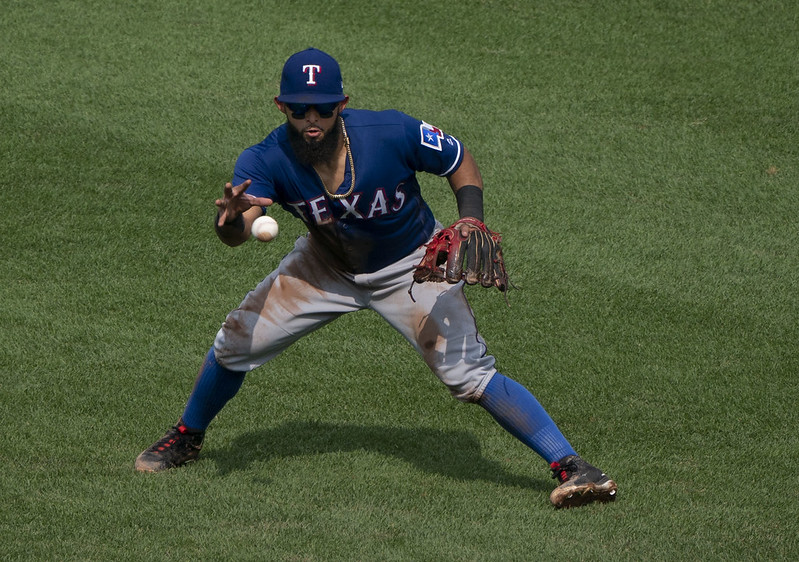
Rougned Odor failed to take a step forward, and looks to be part of an underwhelming 2020 Rangers infield. (Photo: KA Sports Photos)

“A pessimist gets nothing but pleasant surprises, an optimist nothing but unpleasant.” – Rex Stout, Fer-de-Lance

Of all the realistic playoff contenders in 2019, the one that surprised me the most was the Texas Rangers. I have a feeling the Rangers were equally startled. Without successfully developing a new rotation from within or reaching the point when the wallets would be opened for prime free agent talent, the Rangers spent much of 2019 with realistic Wild Card hopes. Texas played under the .500 mark after the All-Star break and fell safely out of postseason contention, but you can’t say it wasn’t enjoyable.

The Setup

It’s always hard to say goodbye to your greatest victories. The Rangers have a rich and storied history of decent-but-unspectacular success since moving to Texas. Never triumphant as the Washington Senators II: Electric Boogaloo, the team had plenty of interesting eras populated with fascinating seasons, but it took until the 1990s for the team to make the playoffs and nearly another 15 years for the team to start winning there. While I’d be hard-pressed to call the 2010s Rangers a true dynasty, five playoff appearances in seven seasons, including two World Series, is a track record a lot of teams would envy.

But anything that can’t last forever won’t. The team’s core faded or departed, and by the time their most recent winning season rolled around in 2016, the Rangers were mainly running on the fumes of past squads. Not helping matters were two giant financial gambles meant to forestall the decline that I argued were monumental blunders: swapping Ian Kinsler for Prince Fielder and signing Shin-Soo Choo to a seven-year, $130 million contract.

The team avoided doing the full slash-and-burn rebuild, hoping instead that a few of the youngish players such as Joey Gallo and Rougned Odor were part of the foundation for the next contending Texas team. Developing a new rotation was slower progress, and the veteran fill-ins meant to eat innings mostly bombed in 2018. Ten pitchers started at least five games for the 2018 Rangers, but only three returned to the team in 2019: Mike Minor, Ariel Jurado, and Yohander Méndez. Jurickson Profar was shipped out to enhance minor league depth. Otherwise, the team’s most significant offseason move was a three-year, $30 million contract with Lance Lynn; Shelby Miller’s one-year deal was of the lottery ticket variety. Bringing in Lynn was an interesting FIP vs. ERA gamble, for while Lynn added a run in ERA from 2017 to 2018, he also subtracted a run in FIP.

The Projection

At the start of the season, ZiPS was quite pessimistic about Texas’ chances of cobbling together an adequate rotation. At 68-94, ZiPS gave the Rangers the second-worst chances of making the playoffs in the American League, only barely escaping the rounding-to-zero humiliation of the Baltimore Orioles. While there was a very good argument to be made that the Rangers had more going for them than the AL Central also-rans, they also played in a significantly tougher division.

ZiPS expected little from the pitching staff after league-average Mike Minor/Lance Lynn projections, and while the offensive projections were slightly less bleak, only Joey Gallo was forecast to eclipse the two-win mark. Even the team’s younger hitters, like Rougned Odor and Nomar Mazara, had serious concerns that held down the projections. When would Odor stop going into half-season slumps? How do you shape Mazara’s raw power into a more refined version?

Better seasons were on the menu — a large market team with a new park would be unlikely to cry poor — but the computer did not see one of those as coming in 2019.

The Results

The Rangers didn’t burst out of the gate in 2019, but they played far better baseball than I expected. I was quite harsh about the team keeping Hunter Pence on the roster over Willie Calhoun, but Pence had a lot more baseball remaining than I expected and hit .294/.353/.608 before a groin injury sidelined him in mid-June. Minor and Lynn weren’t just adequate, but elevated the rotation to near-adequacy in the first half of the season, combining for 232 innings with a 3.22 ERA. Minor made the All-Star Game for the first time in his career, and Lynn spent much of the season leading the American League in FIP.

One of the best bits of news for the Rangers was Joey Gallo finally breaking out. It may seem odd to talk about a player with two 40-homer seasons as a disappointment, but Gallo’s low batting averages — even by 2010s standards — suppressed his on-base and slugging percentages enough to make it a stretch to call him a star. While you didn’t see it in his pure strikeout rate, Gallo knocked a whole quarter off of his out-of-zone swing percentage in 2019. That resulted in him getting far more non-homer hits than usual, enough to add 50 points to his batting average. Gallo’s not a speed demon, but he’s not Albert Pujols-slow either, and combined with his raw power, ZiPS was always befuddled why his career BABIP lingered stubbornly around the .250 mark. It will be hard to maintain the .368 BABIP he posted this year, but I think Gallo’s a more well-rounded hitter than he used to be.

Texas lingered around .500 for most of the summer, but that success was shallow and predicated on riding the bullpen and a small number of elite performances. The non-Lynn and Minor parts of the rotation contributed an abysmal 6.63 ERA. The offense’s 94 wRC+ was largely Gallo-driven, and when he broke the hamate bone in his wrist in July, ending his season with a .253/.389/.598 line, Texas’s offense collapsed; the Rangers put up an 80 wRC+ in the second half, which led only the Detroit Tigers.

Still in contention at the trade deadline, the organization faced a difficult question. Throwing in the towel when your playoff chances are more than theoretical is a tough decision, and if the Rangers were going to stay in the race, they’d have to figure out how to replace Gallo’s bat. The team decided — rightly, in my opinion — not to become buyers, but consistent with their skinny-rebuild, didn’t dump everyone with value. Their one big deadline trade, picking up Kolby Allard from the Braves for reliever Chris Martin, was one that would have been hard for any team to pass up. Likely getting unimpressive offers for Mike Minor in light of the weak return for Marcus Stroman, the Rangers kept the rest of the team together and played out the string.

What Comes Next?

As pleasant as it was to play meaningful baseball in 2019, the Rangers didn’t answer many questions. Picking up Nick Solak was a coup, but Rougned Odor was still undependable, Nomar Mozara’s breakout continued to elude him, and Delino DeShields lost 30 points of OBP over the summer. Elvis Andrus’s .242/.283/.322 second half again raises questions as to whether his 2016-2017 “comeback” was temporary. José Leclerc recovered from his early-season struggles, but I’d be lying if I said I was as high on him entering 2020 as I was in 2019.

I hate to say it about a team that decided not to go the full-tank route, but I feel that 2019’s success will be hard to build on in 2020. You can’t expect Lynn and Minor to match their 2019s, and given their ages and contract situations, winter trades are likely still in the club’s interest. A Calhoun-DeShields-Gallo outfield ought to be fine, but I don’t share that optimism with the non-Solak parts of the infield.

Looking at THE BOARD does not fill me with optimism either. The farm system boasts far more quantity than quality as it currently stands. The team has a whopping 44 prospects with a projected 40-grade or higher, but only a single 50. And that 50, Solak, is already accounted for above. ZiPS only shows significantly more promising results in Leody Taveras. There are no pitching prospects in the top 100 (and nobody I’d quibble with Eric and Kiley over) and few signs of a long-term first baseman or catcher.

The team has money to spend and could theoretically land Gerrit Cole and Anthony Rendon and Yasmani Grandal, should the mood strike them. The problem is that I’m no longer sure that would be quite enough. Some of their lesser prospects will work out, but when sorting through that many maybes, you need time and a lot of roster space.

I’m not as down on the team’s future as this may make me sound, but I’m very down on its turnaround happening as quickly as 2019’s record suggests.

The Absitively, Posilutely, Way-Too-Early ZiPS Projection – Lance Lynn

I liked the Lance Lynn signing and you can’t claim Texas didn’t win this one. While ZiPS never got too excited about Lynn in 2019, I think a lot of that was due to the nature of the in-season model being simpler than the season-to-season model. Lynn had the best fastball velocity of his career in 2019, a relevant stat for a player whose repertoire largely consists of three fastball variants. His two-seamer/sinker has always been the weakest of the three, with batters hitting nearly .300 against it over Lynn’s career. Lynn dialed back the use of the pitch in 2019, relying more on his bog-standard fastball and cutter. The extra velocity on the regular fastball — Lynn could push it to the high 90s at times — gave him some separation from the cutter. Lynn even added a bit of velocity to his vertically oriented curveball, enough to fool pitch algorithms into sometimes thinking it was a splitter.

ZiPS Projections – Lance Lynn
Year W L ERA G GS IP H ER HR BB SO ERA+ WAR
2020 13 9 3.58 29 29 173.3 165 69 17 55 175 116 3.2
2021 11 8 3.70 26 26 153.3 150 63 15 50 151 112 2.7

The computer’s buying it. Meeting this projection actually makes Lynn one of the most valuable veteran pitchers potentially available this offseason. While I’m not sure whether the team will actually go that route, I think Lynn showed enough to net a package I wouldn’t have thought possible for him a few years ago.


Houston Takes Back the Driver’s Seat in Game 4 Shellacking

The Houston Astros evened up the World Series in convincing fashion Saturday night, defeating the Washington Nationals 8-1 in a game that was only in doubt for a few, relatively brief moments. With this win, the Astros reset the World Series into a best-of-three in which they have home-field advantage. By forcing a Game 6, regardless of the outcome of tonight’s Game 5, Houston guarantees that their last game of the year will be in front of their fans.

If there’s one thing that no one should be surprised about, it’s baseball’s ability to surprise. If you were talking to a friend who hasn’t been following the World Series, and told them a tale of a clutch Astros starter throwing five shutout innings on the sport’s biggest stage, they might think you were referring to the team’s 225-win, future Hall of Famer. Or maybe the Cy Young favorite who went undefeated for most of the season, or at least the ace pitcher picked up from the Diamondbacks in a blockbuster July trade.

Your friend in this theoretical may be extraordinarily well-informed and name Jose Urquidy, but three months ago, few would have expected Urquidy to be Houston’s firewall to prevent the team from falling to a 3-1 World Series deficit. The 24-year-old rookie not only isn’t an established veteran; he can’t even claim to be a phenom prospect making good on unlimited potential. Urquidy was barely on the prospect radar (he is currently 19th in the org on THE BOARD), a pitcher with a decent fastball and changeup, and good command, but little dazzle and an injury-shortened minor league career.

With their rotation ranking fourth in baseball in WAR, the Astros didn’t envision having fourth-starter questions in the playoffs. The acquisition of Zack Greinke appeared to make Wade Miley one of the game’s best fourth starters, completing the team’s playoff rotation. But Houston also didn’t envision that Miley, who sported an ERA under three as late as August, struggling immensely down the stretch. Miley pitched himself out of the rotation and then the playoffs entirely, leaving the Astros with something of a situation. A fourth starter wasn’t needed in the ALDS with its ample off-days, and any awkwardness in the ALCS was compensated for by the fact that the Yankees had the same worry. Read the rest of this entry »


Reds Seek Another Chance to Turn Win Ledger Black in 2020

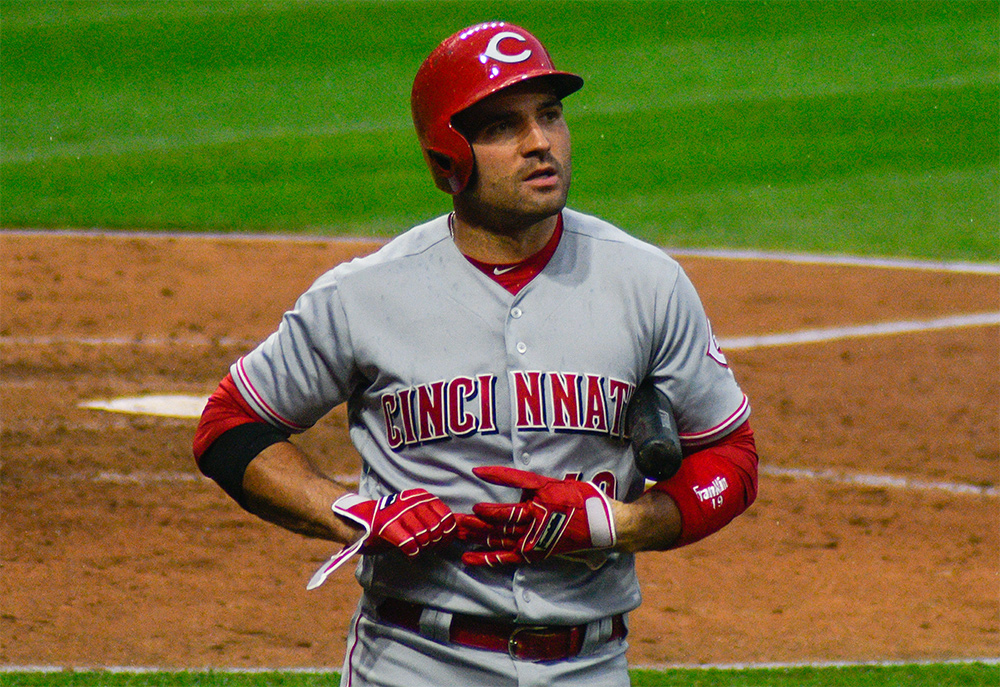
The Reds are close to contention, but they may need Joey Votto to turn back the clock a bit. (Photo: Erik Drost)

“He who never made a mistake, never made a discovery.” – Josh Billings

The Cincinnati Reds used an unusual strategy during the 2018-2019 offseason: trying. OK, that’s a bit hyperbolic, but while last winter’s actual weather was mild, we saw a veritable blizzard of excuses in baseball. As top free agents remained unsigned going into spring training, we heard all sorts of reasoning from teams about why they couldn’t sign this guy or couldn’t afford that guy or why that player over there in the corner was impossible for them to acquire. No, the Reds didn’t pursue Bryce Harper or Manny Machado, but they did make aggressive moves to turn the team into a winner in the short-term, seeing an opportunity in an NL Central where every team had serious flaws. It didn’t quite work out, but many of the reasons they looked like a promising team in 2019 apply to the club in 2020 as well.

The Setup

I appreciated Cincinnati’s ambition last winter, even if I didn’t like every move they made. To be fair, the Reds didn’t go into the offseason intending to please one particularly sarcastic, overweight, middle-aged baseball analyst. But as noted above, there moves were a refreshing departure from baseball’s version of Rasputitsa.

Cincinnati went 67-95 in 2018, and adding 25 wins in one offseason was always going to be difficult. To start with, they needed all of their returning players to be the best versions of themselves. That meant Joey Votto needed to hold off serious decline for another year. Scooter Gennett had to play like an All-Star again. Ideally, Nick Senzel and Jesse Winker would have both been healthy and All-Star candidates themselves. Second-half Luis Castillo would have to become both-halves Luis Castillo. Read the rest of this entry »


Can the Giants Avoid a Full Rebuild?

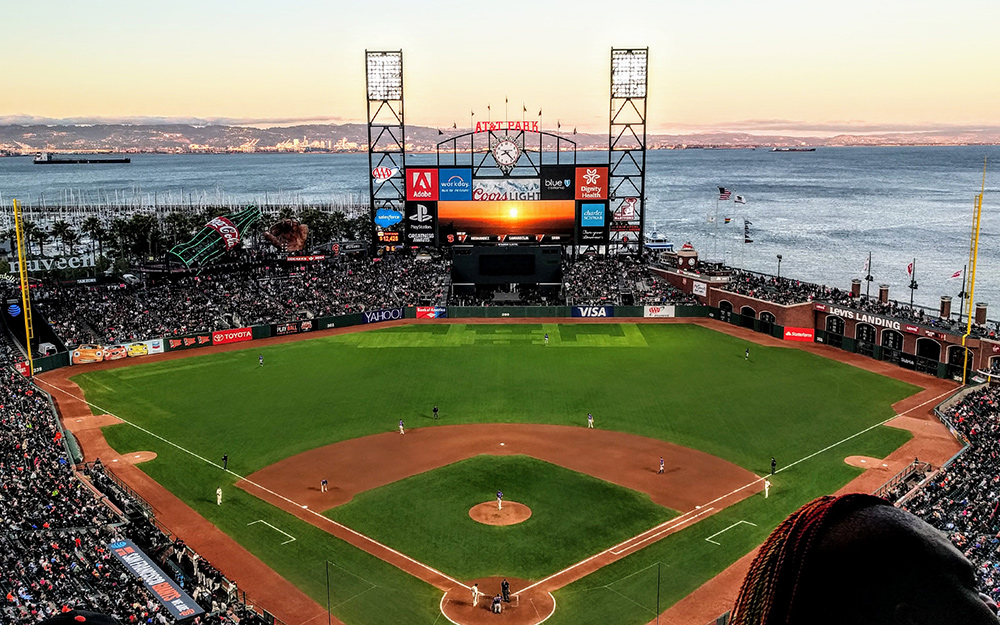
Although 2019 went a bit better than expected, the Giants do not look like a playoff contender in the near future. (Photo: Travis Wise)

“No man is rich enough to buy back his past.” – Oscar Wilde

With three World Series wins over the last decade, it would be a bit greedy for fans of the Giants to bemoan the team’s current state too strenuously. San Francisco fell out of their even-year championship pattern in 2016 and finished the last three seasons with losing records. With the key players of the dynasty either past their prime or gone completely, the club’s laudable goal of putting a quality team on the field every year has become a tricky one to fulfill.

The Setup

Unlike other formerly competitive teams such as the Tigers and Orioles, the Giants were in no mood to head full-bore into a rebuild in 2018. San Francisco rightly realized that the outfield was a major weakness, but the club struck out in their attempts to acquire Giancarlo Stanton, Christian Yelich, and Marcell Ozuna. Unable to be one of the teams pillaging the Marlins during that organization’s latest payroll temper tantrum, the Giants picked up Andrew McCutchen in a trade with the Pittsburgh Pirates in return for Bryan Reynolds, Kyle Crick, and international bonus money. That trade doesn’t look all that phenomenal in 2019 terms given the season Reynolds had, but it was a necessary one given San Francisco’s 2018 goals. Evan Longoria was also acquired in the hopes he could bounce back to being the star he had been for most of his 20s.

As we all know now, 2018 firmly demonstrated that 2017’s 64-98 record wasn’t some horrifying outlier. While the Giants were clearly had not given up on competing, the team’s attempts to stay under the luxury tax threshold made any October aspirations more difficult to achieve. There would be no Lorenzo Cain, no J.D. Martinez, and no Yu Darvish signed in free agency to reinforce the team’s declining core. In any event, none of those signings would have salvaged San Francisco’s 2018 campaign. McCutchen himself didn’t even finish the season with the Giants, as he was sent to the Yankees at the August trade deadline.

San Francisco entered last winter with competitive aspirations, and a combination of a $10 million bump in the luxury tax threshold and $25 million in expiring contracts to Hunter Pence and Matt Cain gave the team a bit of breathing room to add to the roster. One big addition, though not of the roster variety, was that of Farhan Zaidi, formerly the GM of the Dodgers, as head of baseball operations. Zaidi wasn’t brought in — at least at that point — to spearhead a full rebuild, and the Giants went after one of the offseason’s top prizes in free agent outfielder Bryce Harper. The Giants offered Harper 12 years and $310 million, but Harper instead took Philadelphia’s 13-year, $330 million offer. Read the rest of this entry »


Houston Survives Late Inning Scare, Beats Yankees in Six

After what was otherwise a fairly quiet affair punctuated by the occasional home run, the Houston Astros won Game 6 of the American League Championship Series 6-4 on a walkoff home run from José Altuve. Houston takes the series four games to two, and avoids a high-stakes Game 7 that would have left Gerrit Cole unavailable in the World Series until the third game.

The evening got off to an inauspicious start for the Yankees as Houston’s first entrant in the bullpen battle, Brad Peacock, quickly dispatched DJ LeMahieu, Aaron Judge, and Gleyber Torres with seven pitches. Chad Green opened for New York and didn’t perform as well in his half of the inning as Peacock did in his. Green was perhaps fortunate to escape a rather pedestrian slider to Altuve with only a double, but he was less lucky with a high, very inside fastball to Yuli Gurriel, which the first baseman turned on for a home run to give the Astros an early 3-0 lead. That high, inside fastball isn’t usually that dangerous for a pitcher; there were only 13 home runs hit this year by right-handed hitters swinging at a four-seamer in Statcast’s inside and high-inside “chase” zones. Coincidentally enough, Gurriel had one of those home runs, comfortably turning on a sorta-fastball from Trevor Williams. This might have been one of the highest-leverage of those since Kit Keller’s.

Read the rest of this entry »


ALCS Rainout a Mixed Bag for Pitchers

The Yankees and Astros both won over 100 games in the regular season but nobody beats Mother Nature. When a rainstorm causes cool terms like “bomb cyclone” or “explosive cyclogenesis” to be bandied about, you know you’re not expecting a light drizzle. Yankee Stadium is currently dry, but with a system the size of the mid-Atlantic barreling up the coast, it didn’t make sense for MLB to pretend that tonight’s ALCS Game 4 was going to take place. Just look at the radar, courtesy of the National Weather Service:

Yikes. The rain provides the Yankees and Astros with an extra off-day now at the expense of losing an off-day between a possible Game 5 and Game 6. This isn’t a big deal for the hitters, but it will result in some revised pitching plans. In a five-game divisional series, teams can generally muddle through with a three-man rotation. Due to the 2-2-1 format, no team plays on three consecutive days, and while the Game 1 starter would have to pitch Game 4 on short rest, the Game 2 starter can pitch in a possible rubber match on normal rest. This extra rest gives teams the flexibility to either stretch their best three starters or, as the Nationals demonstrated, use starting pitchers in relief more aggressively.

But short of baseball going to some kind of impractical 2-2-1-1-1 format, that doesn’t quite work in a seven-game series. So unless you’re going to have your entire rotation do it 1930-style, you’ll need to use a fourth starter. That isn’t an ideal situation for either the Yankees or the Astros. From a pure projection standpoint, it’s actually doesn’t move the probabilities. The Astros get an immediate benefit in that they avoid a Bullpen vs. Bullpen Game 4; ZiPS takes bullpen depth into consideration and Yankees enjoy a significant projected edge in any such bullpen game. Before the rainout, ZiPS projected the Yankees to have a 56%-44% edge in a home bullpen duel, so it’s a nice game to delay if you’re Houston.

The problem you run into with this model is that the rainout doesn’t really add an extra day of rest, it simply moves it. Since there are only two days of rest for a Game 4 starter to pitch in Game 7 now, both teams end up repeating the dilemma of either using a fourth starter — particularly problematic for the Astros — or going with a bullpen game. Read the rest of this entry »