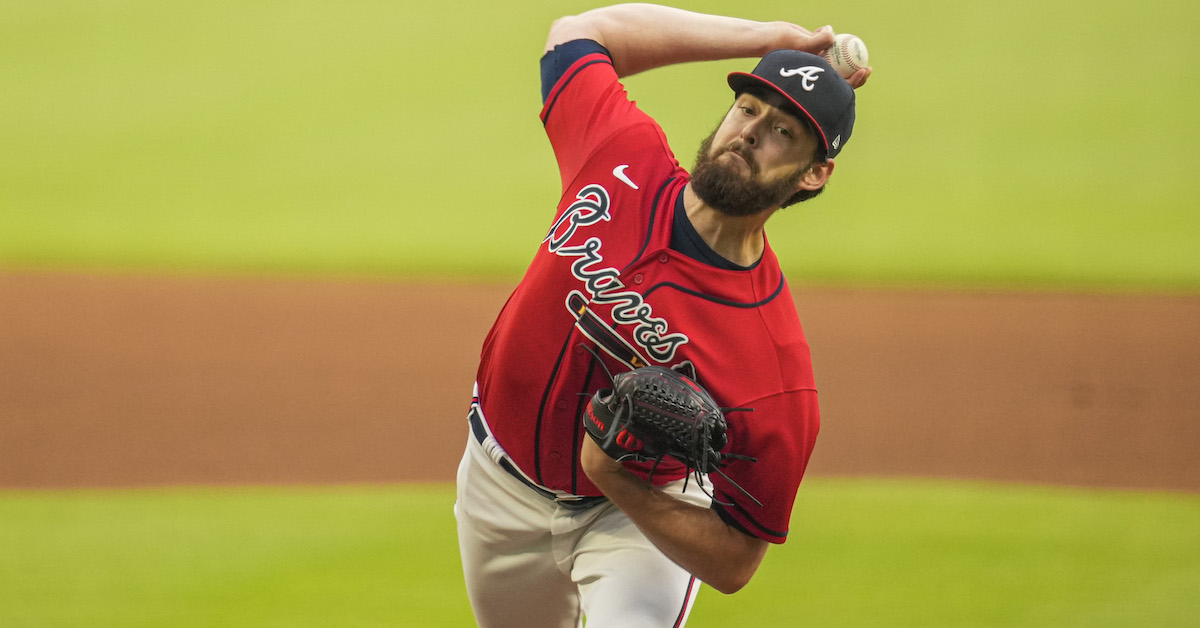
Sunday afternoon, Drew Rasmussen had everything working. For eight innings, his fastball/cutter combination kept Orioles batters off balance, with intermittent sliders only deepening their confusion. The first 24 Orioles to come to the plate walked away empty-handed. It took Rasmussen just 79 pitches to navigate those eight innings. He was on course for both a perfect game and a Maddux, and the Orioles looked unlikely to stop him.
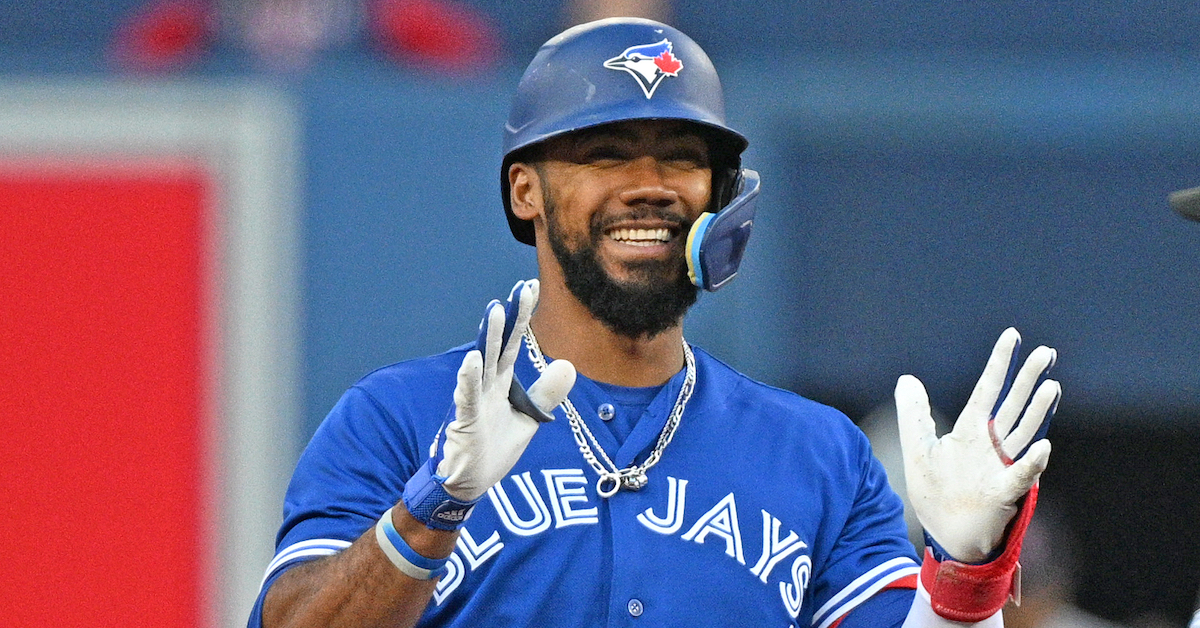
They managed to break through. Jorge Mateo led off the ninth inning by lacing a double down the third base line. He advanced on a groundout, then scored on a wild pitch. Rasmussen didn’t even manage a complete game; after Brett Phillips reached on a dropped third strike, Kevin Cash went to the bullpen for the last two outs of the game. It wasn’t the crowning achievement for Rasmussen that it might have been, but this season has been a success nonetheless, and a near-perfecto presents a great excuse to examine what’s gone right.
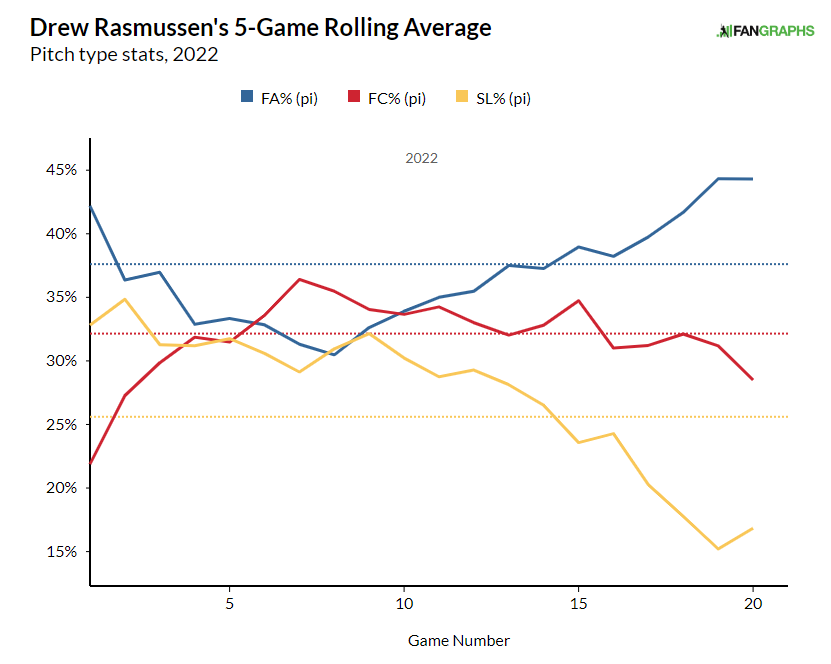
I last checked in on Rasmussen after his first start this season, when he adopted a new sweeping slider and threw it a ton. In 2021, he’d been a fastball-first pitcher with a slider that changed shape as he worked on it throughout the year. In 2022, he came out featuring the slider, with a new cutter to boot. Would 2022 be the year of the sweeper for Rasmussen?
As it turns out, not so much. His first few starts represented a local high in slider usage, and he’s been leaning on the pitch less and less since. He’s filled in that gap by going back to his high-octane fastball and by trusting that new cutter: Read the rest of this entry »
In a shocking story heading into the weekend, MLB announced that Padres shortstop Fernando Tatis Jr. would be suspended for 80 games under the league’s Joint Drug Prevention and Treatment Program. His positive test was for Clostebol, an anabolic steroid that previously led to the suspensions of Dee Strange-Gordon and Freddy Galvis. The ban ends his 2022 season before it ever officially started, and he will also miss a decent chunk of next year, as well.
To say this is unwelcome news would be an understatement. The Padres are in prime playoff position without having the services of Tatis this year, but this is a giant hit; they’re in this position in spite of his loss. Whether you’re talking about the projections of nerdy computer systems or the expectations of team employees and their fans, the idea that he would be back on the roster for at least most of the stretch run and the playoffs was baked into the assumptions.
While a certain trade with the team in D.C. for a specific outfielder of much acclaim rightfully got the most thundering plaudits after the deadline, the depth move for Brandon Drury in a small trade with the Reds is looking even better. After a string of disappointing seasons following his early success in Arizona, he’s having a career year, hitting .269/.333/.521 for a wRC+ of 130 and playing several positions. Drury is competent at both second base and third base, which amplifies the value of his offensive production, and that flexibility allows the Padres to shuffle players around the diamond as needs, matchups, or injuries demand. He’s even played enough shortstop that he can be at least considered an emergency option, but it’s less needed in San Diego with Ha-Seong Kim and Jake Cronenworth likely ahead of him in the depth chart at the position.
The Padres’ depth mitigates the loss of Tatis, but their young superstar is so good that practically any timeshare of mortals will represent a significant downgrade at the position. Entering 2022, ZiPS ranked him second in baseball in projected WAR, behind only Juan Soto, and only because it projected fewer games played for Tatis because of his injury history. ZiPS was not exactly going out on a limb here; Steamer and THE BAT held him in similar regard, as did, well, every person who was even vaguely familiar with baseball. Even my mom, who has just about zero interest in the sport, knew about the suspension, though admittedly she referred to him as “Taters.”
In any case, let’s run the median projections for the NL West, both without a Tatis suspension and with him returning at the end of this week:
ZiPS Projected Standings – NL West (Pre-Tatis Suspension)
Team
W
L
GB
Pct
Div%
WC%
Playoff%
WS Win%
Los Angeles Dodgers
106
56
—
.654
99.9%
0.1%
100.0%
10.7%
San Diego Padres
91
71
15
.562
0.1%
85.5%
85.6%
6.3%
San Francisco Giants
82
80
24
.506
0.0%
5.4%
5.4%
0.2%
Arizona Diamondbacks
72
90
34
.444
0.0%
0.0%
0.0%
0.0%
Colorado Rockies
69
93
37
.426
0.0%
0.0%
0.0%
0.0%
The Dodgers have basically closed the door on the longshot chance that San Diego would catch them in the NL West, but the Padres are among the best situated of the plausible wild card teams. Adding Soto gave them the strongest roster among wild card contenders, a roster as strong as Los Angeles’ until Walker Buehler and Clayton Kershaw return. ZiPS saw San Diego, against league-average competition, as a .582 team with the assumption that Tatis would be back. Now let’s go to the current projection without Tatis, which reduces the roster strength by 26 points of winning percentage, to .556.
ZiPS Projected Standings – NL West (After 8/15 Games)
Team
W
L
GB
Pct
Div%
WC%
Playoff%
WS Win%
Los Angeles Dodgers
106
56
—
.654
100.0%
0.0%
100.0%
10.7%
San Diego Padres
90
72
16
.556
0.0%
76.0%
76.0%
5.3%
San Francisco Giants
82
80
24
.506
0.0%
6.5%
6.5%
0.2%
Arizona Diamondbacks
72
90
34
.444
0.0%
0.0%
0.0%
0.0%
Colorado Rockies
69
93
37
.426
0.0%
0.0%
0.0%
0.0%
The impact on both San Diego’s chances of making the playoffs and winning the World Series is significant. In terms of the postseason, just under a tenth of the time, the Padres playing postseason baseball becomes the Padres playing golf and watching the playoffs on TV. Playoffs being a bit of a crapshoot, the absolute impact is relatively small, but that a sixth of their World Series chances just evaporated has to be a sore spot for a team trying to win right now. Against a .575 team, going from a .582 team to a .556 team reduces the chances of victory by about four to six percentage points every series, depending on length.
Naturally, Tatis’ teammates and organization have expressed their frustration with him publicly; it would be unreasonable for them to feel differently. Nobody can find fault when a player is injured, but when he’s out from actions of his own doing, it feels a bit like a betrayal. If I were suspended from my BBWAA membership for a year for conduct violations, while it would obviously affect my personal career, it would be a real slap in the face of my colleagues at FanGraphs and the many writers who have spread my work around over the years.
“A little bummed, a little pissed,” said Joe Musgrove, the lifelong Padres fan and now a pitcher and a leader on the team. “It’s hard to make a judgement or say anything until I hear from Tati or what those details are. But yeah, not a good day.”
[…]
“You can say he’s a young kid and he’s gonna learn his lessons or whatnot,” Musgrove said. “But ultimately, I think you’ve got to start showing a little bit of that remorse and showing us that you’re committed to it and that you want to be here.”
“The second time we’ve been disappointed with him,” pitcher Mike Clevinger said last night. “You hope he grows up and learns from this and learns it’s about more than just him.”
President of Baseball Operations A.J. Preller:
“It’s very disappointing,” Preller said. “He’s somebody that from the organization’s standpoint we’ve invested time and money into. When he’s on the field, he’s a difference maker. You have to learn from the situations. We were hoping that from the offseason to now that there would be some maturity, and obviously with the news today, it’s more of a pattern and it’s something that we’ve got to dig a bit more into. … I’m sure he’s very disappointed. But at the end of the day, it’s one thing to say it. You’ve got to start showing by your actions.”
The explanation given by Tatis was unconvincing.
The Major League Baseball Players Association issued the following statement on behalf of Fernando Tatis, Jr.: pic.twitter.com/gCNVcs0a5Y
Athletes blaming their positive tests on others is old hat, but the claims of a tainted ringworm treatment, while not impossible, sound like a stretch. Dr. Rany Jazayerli, a name most of you ought to be familiar with, is at that rare intersection of baseball analyst, long-suffering Royals fan, and working dermatologist, and he was highly skeptical about Tatis’ claims. On Twitter, he reiterated that he would not consider prescribing anything with Clostebol — as opposed to the similarly named Clobetasol — to a patient with ringworm.
I only speak from my experience as a US-trained, board-certified dermatologist for 19 years. Maybe Clostebol is used to treat ringworm elsewhere, even though it makes no medical sense.
Or maybe Tatis googled Clostebol and was fed a bunch of results for Clobetasol instead. ????
Tatis accepted the suspension without appealing, but that’s hardly a great sacrifice given that drug suspensions in baseball are largely strict liability. Without being able to challenge the proof of the violation itself, he must prove by clear and convincing evidence that he bore no significant fault or negligence for the positive test. That’s a tough burden and mostly serves simply to mitigate the penalty to a minimum of 30 games for a first-time offender while still leaving him ineligible for the playoffs. Luckily for the Padres, the postseason ban only applies to the season during which a suspension commences, not all seasons in which there is a suspension, which leaves Tatis eligible to play in the 2023 postseason along with most of the regular season.
There’s no real silver lining, but if Tatis had been suspended just a few weeks later, there would have been an additional problem for the Padres. Since his suspension runs for fewer than 40 games in 2023, he is allowed to play in all spring training games, not just the intrasquad games for which no tickets are sold. Given that Tatis had already missed most of a season with a fractured wrist, the franchise should be happy to get him into as many actual baseball games as they can before he returns sometime next year. If San Diego plays in the maximum of 22 postseason games, he could be back as soon as mid-April!
From a projection standpoint, little changes about Tatis other than the additional normal hit taken from missing time from a non-injury. ZiPS does not look at drug suspensions differently because, after spending a decade researching this issue from every angle I can think of, knowing whether or not a player has been banned for PED use has had no predictive value in the context of performance from MLB-level players. This is largely why I consider PED use a safety issue — players shouldn’t feel forced to use, whether or not they’re effective — and a public relations one.
That latter arena is where Tatis might take the biggest hit of all. The reputational damage will be immense, no matter the efficacy of his PED use. We’re in uncharted territory here, in which a young, elite player is caught using. While Alex Rodriguez has admitted using, and there’s at least a question about David Ortiz as a young player in 2003, these weren’t known at the time. Tatis could come back, put up a Hall of Fame-type run for a decade and pass every drug test with flying colors, and there will be inevitably some people who still think of him as a cheater. Robinson Canó didn’t have to play baseball for 15 years after a drug suspension, and players like Frankie Montas and Nelson Cruz just aren’t in the same tier as Tatis; fans seem to be far more forgiving of moderate talents than transcendent ones.
There could even be Cooperstown consequences. Only speaking for myself, I consider a drug suspension, even if I don’t believe it significantly changed performance, to be a serious offense. To me, as with corked bats, it’s the attempt to cheat, not the efficacy. I do think there is a gray area, as when Mark McGwire allegedly was using. Some will cite Fay Vincent’s 1991 memo banning steroid use as evidence of a baseball rule, but even Vincent himself didn’t believe his memo applied to players.
“I sent it out because I believed it was important to take the position that steroids were dangerous, as were other illegal drugs,” Vincent said. “As you know, the union would not bargain with us, would not discuss, would not agree to any form of a coherent drug plan. So my memo really applied to all the people who were not players.”
In other words, that memo could ban Jim Fregosi or Terry Collins for steroid use. But the drug testing agreement explicitly made it against the rules with penalties attached, and that wiggle room vanished.
Unlike some writers, I don’t consider a PED suspension an automatic disqualifier, but under the Hall of Fame’s voting guidelines, I consider it a violation of the character clause, which I see in baseball terms, and for a borderline candidate, that could put him out. That said, the Hall of Fame voting pool will change a lot in the 20–25 years before Tatis would come up to the electorate — I don’t vote until after the 2025 season, and by the point I would be voting on Tatis, I’ll be in my mid-to-late 60s — so it’s hard to gauge exactly how writers will feel about drug use with another quarter century of experience.
Regardless of what happens to Tatis personally, this is a hit for baseball. He’s one of the league’s most marketable young talents, and one of the proponents for baseball actually being allowed to be fun, not a Very Serious Affair in which we tut-tut about brutish bat flips and proletariat celebrations as we gently sip our beers (pinky out!) and yearn for the return of Regency Baseball standards. Tatis should be one of the faces of baseball, not one of its disgraces. When we lose a player like that, everybody who loves the game loses.
The Baltimore Orioles were nine games under. 500 when I talked to Jordan Lyles in late May, and they were only a smattering of games better when the veteran right-hander was featured here in Sunday Notes on June 26. Not much changed over a month’s time. Moreover, most signs pointed to the rebuilding Birds’ going on to have a sixth straight losing season.
A revisiting of what I wrote seven weeks ago is in order. Not only has Baltimore morphed into one of baseball’s hottest teams, the crux of that column was Lyles’s bad-club background. Now in his 12th big-league season, the journeyman hurler came into the current campaign having never played a full year with a team that finished above .500.
That might be about to change. With 24 wins in their last 33 games, the Orioles went into last night with a record of 59-53, in third place in the American League East and in possession of the final wildcard slot. Earlier this week, I asked Lyles about the team’s unexpected ascent in the standings.
“When we talked, there was a different atmosphere around our ball club, our clubhouse,” said Lyles. “Things definitely turned around and got moving in a better direction for us. It’s been a joyful ride. It’s been fun to see these young guys start to grow, and to grow quickly.”
Amid that growth, the Orioles front office saw fit to take one step backward in hopes of taking two steps forward. In moves that weren’t well-received by much of the fan base, Baltimore traded Trey Mancini and Jorge Lopez. On back-to-back days, an impact bat and a closer departed town in exchange for a further influx of promising, yet mostly-unproven, talent. Read the rest of this entry »
Justin Verlander wasn’t quite at his best on Wednesday night, yielding three runs in six innings against the Rangers in Houston — his first time surrendering more than two runs since June 24. Even so, the 39-year-old righty continued an impressive comeback following nearly two full seasons lost to injuries — first a forearm strain and then Tommy John surgery. In fact, he leads the American League in both wins (15) and ERA (1.85), and while those don’t carry the same currency at FanGraphs as they do elsewhere, it’s not hard to imagine him adding a third Cy Young award to his trophy room if he keeps this up.
Verlander won the award for the first time in 2011, when he went 24-5 with a 2.40 ERA and 250 strikeouts in 251 innings; by leading the league in wins, strikeouts, and ERA, he also claimed the pitching triple crown and added the AL MVP award as well. Over the next seven seasons, he finished as the runner-up for the AL Cy Young three times (2012, ’16, and ’18) but also endured some ups and downs, including a 4.54-ERA season (2014), an injury-shortened one (2015), and a late-season trade to the Astros that helped him claim a World Series ring (2017), albeit on a team that was later sanctioned for its illegal electronic sign-stealing efforts.
After narrowly losing out to Blake Snell for the award in 2018, Verlander finally won another Cy Young in 2019, going 21-6 with a 2.58 ERA and an even 300 strikeouts; in the same game he reached that plateau, he also became the 18th pitcher to surpass the 3,000-strikeout milestone. It’s taken more than two years to follow that up, however. After a spring in which he suffered both lat and groin strains, Verlander underwent surgery to repair the latter shortly after Major League Baseball was forced to postpone Opening Day due to the COVID-19 pandemic. When he finally did take the mound roughly four months later for the Astros’ season opener, he suffered a forearm strain, and after experiencing pain during a simulated game while rehabbing, he was diagnosed with a torn UCL and underwent Tommy John surgery in late September, which cost him all of 2021. Read the rest of this entry »
On Wednesday, the Detroit Tigers fired general manager Al Avila. Mired in last place in the American League Central in what was supposed to be a resurgent season, the firing fit the mood around Detroit. This was meant to be the Tigers’ triumphant return to postseason contention, a culmination of seven years of stockpiling and honing. Instead, it’s been another lost season, adding to the gulf that separates today’s Tigers from the perennial World Series contenders of a decade ago.
Four months later, all of that optimism has disappeared. Báez is having one of his worst years as a professional. Rodriguez got hurt early in the year and then hit the restricted list while dealing with a personal matter. He last pitched in the majors on May 18; when he took the mound for Single-A Lakeland this past Saturday, it was his first game action since June 9. Meadows, the third piece of the team’s major league talent trifecta, has missed extended time with a laundry list of injuries, and playing hurt when available has resulted in sub-replacement-level production.
That alone would hurt the offense, but it gets worse. Torkelson, who came into the season as our fifth-ranked prospect overall, made the Opening Day roster. To put it mildly, things haven’t gone according to plan since. His .197/.282/.295 line led to a demotion to Triple-A, where he’s also scuffled. Greene broke his foot in spring training and hasn’t lit the world on fire since joining the big league club in June. Read the rest of this entry »
If you’re a one-number kind of analyst, Teoscar Hernández is having an unremarkable season. After posting a 132 wRC+ last year, he’s back at it with a 129 mark this year. His overall batting line is down – .274/.326/.495 compared to .296/.346/.524 in 2021 – but between playing all of his home games in Toronto instead of Dunedin and Buffalo and the overall decline in league-wide offense, he’s been roughly the same hitter relative to league average in both years.
If you look at his underlying rates, you still won’t see much difference. Hernández is walking 0.5 percentage points more often this season than last season. He’s striking out 1.4 percentage points more often. He’s running a similar ISO, a similar BABIP, and a similar barrel rate. But zoom in juuust a little bit and things splinter:
Teoscar Hernández’s Season Splits
Split
AVG
OBP
SLG
BB%
K%
xwOBA
wRC+
First 1/3
.229
.294
.385
6.7%
24.4%
.324
90
Second 1/3
.286
.322
.518
5.1%
31.4%
.359
133
Latest 1/3
.308
.363
.587
8.0%
23.0%
.378
165
Here’s one story you could tell about his season: he scuffled to start the year, made some adjustments that righted the ship somewhat but resulted in too many strikeouts, and finally dialed things in. You wouldn’t even necessarily be wrong; descriptively, those things all happened. Under the hood, though, Hernández made a big adjustment, one you won’t see in that data. Read the rest of this entry »
In addition to weathering an endless barrage of Jethro Tull jokes, Ian Anderson has played an outsized role in the Braves’ success since reaching the majors in late 2020. The 24-year-old righty has struggled this year, however, and on Sunday, the Braves optioned him to Triple-A Gwinnett in hopes that he can recover the form that helped his team come within one win of a trip to the World Series in 2020, then win a championship last year.
Anderson has pitched to a 5.11 ERA, the sixth-highest in the majors among pitchers with at least 100 innings, and a 4.24 FIP in 105.2 frames this year. He has been frustratingly inconsistent, allowing four runs or more in eight of his last 14 starts, five of those while failing to complete at least five innings. In his other six outings in that span, he’s allowed two runs or fewer.
Consider the sequence of Anderson’s last eight starts, a mix of good and bad outings versus good and bad teams: 4 IP/4 ER (vs. Dodgers on June 24), 2 IP/7 ER (vs Phillies on June 30), 5 IP/1 ER (vs. Cardinals on July 5), 5.2 IP/2 ER (vs. Nationals on July 10), 5.2 IP/ 1 ER (vs. Nationals again on July 15), 3 IP/7 ER (vs. Angels on July 24), 6 IP/0 ER (vs. Diamondbacks on July 30), and 4 IP/4 ER (vs. Mets on August 5). In the penultimate start in that stretch, he held Arizona to one hit and one walk, matching his season high of nine strikeouts, and on Friday, he yielded seven hits and four walks to the Mets, striking out just three. That’s not only a lot of variance, but it’s also a 6.62 ERA and a 12.4% walk rate over a six-week stretch, too much for any team — particularly a contender — to stomach.
“We need to get him right,” said Braves manager Brian Snitker of the move. “Hopefully, he can take a step back, reassess things and get himself going. He’s experienced a lot during his young Major League career, but he’s not a finished product.”
“They think I’m a big part of this,” said Anderson. “I need to get back to what I know I can be, and what they know, as well… Now it’s just kind of about getting confidence back and figuring some things out.”
Anderson relies on a three-pitch mix, with his changeup — thrown from a high and vertical arm slot — the star of the show. That pitch is still exceptional, but his results on both his four-seam fastball and his curve have receded significantly since he reached the majors, in part because he throws the latter less often when he falls behind in the count — and he’s falling behind more often. Always a pitcher with a reverse platoon split, he’s also been rocked for a .316/.380/.505 line by righties this year.
Anderson’s jump from last year’s 3.58 ERA is the third-largest in the majors among pitchers with at least 100 innings in both seasons:
Minimum 100 IP in both 2021 and ’22. All statistics through August 7.
Factoring parks and scoring environments into this, Anderson’s 39-point gain in ERA- (from 83 to 122) drops him to fifth, with Giolito and Ray leapfrogging him, but any way you slice it, that’s an unflattering list to land on. Read the rest of this entry »
From 2018 through the first half of 2021, watching Jacob deGrom carve his way through whatever hapless lineup the Mets faced was a constant. His 1.94 ERA over that stretch was wildly impressive, but that doesn’t tell the whole story. He wasn’t just enjoyable for the ERA, or even his entire statistical line, though that also boggled the mind.
To me, what was most impressive about deGrom is how he seemed to make the opposition inconsequential. It didn’t matter who he was facing, really. Every start was deGrom against himself, a pitcher perfecting his craft. When he located well (and he frequently did), he might as well have been pitching to cardboard cutouts. Fastball on the upper corner, slider falling away beneath it — the specifics changed, but deGrom’s repetition of his pitches never did.
Then disaster fell. Though he’d been remarkably durable during his run, missing only a few games with lat issues early in the 2021 season, the fun came to an end last July. He sprained his flexor tendon — the tendon that runs from forearm to finger, which sounds pretty important for pitching — and never threw another pitch that year. Some of that was the Mets falling out of the race; the team said he would have been ready for the postseason.
After he missed the first half of this season with a right scapula stress reaction, no one would blame you for wondering whether the ride was coming to an end. An entire year without a major league start is an eternity for someone who didn’t get Tommy John surgery. But I have good news for those of you who, like me, found watching deGrom’s casual dominance calming and delightful: He’s back, and with little rust to be found. Read the rest of this entry »
In what may prove to be their highest impact move of the trade deadline, the Dodgers traded swingman Mitch White to the Blue Jays as part of a four-player deal that lessened the immediate depth of their rotation. Less than 48 hours later, they watched as Clayton Kershaw once again left the mound in the company of a trainer, his future availability in doubt. While the combination of the trade and the loss of the three-time Cy Young winner isn’t likely to threaten their stranglehold on the NL West, the Dodgers suddenly have little margin for error when it comes to assembling a strong rotation for October — an issue that they’re all too familiar with after last year.
Kershaw left Thursday afternoon’s start against the Giants after experiencing lower back pain while warming up for the bottom of the fifth inning. Via MLB.com’s Juan Toribio: “Kershaw felt his back tighten up after his penultimate warmup throw. He then tried to throw one more to test the back, but immediately motioned over to the Dodgers dugout.”
The 34-year-old lefty underwent an MRI that didn’t yield any surprises, but he received an epidural injection to counter the pain and was placed on the 15-day injured list. “There wasn’t any new findings, so that’s a positive,” said manager Dave Roberts “This was the best-case scenario coming from the MRI.”
A best case scenario still is likely to mean a substantial absence for Kershaw. This is his seventh time in nine seasons missing time due to a back injury, and the second time this year; he had never doubled up before:
Clayton Kershaw’s Back Injuries
Start
End
Days
Description
3/26/14
5/6/14
41
inflammation
6/27/16
9/9/16
74
slight herniation in lower back
7/24/17
9/1/17
39
lower back strain
6/1/18
6/23/18
22
lower back strain
7/23/20
8/2/20
10
lower back stiffness
5/9/22
6/11/22
33
SI joint inflammation
8/5/22
—
—
lower back pain
SOURCE: Baseball Prospectus & MLB.com
That’s an average of 36 games missed for the previous six absences, with four of the six lasting longer than one month. An absence of similar length would still leave Kershaw enough time get a few regular-season turns under his belt before the playoffs, but any kind of setback could threaten his October availability. Read the rest of this entry »
Detroit didn’t do much at the deadline. Trading Robbie Grossman to Atlanta in exchange for soon-to-turn 21-year-old pitching prospect Kris Anglin was the only move. Many expected more. A disgruntled fan base thought that Monday’s swap of an underachieving outfielder for a potential future asset would be the first of multiple deals for Al Avila’s underachieving team.
[Update/correction: The Tigers also traded reliever Michael Fulmer to the Minnesota Twins in exchange for Sawyer Gipson-Long, a 24-year-old 2019 sixth-round pick who was pitching at the Double-A level.]
The extent to which the relative inactivity was an indictment of Avila is a matter of opinion. Rival executives almost assuredly weren’t knocking down the GM’s door with appealing offers, and making trades for the sake of making trades is eyewash. Placating fans by simply moving pieces around doesn’t move the needle in any meaningful direction.
With a record of 43-66 and baseball’s 24th-rated farm system, which direction the club is heading in is far less clear than it was a year ago. Much for that reason, it’s easy to see why many in Motown would like to see Avila kicked to the curb.
Not everything that has gone wrong — and a lot has certainly gone wrong — can be placed squarely on the Detroit GM’s shoulders. But while this year’s plethorae of injuries and disappointing performances were largely beyond his control, Avila is nonetheless the architect of what has been a sluggish rebuild. The idea that said rebuild is in need of a rebuild of its own may be a valid one.